

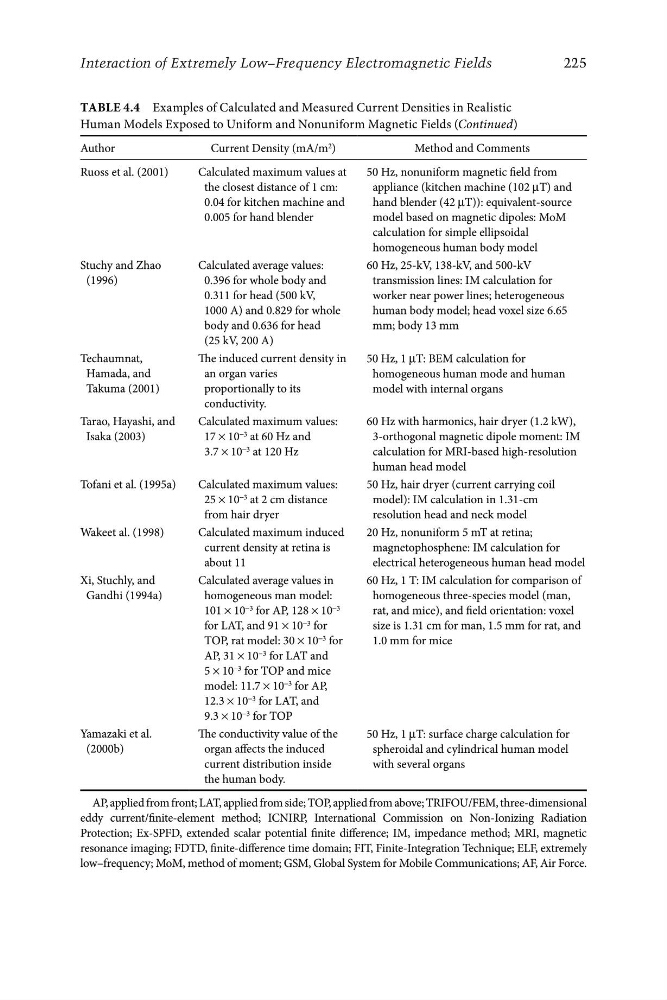
Author
Current Density (mA/m 2 )
Method and Comments
Ruoss et al. (2001)
Calculated maximum values at
the closest distance of 1 cm:
0.04 for kitchen machine and
0.005 for hand blender
Stuchy and Zhao
Calculated average values:
(1996)
0.396 for whole body and
0.311 for head (500 kV,
1000 A) and 0.829 for whole
body and 0.636 for head
(25 kV, 200 A)
Techaumnat,
The induced current density in
Hamada, and
an organ varies
Takuma (2001)
proportionally to its
conductivity.
Tarao, Hayashi, and
Calculated maximum values:
Isaka (2003)
17 × 10 −3 at 60 Hz and
3.7 × 10 −3 at 120 Hz
Tofani et al. (1995a)
Calculated maximum values:
25 × 10 −3 at 2 cm distance
from hair dryer
Wakeet al. (1998)
Calculated maximum induced
current density at retina is
about 11
Xi, Stuchly, and
Calculated average values in
Gandhi (1994a)
homogeneous man model:
101 × 10 −3 for AP, 128 × 10 −3
for LAT, and 91 × 10 −3 for
TOP, rat model: 30 × 10 −3 for
AP, 31 × 10 −3 for LAT and
5 × 10 −3 for TOP and mice
model: 11.7 × 10 −3 for AP,
12.3 × 10 −3 for LAT, and
9.3 × 10 −3 for TOP
Yamazaki et al.
The conductivity value of the
(2000b)
organ affects the induced
current distribution inside
the human body.
50 Hz, nonuniform magnetic field from
appliance (kitchen machine (102 μT) and
hand blender (42 μT)): equivalent-source
model based on magnetic dipoles: MoM
calculation for simple ellipsoidal
homogeneous human body model
60 Hz, 25-kV, 138-kV, and 500-kV
transmission lines: IM calculation for
worker near power lines; heterogeneous
human body model; head voxel size 6.65
mm; body 13 mm
50 Hz, 1 μT: BEM calculation for
homogeneous human mode and human
model with internal organs
60 Hz with harmonics, hair dryer (1.2 kW),
3-orthogonal magnetic dipole moment: IM
calculation for MRI-based high-resolution
human head model
50 Hz, hair dryer (current carrying coil
model): IM calculation in 1.31-cm
resolution head and neck model
20 Hz, nonuniform 5 mT at retina;
magnetophosphene: IM calculation for
electrical heterogeneous human head model
60 Hz, 1 T: IM calculation for comparison of
homogeneous three-species model (man,
rat, and mice), and field orientation: voxel
size is 1.31 cm for man, 1.5 mm for rat, and
1.0 mm for mice
50 Hz, 1 μT: surface charge calculation for
spheroidal and cylindrical human model
with several organs
225
Interaction of Extremely Low–Frequency Electromagnetic Fields
Table 4.4 Examples of Calculated and Measured Current Densities in Realistic
Human Models Exposed to Uniform and Nonuniform Magnetic Fields (Continued)
AP, applied from front; LAT, applied from side; TOP, applied from above; TRIFOU/FEM, three-dimensional
eddy current/finite-element method; ICNIRP, International Commission on Non-Ionizing Radiation
Protection; Ex-SPFD, extended scalar potential finite difference; IM, impedance method; MRI, magnetic
resonance imaging; FDTD, finite-difference time domain; FIT, Finite-Integration Technique; ELF, extremely
low–frequency; MoM, method of moment; GSM, Global System for Mobile Communications; AF, Air Force.