

Author
Current Density (mA/m 2 )
Method and Comments
Baraton and Hutzler
Calculated average values:
50 Hz, 1 A/m: TRIFOU/FEM calculations for
(1995)
1.73 × 10 −3 for LAT, 1.53 ×
human model: (1) standing in an uniform
10 −3 for AP, and 1.31 × 10 −3
magnetic field, (2) live-line working, and
for TOP in standing uniform
(3) using an hair dryer
conductivity human model
Barchanski et al.
Calculated maximum values
50 Hz, two electric blankets, (a) 73.7 μT and
(2006a)
for whole body: 1.03 × 10 −2
(b) 78.1 μT: Ex-SPFD calculation for
for (a); 4.38 × 10 −3 for (b)
HUGO
model
from
the
Visible
Human
Project
Barchanski et al.
Current density is well below 2
Ex-SPFD calculation for anatomical,
(2007)
(ICNIRP limit for basic
MRI-based, realistic, 1-mm resolution
restriction of public
human model for exposure to electric
exposure) for electric
blankets and for brain model for
blankets
transcranial magnetic stimulation
Caputa et al. (2002)
The comparisons of induced
60 Hz, 1 μT AP: SPFD calculations for
electric field for all the organs
realistic human body models; NORMAN
show differences of 1% or less
(2- to 4-mm resolution), Uvic (1.8-mm
for the majority of tissues
resolution), and AF (2-mm resolution)
(liver and stomach, etc.)
Cheng et al. (1995)
Calculated maximum values:
60 Hz, single dipole from portable appliances
8 for the hair dryer and 10.8
(hair dryer and electric shaver): IM
for the electric shaver
calculation for MRI-based human head
model, 5-mm voxel
Dawson, Caputa,
Calculated average values for
60 Hz, 1 μT: SPFD calculation for MRI-based
and Stuchly
whole body: 1.2 with a
3.6- and 7.2-mm resolution human body
(1997b)
maximum of 32; for the heart,
models
0.5 with a maximum of 2.8
Dawson and Stuchly
Calculated average values for
60 Hz, 1 μT (AP, LAT, and TOP): SPFD
(1998b)
whole body: 2.78 × 10 −3 for
calculation for anatomically realistic,
LAT, 3.37 × 10 −3 for AP and
MRI-based, 3.6-mm resolution human
2.34 × 10 −3 for TOP
model; effects of field orientation
Dawson, Caputa,
Calculated peak values: 28.4
60 Hz, three-phase transmission line, each
and Stuchly
for whole body (scenario A),
phase 500 A: live worker: SPFD calculation
(1999a)
25.0 (B), and 5.9 (C)
for anatomically heterogeneous, 3.6-mm
voxel conductivity, human body model A:
Worker in a bucket; B: worker in a
conductor-mounted cart; C: worker in an
underground vault
Dawson, Caputa,
Calculated peak values for
60
Hz,
230–500
kV,
single-line,
live-line
and Stuchly
whole body at 1 A: 18.9 × 10 −3
worker: SPFD calculation for anatomical,
(1999b)
for A, 27.1 × 10 −3 for B,
voxel-based, heterogeneous conductivity
26.3 × 10 −3 for C, and 20.6 ×
human model; scenario A: seated worker,
10 −3 for D
230
kV,
600
A;
B:
worker
with
extended
arms seated within a
four-conductor
500
kV
transmission line bundle, each conductor
380 A, 500
kV,
each
conductor
380
A;
C
and
D:
500
kV,
four-conductor,
each
250 A
(Continued)
223
Interaction of Extremely Low–Frequency Electromagnetic Fields
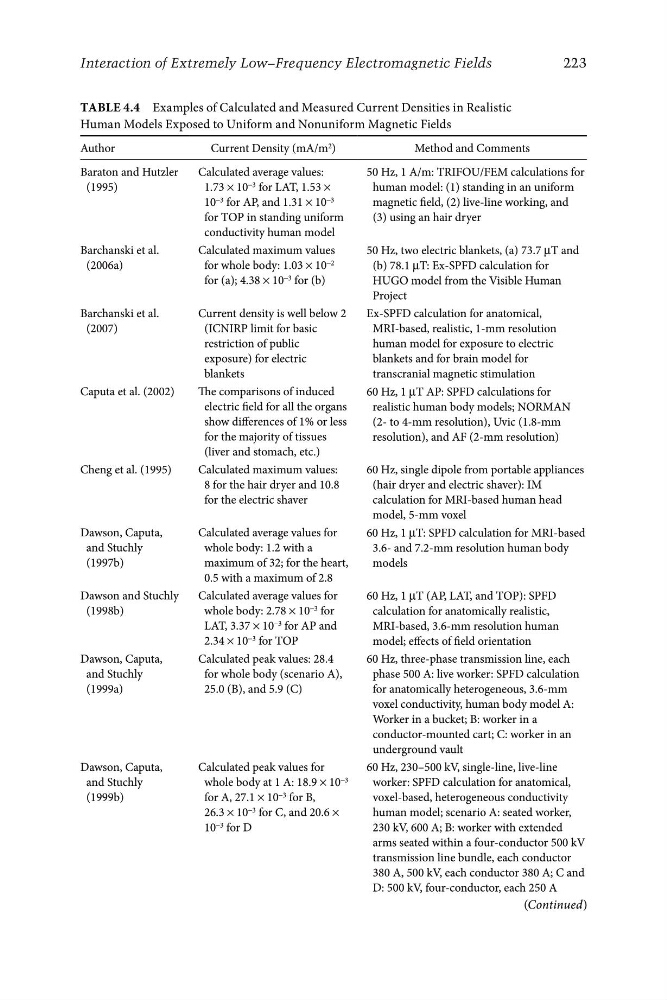
Table 4.4 Examples of Calculated and Measured Current Densities in Realistic
Human Models Exposed to Uniform and Nonuniform Magnetic Fields
Current Density (mA/m 2 )
Method and Comments
Baraton and Hutzler
Calculated average values:
50 Hz, 1 A/m: TRIFOU/FEM calculations for
(1995)
1.73 × 10 −3 for LAT, 1.53 ×
human model: (1) standing in an uniform
10 −3 for AP, and 1.31 × 10 −3
magnetic field, (2) live-line working, and
for TOP in standing uniform
(3) using an hair dryer
conductivity human model
Barchanski et al.
Calculated maximum values
50 Hz, two electric blankets, (a) 73.7 μT and
(2006a)
for whole body: 1.03 × 10 −2
(b) 78.1 μT: Ex-SPFD calculation for
for (a); 4.38 × 10 −3 for (b)
HUGO
model
from
the
Visible
Human
Project
Barchanski et al.
Current density is well below 2
Ex-SPFD calculation for anatomical,
(2007)
(ICNIRP limit for basic
MRI-based, realistic, 1-mm resolution
restriction of public
human model for exposure to electric
exposure) for electric
blankets and for brain model for
blankets
transcranial magnetic stimulation
Caputa et al. (2002)
The comparisons of induced
60 Hz, 1 μT AP: SPFD calculations for
electric field for all the organs
realistic human body models; NORMAN
show differences of 1% or less
(2- to 4-mm resolution), Uvic (1.8-mm
for the majority of tissues
resolution), and AF (2-mm resolution)
(liver and stomach, etc.)
Cheng et al. (1995)
Calculated maximum values:
60 Hz, single dipole from portable appliances
8 for the hair dryer and 10.8
(hair dryer and electric shaver): IM
for the electric shaver
calculation for MRI-based human head
model, 5-mm voxel
Dawson, Caputa,
Calculated average values for
60 Hz, 1 μT: SPFD calculation for MRI-based
and Stuchly
whole body: 1.2 with a
3.6- and 7.2-mm resolution human body
(1997b)
maximum of 32; for the heart,
models
0.5 with a maximum of 2.8
Dawson and Stuchly
Calculated average values for
60 Hz, 1 μT (AP, LAT, and TOP): SPFD
(1998b)
whole body: 2.78 × 10 −3 for
calculation for anatomically realistic,
LAT, 3.37 × 10 −3 for AP and
MRI-based, 3.6-mm resolution human
2.34 × 10 −3 for TOP
model; effects of field orientation
Dawson, Caputa,
Calculated peak values: 28.4
60 Hz, three-phase transmission line, each
and Stuchly
for whole body (scenario A),
phase 500 A: live worker: SPFD calculation
(1999a)
25.0 (B), and 5.9 (C)
for anatomically heterogeneous, 3.6-mm
voxel conductivity, human body model A:
Worker in a bucket; B: worker in a
conductor-mounted cart; C: worker in an
underground vault
Dawson, Caputa,
Calculated peak values for
60
Hz,
230–500
kV,
single-line,
live-line
and Stuchly
whole body at 1 A: 18.9 × 10 −3
worker: SPFD calculation for anatomical,
(1999b)
for A, 27.1 × 10 −3 for B,
voxel-based, heterogeneous conductivity
26.3 × 10 −3 for C, and 20.6 ×
human model; scenario A: seated worker,
10 −3 for D
230
kV,
600
A;
B:
worker
with
extended
arms seated within a
four-conductor
500
kV
transmission line bundle, each conductor
380 A, 500
kV,
each
conductor
380
A;
C
and
D:
500
kV,
four-conductor,
each
250 A
(Continued)
223
Interaction of Extremely Low–Frequency Electromagnetic Fields
Table 4.4 Examples of Calculated and Measured Current Densities in Realistic
Human Models Exposed to Uniform and Nonuniform Magnetic Fields