

102
1.8
1.6
1.4
1.2
1
0.8
= 8 ns
0.6
t on
t on
= 4 ns
0.4
t on = 2 ns
0.2
= 0.8 ns
0
t on
0
2
4
6
Transmembrane voltage (V)
8
10
Electromagnetic Fields in Biological Systems
Time (ns)
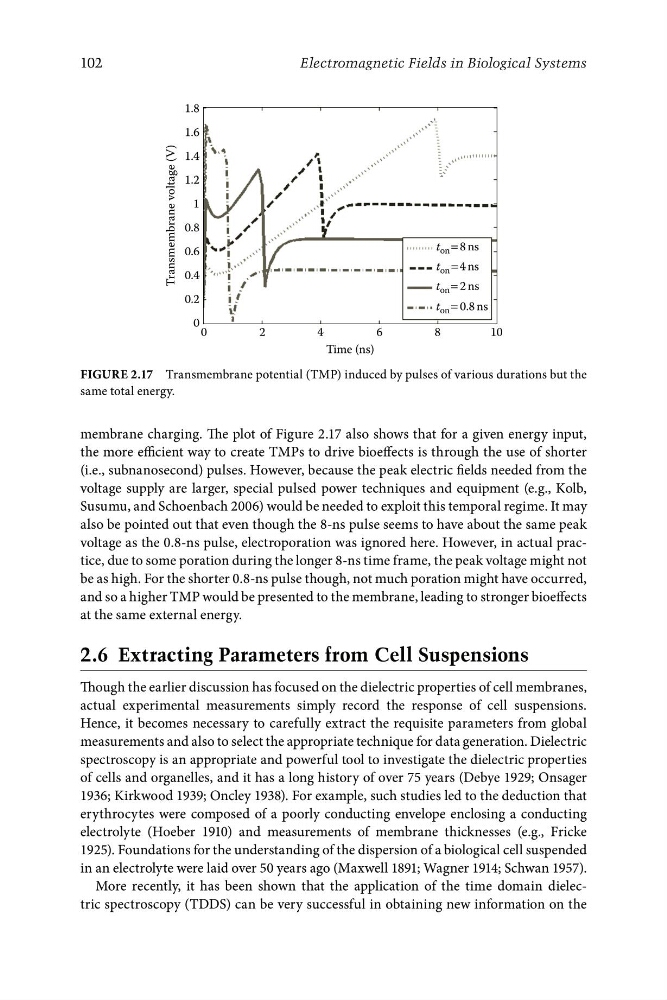
Figure 2.17 Transmembrane potential (TMP) induced by pulses of various durations but the
same total energy.
membrane charging. The plot of Figure 2.17 also shows that for a given energy input,
the more efficient way to create TMPs to drive bioeffects is through the use of shorter
(i.e., subnanosecond) pulses. However, because the peak electric fields needed from the
voltage supply are larger, special pulsed power techniques and equipment (e.g., Kolb,
Susumu, and Schoenbach 2006) would be needed to exploit this temporal regime. It may
also be pointed out that even though the 8-ns pulse seems to have about the same peak
voltage as the 0.8-ns pulse, electroporation was ignored here. However, in actual practice, due to some poration during the longer 8-ns time frame, the peak voltage might not
be as high. For the shorter 0.8-ns pulse though, not much poration might have occurred,
and so a higher TMP would be presented to the membrane, leading to stronger bioeffects
at the same external energy.
2.6 Extracting Parameters from Cell Suspensions
Though the earlier discussion has focused on the dielectric properties of cell membranes,
actual experimental measurements simply record the response of cell suspensions.
Hence, it becomes necessary to carefully extract the requisite parameters from global
measurements and also to select the appropriate technique for data generation. Dielectric
spectroscopy is an appropriate and powerful tool to investigate the dielectric properties
of cells and organelles, and it has a long history of over 75 years (Debye 1929; Onsager
1936; Kirkwood 1939; Oncley 1938). For example, such studies led to the deduction that
erythrocytes were composed of a poorly conducting envelope enclosing a conducting
electrolyte (Hoeber 1910) and measurements of membrane thicknesses (e.g., Fricke
1925). Foundations for the understanding of the dispersion of a biological cell suspended
in an electrolyte were laid over 50 years ago (Maxwell 1891; Wagner 1914; Schwan 1957).
More recently, it has been shown that the application of the time domain dielectric spectroscopy (TDDS) can be very successful in obtaining new information on the
1.8
1.6
1.4
1.2
1
0.8
= 8 ns
0.6
t on
t on
= 4 ns
0.4
t on = 2 ns
0.2
= 0.8 ns
0
t on
0
2
4
6
Transmembrane voltage (V)
8
10
Electromagnetic Fields in Biological Systems
Time (ns)
Figure 2.17 Transmembrane potential (TMP) induced by pulses of various durations but the
same total energy.
membrane charging. The plot of Figure 2.17 also shows that for a given energy input,
the more efficient way to create TMPs to drive bioeffects is through the use of shorter
(i.e., subnanosecond) pulses. However, because the peak electric fields needed from the
voltage supply are larger, special pulsed power techniques and equipment (e.g., Kolb,
Susumu, and Schoenbach 2006) would be needed to exploit this temporal regime. It may
also be pointed out that even though the 8-ns pulse seems to have about the same peak
voltage as the 0.8-ns pulse, electroporation was ignored here. However, in actual practice, due to some poration during the longer 8-ns time frame, the peak voltage might not
be as high. For the shorter 0.8-ns pulse though, not much poration might have occurred,
and so a higher TMP would be presented to the membrane, leading to stronger bioeffects
at the same external energy.
2.6 Extracting Parameters from Cell Suspensions
Though the earlier discussion has focused on the dielectric properties of cell membranes,
actual experimental measurements simply record the response of cell suspensions.
Hence, it becomes necessary to carefully extract the requisite parameters from global
measurements and also to select the appropriate technique for data generation. Dielectric
spectroscopy is an appropriate and powerful tool to investigate the dielectric properties
of cells and organelles, and it has a long history of over 75 years (Debye 1929; Onsager
1936; Kirkwood 1939; Oncley 1938). For example, such studies led to the deduction that
erythrocytes were composed of a poorly conducting envelope enclosing a conducting
electrolyte (Hoeber 1910) and measurements of membrane thicknesses (e.g., Fricke
1925). Foundations for the understanding of the dispersion of a biological cell suspended
in an electrolyte were laid over 50 years ago (Maxwell 1891; Wagner 1914; Schwan 1957).
More recently, it has been shown that the application of the time domain dielectric spectroscopy (TDDS) can be very successful in obtaining new information on the