

2007). The usage of fossil fuel is one which contributes more to energy supply across
the globe.
So there comes the demand of renewable energy in which biofuel is one of the
renewable energies. Biofuel is bioenergy which is generated in sustainable methods
with the help of biological methods. Thus, by using the renewable energy source, we
can protect the environment by providing energy security and also take into consideration the climatic change and provide ecofriendly and sustainable fuel which can
be used as an energy carrier (Bullen et al. 2006). Apart from these, the renewable
energy also provides additional benefits like increase of the energy security, reduction of the GHG emissions, and solution for many health issues. Along with this, the
demand for biofuel is increasing day by day. So many researches are going on to
develop a new sustainable and safe biofuel which can satisfy the needs and social
conditions (Davis and Higson 2007). The sustainability of biofuel means not only
providing a better biofuel but also protecting the environment and satisfying the
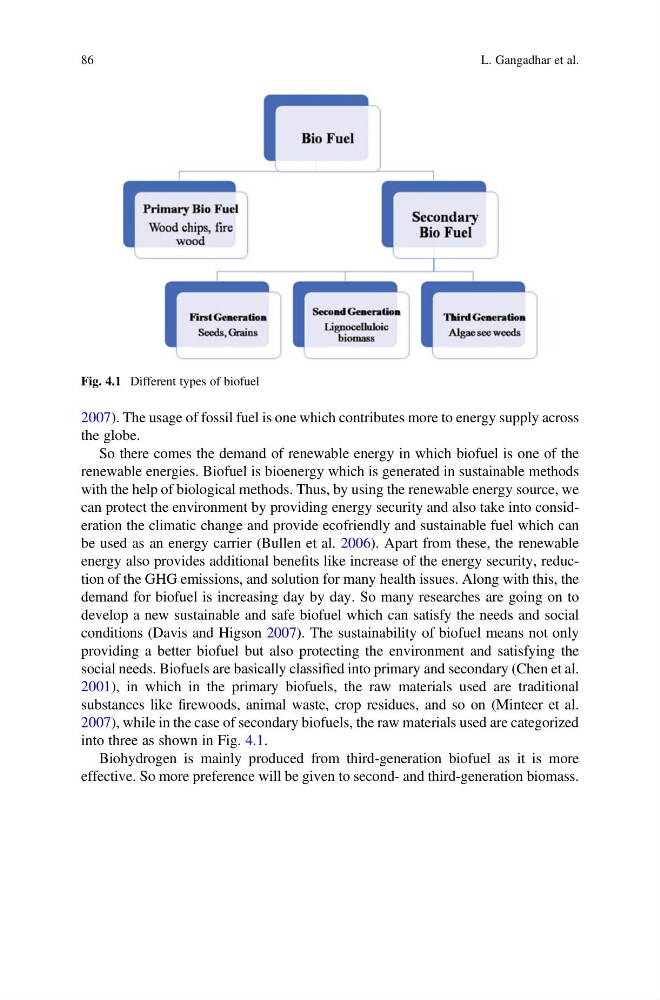
social needs. Biofuels are basically classified into primary and secondary (Chen et al.
2001), in which in the primary biofuels, the raw materials used are traditional
substances like firewoods, animal waste, crop residues, and so on (Minteer et al.
2007), while in the case of secondary biofuels, the raw materials used are categorized
into three as shown in Fig. 4.1.
Biohydrogen is mainly produced from third-generation biofuel as it is more
effective. So more preference will be given to second- and third-generation biomass.
Fig. 4.1 Different types of biofuel
86
L. Gangadhar et al.
the globe.
So there comes the demand of renewable energy in which biofuel is one of the
renewable energies. Biofuel is bioenergy which is generated in sustainable methods
with the help of biological methods. Thus, by using the renewable energy source, we
can protect the environment by providing energy security and also take into consideration the climatic change and provide ecofriendly and sustainable fuel which can
be used as an energy carrier (Bullen et al. 2006). Apart from these, the renewable
energy also provides additional benefits like increase of the energy security, reduction of the GHG emissions, and solution for many health issues. Along with this, the
demand for biofuel is increasing day by day. So many researches are going on to
develop a new sustainable and safe biofuel which can satisfy the needs and social
conditions (Davis and Higson 2007). The sustainability of biofuel means not only
providing a better biofuel but also protecting the environment and satisfying the
social needs. Biofuels are basically classified into primary and secondary (Chen et al.
2001), in which in the primary biofuels, the raw materials used are traditional
substances like firewoods, animal waste, crop residues, and so on (Minteer et al.
2007), while in the case of secondary biofuels, the raw materials used are categorized
into three as shown in Fig. 4.1.
Biohydrogen is mainly produced from third-generation biofuel as it is more
effective. So more preference will be given to second- and third-generation biomass.
Fig. 4.1 Different types of biofuel
86
L. Gangadhar et al.