

OLR of 115 g total volatile solid/l/d (HRT ¼ 0.6 d). HP ranged from 0.1 to 5.6 L
hydrogen/l/d. Nakasaki et al. (2020) characterized the microbial community and its
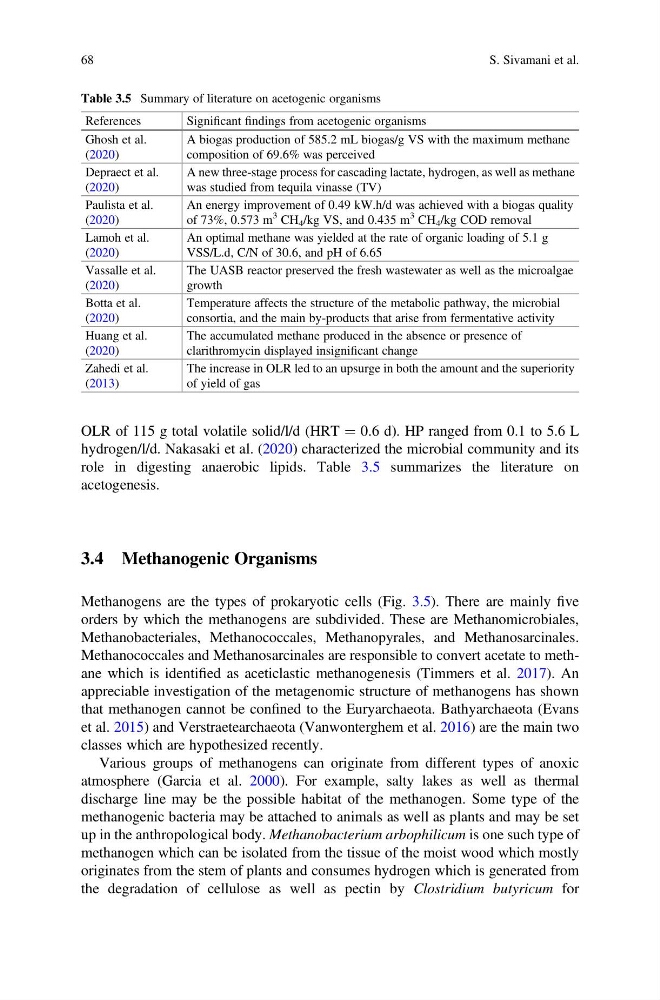
role in digesting anaerobic lipids. Table 3.5 summarizes the literature on
acetogenesis.
3.4 Methanogenic Organisms
Methanogens are the types of prokaryotic cells (Fig. 3.5). There are mainly five
orders by which the methanogens are subdivided. These are Methanomicrobiales,
Methanobacteriales, Methanococcales, Methanopyrales, and Methanosarcinales.
Methanococcales and Methanosarcinales are responsible to convert acetate to methane which is identified as aceticlastic methanogenesis (Timmers et al. 2017). An
appreciable investigation of the metagenomic structure of methanogens has shown
that methanogen cannot be confined to the Euryarchaeota. Bathyarchaeota (Evans
et al. 2015) and Verstraetearchaeota (Vanwonterghem et al. 2016) are the main two
classes which are hypothesized recently.
Various groups of methanogens can originate from different types of anoxic
atmosphere (Garcia et al. 2000). For example, salty lakes as well as thermal
discharge line may be the possible habitat of the methanogen. Some type of the
methanogenic bacteria may be attached to animals as well as plants and may be set
up in the anthropological body. Methanobacterium arbophilicum is one such type of
methanogen which can be isolated from the tissue of the moist wood which mostly
originates from the stem of plants and consumes hydrogen which is generated from
the degradation of cellulose as well as pectin by Clostridium butyricum for
Table 3.5 Summary of literature on acetogenic organisms
References
Significant findings from acetogenic organisms
Ghosh et al.
(2020)
A biogas production of 585.2 mL biogas/g VS with the maximum methane
composition of 69.6% was perceived
Depraect et al.
(2020)
A new three-stage process for cascading lactate, hydrogen, as well as methane
was studied from tequila vinasse (TV)
Paulista et al.
(2020)
An energy improvement of 0.49 kW.h/d was achieved with a biogas quality
of 73%, 0.573 m
3 CH 4 /kg VS, and 0.435 m
3 CH 4 /kg COD removal
Lamoh et al.
(2020)
An optimal methane was yielded at the rate of organic loading of 5.1 g
VSS/L.d, C/N of 30.6, and pH of 6.65
Vassalle et al.
(2020)
The UASB reactor preserved the fresh wastewater as well as the microalgae
growth
Botta et al.
(2020)
Temperature affects the structure of the metabolic pathway, the microbial
consortia, and the main by-products that arise from fermentative activity
Huang et al.
(2020)
The accumulated methane produced in the absence or presence of
clarithromycin displayed insignificant change
Zahedi et al.
(2013)
The increase in OLR led to an upsurge in both the amount and the superiority
of yield of gas
68
S. Sivamani et al.
hydrogen/l/d. Nakasaki et al. (2020) characterized the microbial community and its
role in digesting anaerobic lipids. Table 3.5 summarizes the literature on
acetogenesis.
3.4 Methanogenic Organisms
Methanogens are the types of prokaryotic cells (Fig. 3.5). There are mainly five
orders by which the methanogens are subdivided. These are Methanomicrobiales,
Methanobacteriales, Methanococcales, Methanopyrales, and Methanosarcinales.
Methanococcales and Methanosarcinales are responsible to convert acetate to methane which is identified as aceticlastic methanogenesis (Timmers et al. 2017). An
appreciable investigation of the metagenomic structure of methanogens has shown
that methanogen cannot be confined to the Euryarchaeota. Bathyarchaeota (Evans
et al. 2015) and Verstraetearchaeota (Vanwonterghem et al. 2016) are the main two
classes which are hypothesized recently.
Various groups of methanogens can originate from different types of anoxic
atmosphere (Garcia et al. 2000). For example, salty lakes as well as thermal
discharge line may be the possible habitat of the methanogen. Some type of the
methanogenic bacteria may be attached to animals as well as plants and may be set
up in the anthropological body. Methanobacterium arbophilicum is one such type of
methanogen which can be isolated from the tissue of the moist wood which mostly
originates from the stem of plants and consumes hydrogen which is generated from
the degradation of cellulose as well as pectin by Clostridium butyricum for
Table 3.5 Summary of literature on acetogenic organisms
References
Significant findings from acetogenic organisms
Ghosh et al.
(2020)
A biogas production of 585.2 mL biogas/g VS with the maximum methane
composition of 69.6% was perceived
Depraect et al.
(2020)
A new three-stage process for cascading lactate, hydrogen, as well as methane
was studied from tequila vinasse (TV)
Paulista et al.
(2020)
An energy improvement of 0.49 kW.h/d was achieved with a biogas quality
of 73%, 0.573 m
3 CH 4 /kg VS, and 0.435 m
3 CH 4 /kg COD removal
Lamoh et al.
(2020)
An optimal methane was yielded at the rate of organic loading of 5.1 g
VSS/L.d, C/N of 30.6, and pH of 6.65
Vassalle et al.
(2020)
The UASB reactor preserved the fresh wastewater as well as the microalgae
growth
Botta et al.
(2020)
Temperature affects the structure of the metabolic pathway, the microbial
consortia, and the main by-products that arise from fermentative activity
Huang et al.
(2020)
The accumulated methane produced in the absence or presence of
clarithromycin displayed insignificant change
Zahedi et al.
(2013)
The increase in OLR led to an upsurge in both the amount and the superiority
of yield of gas
68
S. Sivamani et al.