

nanoparticles as desired can be achieved via optimizing and maintaining the optimized parameters. Although there may be few primary shortcomings of physical
techniques such as high cost of equipments, time-intensive procedures and high
parameters (that are not conducive to the environment), this technique helps in
obtaining the uniform size as well as shape of nanoparticles (Khan et al. 2019).
8.3.3 Green Synthesis of Nanoparticles
Green synthesis of nanoparticles is considered as an eco-friendly substitute to
diminish the harsh outcome integrated with the physical as well as chemical techniques employed for the production of nanoparticles (Singh et al. 2018a, b). Moreover, green synthesis creates nanoparticles having high disparity, narrow size
distribution, and high stability (Gour and Jain 2019a, b). Here in this chapter, we
sum up the basic processes and mechanisms of green synthesis approaches of
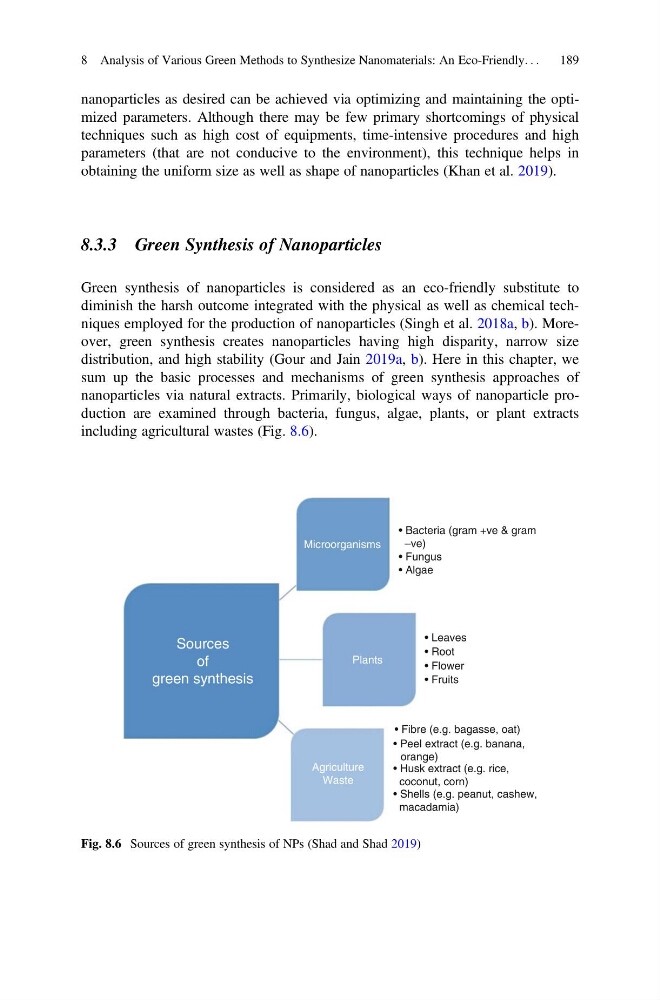
nanoparticles via natural extracts. Primarily, biological ways of nanoparticle production are examined through bacteria, fungus, algae, plants, or plant extracts
including agricultural wastes (Fig. 8.6).
Microorganisms
• Bacteria (gram +ve & gram
–ve)
• Fungus
• Algae
• Leaves
• Root
• Flower
• Fruits
• Fibre (e.g. bagasse, oat)
• Peel extract (e.g. banana,
orange)
• Husk extract (e.g. rice,
coconut, corn)
• Shells (e.g. peanut, cashew,
macadamia)
Plants
Agriculture
Waste
Sources
of
green synthesis
Fig. 8.6 Sources of green synthesis of NPs (Shad and Shad 2019)
8 Analysis of Various Green Methods to Synthesize Nanomaterials: An Eco-Friendly. . .
189
techniques such as high cost of equipments, time-intensive procedures and high
parameters (that are not conducive to the environment), this technique helps in
obtaining the uniform size as well as shape of nanoparticles (Khan et al. 2019).
8.3.3 Green Synthesis of Nanoparticles
Green synthesis of nanoparticles is considered as an eco-friendly substitute to
diminish the harsh outcome integrated with the physical as well as chemical techniques employed for the production of nanoparticles (Singh et al. 2018a, b). Moreover, green synthesis creates nanoparticles having high disparity, narrow size
distribution, and high stability (Gour and Jain 2019a, b). Here in this chapter, we
sum up the basic processes and mechanisms of green synthesis approaches of
nanoparticles via natural extracts. Primarily, biological ways of nanoparticle production are examined through bacteria, fungus, algae, plants, or plant extracts
including agricultural wastes (Fig. 8.6).
Microorganisms
• Bacteria (gram +ve & gram
–ve)
• Fungus
• Algae
• Leaves
• Root
• Flower
• Fruits
• Fibre (e.g. bagasse, oat)
• Peel extract (e.g. banana,
orange)
• Husk extract (e.g. rice,
coconut, corn)
• Shells (e.g. peanut, cashew,
macadamia)
Plants
Agriculture
Waste
Sources
of
green synthesis
Fig. 8.6 Sources of green synthesis of NPs (Shad and Shad 2019)
8 Analysis of Various Green Methods to Synthesize Nanomaterials: An Eco-Friendly. . .
189