

(Tanaka 2018), and electrochemical technique as well as photochemical reaction in
reverse micelles. These abovementioned chemical methods involve strong reducing
agents for the reduction of nanoparticles and capping agents (oleic acid,
triethanolamine, and thioglycerol), in order to manage the size and stabilization of
the synthesized nanoparticles. The major limitations of chemical techniques comprise their high cost and the toxicity of chemicals employed (Kalpana and Rajeswari
2018).
8.3.2 Physical Synthesis of Nanoparticles
A variety of metals, namely, gold (Au), lead sulfide (PbS), fullerene, silver, etc.,
have been used for the production of nanoparticles through techniques such as
evaporation/condensation (Zhang et al. 2016). Physical techniques used for nanoparticle synthesis involve thermolysis, physical vapor deposition (PVD) (Kim and
Hwan 2018), pulsed laser method (Kim et al. 2017), microwave-assisted synthesis
(Nikam et al. 2018), high-energy ball milling (Piras et al. 2019), melt mixing (Dhand
et al. 2015a, b), sputter deposition (Nguyen and Yonezawa 2018a, b), etc. In all of
these techniques, one or the other physical parameter is altered, such as changing
temperature in thermolysis, increase/decrease in pressure in ball milling, pH alteration in ion implantation, radiations in laser ablation, etc. The shape and size of the
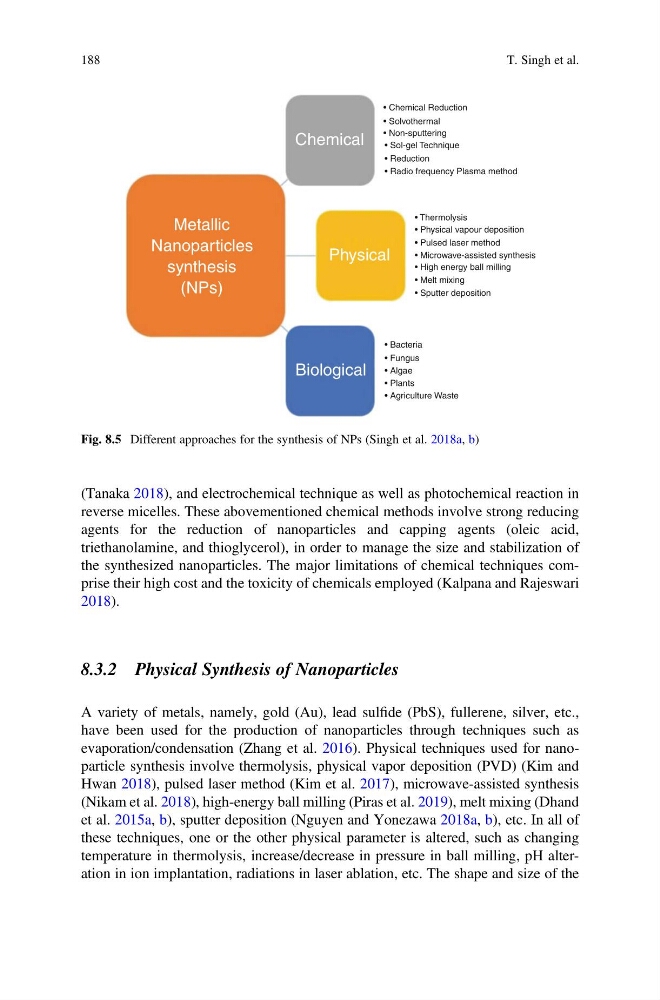
• Chemical Reduction
• Solvothermal
• Non-sputtering
• Sol-gel Technique
• Reduction
Chemical
Physical
Metallic
Nanoparticles
synthesis
(NPs)
Biological
• Radio frequency Plasma method
• Thermolysis
• Physical vapour deposition
• Pulsed laser method
• Microwave-assisted synthesis
• High energy ball milling
• Melt mixing
• Sputter deposition
• Bacteria
• Fungus
• Algae
• Plants
• Agriculture Waste
Fig. 8.5 Different approaches for the synthesis of NPs (Singh et al. 2018a, b)
188
T. Singh et al.
reverse micelles. These abovementioned chemical methods involve strong reducing
agents for the reduction of nanoparticles and capping agents (oleic acid,
triethanolamine, and thioglycerol), in order to manage the size and stabilization of
the synthesized nanoparticles. The major limitations of chemical techniques comprise their high cost and the toxicity of chemicals employed (Kalpana and Rajeswari
2018).
8.3.2 Physical Synthesis of Nanoparticles
A variety of metals, namely, gold (Au), lead sulfide (PbS), fullerene, silver, etc.,
have been used for the production of nanoparticles through techniques such as
evaporation/condensation (Zhang et al. 2016). Physical techniques used for nanoparticle synthesis involve thermolysis, physical vapor deposition (PVD) (Kim and
Hwan 2018), pulsed laser method (Kim et al. 2017), microwave-assisted synthesis
(Nikam et al. 2018), high-energy ball milling (Piras et al. 2019), melt mixing (Dhand
et al. 2015a, b), sputter deposition (Nguyen and Yonezawa 2018a, b), etc. In all of
these techniques, one or the other physical parameter is altered, such as changing
temperature in thermolysis, increase/decrease in pressure in ball milling, pH alteration in ion implantation, radiations in laser ablation, etc. The shape and size of the
• Chemical Reduction
• Solvothermal
• Non-sputtering
• Sol-gel Technique
• Reduction
Chemical
Physical
Metallic
Nanoparticles
synthesis
(NPs)
Biological
• Radio frequency Plasma method
• Thermolysis
• Physical vapour deposition
• Pulsed laser method
• Microwave-assisted synthesis
• High energy ball milling
• Melt mixing
• Sputter deposition
• Bacteria
• Fungus
• Algae
• Plants
• Agriculture Waste
Fig. 8.5 Different approaches for the synthesis of NPs (Singh et al. 2018a, b)
188
T. Singh et al.