

1.3 Biofuel Production: Biodiesel and Bioalcohol
Biodiesel (Greek, bio, life, and diesel from Rudolf Diesel) as a managed energy are
resulting from a natural source (Jayed et al. 2011). Biodiesel, as a sustainable power
source, can possibly be utilized as a substitute fuel in diesel machines (Atadashi et al.
2012).
Biodiesel is a fuel containing monoalkyl esters of long-chain unsaturated fats that
are resultant from renewable biological sources, for example, herbal oils or animal
fats (Singh and Nigam 2014). To put it simply, biodiesel can be made from any
oil/lipid source. The main apparatuses of these sources (oils and fats) are
triacylglycerol molecules (Nigam and Singh 2011).
In other words, biodiesel is made by the esterification of free unsaturated fats or
the transesterification of triacylglycerols (Veljković et al. 2018).
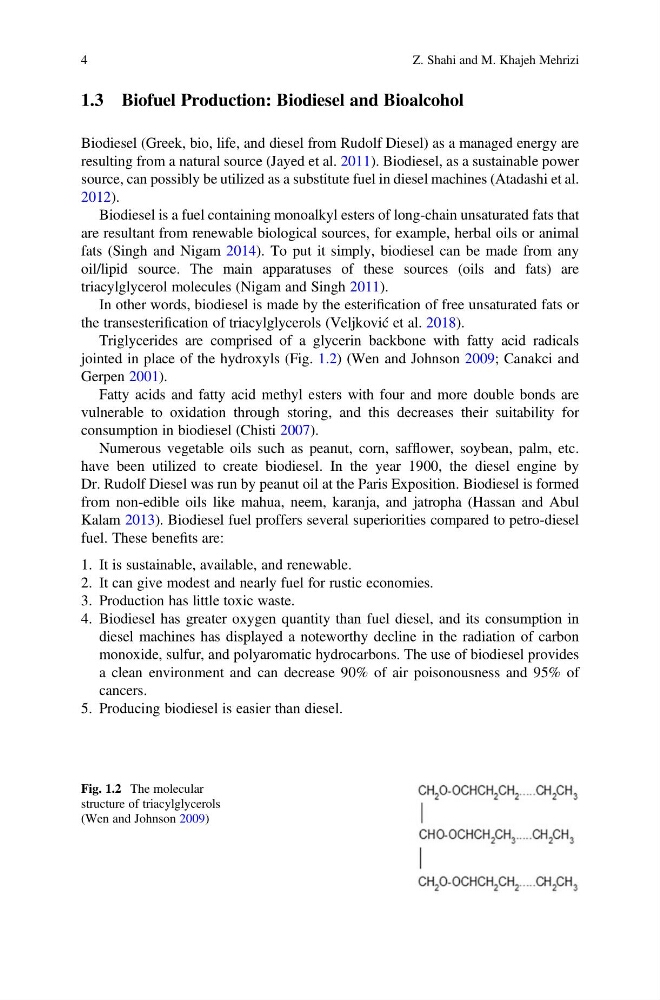
Triglycerides are comprised of a glycerin backbone with fatty acid radicals
jointed in place of the hydroxyls (Fig. 1.2) (Wen and Johnson 2009; Canakci and
Gerpen 2001).
Fatty acids and fatty acid methyl esters with four and more double bonds are
vulnerable to oxidation through storing, and this decreases their suitability for
consumption in biodiesel (Chisti 2007).
Numerous vegetable oils such as peanut, corn, safflower, soybean, palm, etc.
have been utilized to create biodiesel. In the year 1900, the diesel engine by
Dr. Rudolf Diesel was run by peanut oil at the Paris Exposition. Biodiesel is formed
from non-edible oils like mahua, neem, karanja, and jatropha (Hassan and Abul
Kalam 2013). Biodiesel fuel proffers several superiorities compared to petro-diesel
fuel. These benefits are:
1. It is sustainable, available, and renewable.
2. It can give modest and nearly fuel for rustic economies.
3. Production has little toxic waste.
4. Biodiesel has greater oxygen quantity than fuel diesel, and its consumption in
diesel machines has displayed a noteworthy decline in the radiation of carbon
monoxide, sulfur, and polyaromatic hydrocarbons. The use of biodiesel provides
a clean environment and can decrease 90% of air poisonousness and 95% of
cancers.
5. Producing biodiesel is easier than diesel.
Fig. 1.2 The molecular
structure of triacylglycerols
(Wen and Johnson 2009)
4
Z. Shahi and M. Khajeh Mehrizi
Biodiesel (Greek, bio, life, and diesel from Rudolf Diesel) as a managed energy are
resulting from a natural source (Jayed et al. 2011). Biodiesel, as a sustainable power
source, can possibly be utilized as a substitute fuel in diesel machines (Atadashi et al.
2012).
Biodiesel is a fuel containing monoalkyl esters of long-chain unsaturated fats that
are resultant from renewable biological sources, for example, herbal oils or animal
fats (Singh and Nigam 2014). To put it simply, biodiesel can be made from any
oil/lipid source. The main apparatuses of these sources (oils and fats) are
triacylglycerol molecules (Nigam and Singh 2011).
In other words, biodiesel is made by the esterification of free unsaturated fats or
the transesterification of triacylglycerols (Veljković et al. 2018).
Triglycerides are comprised of a glycerin backbone with fatty acid radicals
jointed in place of the hydroxyls (Fig. 1.2) (Wen and Johnson 2009; Canakci and
Gerpen 2001).
Fatty acids and fatty acid methyl esters with four and more double bonds are
vulnerable to oxidation through storing, and this decreases their suitability for
consumption in biodiesel (Chisti 2007).
Numerous vegetable oils such as peanut, corn, safflower, soybean, palm, etc.
have been utilized to create biodiesel. In the year 1900, the diesel engine by
Dr. Rudolf Diesel was run by peanut oil at the Paris Exposition. Biodiesel is formed
from non-edible oils like mahua, neem, karanja, and jatropha (Hassan and Abul
Kalam 2013). Biodiesel fuel proffers several superiorities compared to petro-diesel
fuel. These benefits are:
1. It is sustainable, available, and renewable.
2. It can give modest and nearly fuel for rustic economies.
3. Production has little toxic waste.
4. Biodiesel has greater oxygen quantity than fuel diesel, and its consumption in
diesel machines has displayed a noteworthy decline in the radiation of carbon
monoxide, sulfur, and polyaromatic hydrocarbons. The use of biodiesel provides
a clean environment and can decrease 90% of air poisonousness and 95% of
cancers.
5. Producing biodiesel is easier than diesel.
Fig. 1.2 The molecular
structure of triacylglycerols
(Wen and Johnson 2009)
4
Z. Shahi and M. Khajeh Mehrizi