

Fossil fuels are widely used because of their high heating authority, accessibility,
and modality ignition features (Hassan and Abul Kalam 2013).
These fossil fuels have many adverse effects including energy security concerns;
increasing oil prices; climate change and global warming; emissions of greenhouse
gases such as CO 2 , CO, and SO 2 ; environmental pollution; damage of biodiversity;
and others, which conduct to transports and focus to renewable, maintainable,
effective, and impressive power sources (Taparia et al. 2016; Atadashi et al. 2012;
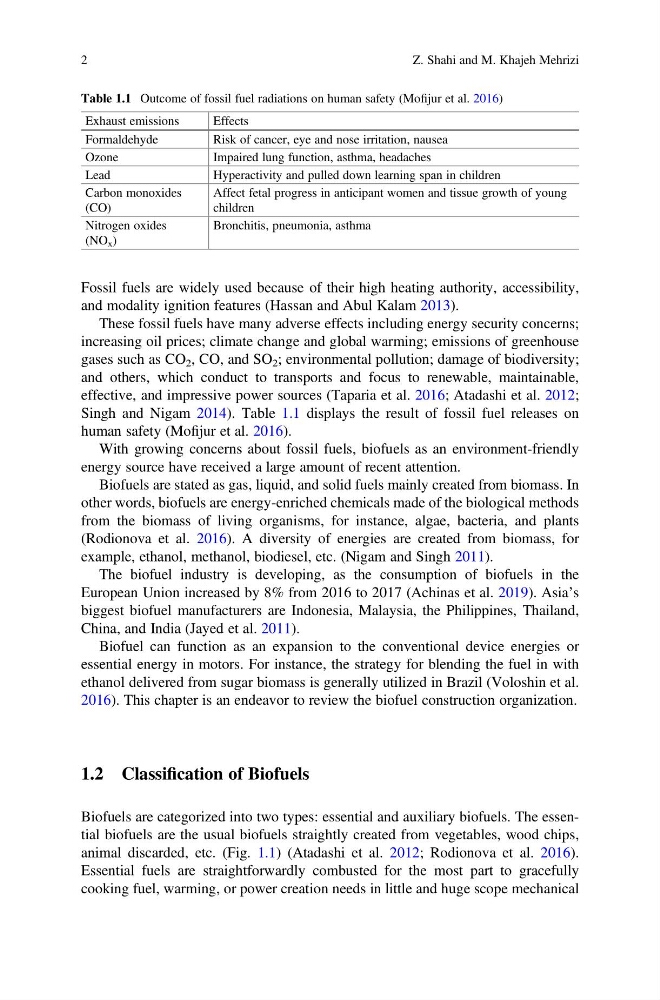
Singh and Nigam 2014). Table 1.1 displays the result of fossil fuel releases on
human safety (Mofijur et al. 2016).
With growing concerns about fossil fuels, biofuels as an environment-friendly
energy source have received a large amount of recent attention.
Biofuels are stated as gas, liquid, and solid fuels mainly created from biomass. In
other words, biofuels are energy-enriched chemicals made of the biological methods
from the biomass of living organisms, for instance, algae, bacteria, and plants
(Rodionova et al. 2016). A diversity of energies are created from biomass, for
example, ethanol, methanol, biodiesel, etc. (Nigam and Singh 2011).
The biofuel industry is developing, as the consumption of biofuels in the
European Union increased by 8% from 2016 to 2017 (Achinas et al. 2019). Asia’s
biggest biofuel manufacturers are Indonesia, Malaysia, the Philippines, Thailand,
China, and India (Jayed et al. 2011).
Biofuel can function as an expansion to the conventional device energies or
essential energy in motors. For instance, the strategy for blending the fuel in with
ethanol delivered from sugar biomass is generally utilized in Brazil (Voloshin et al.
2016). This chapter is an endeavor to review the biofuel construction organization.
1.2 Classification of Biofuels
Biofuels are categorized into two types: essential and auxiliary biofuels. The essential biofuels are the usual biofuels straightly created from vegetables, wood chips,
animal discarded, etc. (Fig. 1.1) (Atadashi et al. 2012; Rodionova et al. 2016).
Essential fuels are straightforwardly combusted for the most part to gracefully
cooking fuel, warming, or power creation needs in little and huge scope mechanical
Table 1.1 Outcome of fossil fuel radiations on human safety (Mofijur et al. 2016)
Exhaust emissions
Effects
Formaldehyde
Risk of cancer, eye and nose irritation, nausea
Ozone
Impaired lung function, asthma, headaches
Lead
Hyperactivity and pulled down learning span in children
Carbon monoxides
(CO)
Affect fetal progress in anticipant women and tissue growth of young
children
Nitrogen oxides
(NO x )
Bronchitis, pneumonia, asthma
2
Z. Shahi and M. Khajeh Mehrizi
and modality ignition features (Hassan and Abul Kalam 2013).
These fossil fuels have many adverse effects including energy security concerns;
increasing oil prices; climate change and global warming; emissions of greenhouse
gases such as CO 2 , CO, and SO 2 ; environmental pollution; damage of biodiversity;
and others, which conduct to transports and focus to renewable, maintainable,
effective, and impressive power sources (Taparia et al. 2016; Atadashi et al. 2012;
Singh and Nigam 2014). Table 1.1 displays the result of fossil fuel releases on
human safety (Mofijur et al. 2016).
With growing concerns about fossil fuels, biofuels as an environment-friendly
energy source have received a large amount of recent attention.
Biofuels are stated as gas, liquid, and solid fuels mainly created from biomass. In
other words, biofuels are energy-enriched chemicals made of the biological methods
from the biomass of living organisms, for instance, algae, bacteria, and plants
(Rodionova et al. 2016). A diversity of energies are created from biomass, for
example, ethanol, methanol, biodiesel, etc. (Nigam and Singh 2011).
The biofuel industry is developing, as the consumption of biofuels in the
European Union increased by 8% from 2016 to 2017 (Achinas et al. 2019). Asia’s
biggest biofuel manufacturers are Indonesia, Malaysia, the Philippines, Thailand,
China, and India (Jayed et al. 2011).
Biofuel can function as an expansion to the conventional device energies or
essential energy in motors. For instance, the strategy for blending the fuel in with
ethanol delivered from sugar biomass is generally utilized in Brazil (Voloshin et al.
2016). This chapter is an endeavor to review the biofuel construction organization.
1.2 Classification of Biofuels
Biofuels are categorized into two types: essential and auxiliary biofuels. The essential biofuels are the usual biofuels straightly created from vegetables, wood chips,
animal discarded, etc. (Fig. 1.1) (Atadashi et al. 2012; Rodionova et al. 2016).
Essential fuels are straightforwardly combusted for the most part to gracefully
cooking fuel, warming, or power creation needs in little and huge scope mechanical
Table 1.1 Outcome of fossil fuel radiations on human safety (Mofijur et al. 2016)
Exhaust emissions
Effects
Formaldehyde
Risk of cancer, eye and nose irritation, nausea
Ozone
Impaired lung function, asthma, headaches
Lead
Hyperactivity and pulled down learning span in children
Carbon monoxides
(CO)
Affect fetal progress in anticipant women and tissue growth of young
children
Nitrogen oxides
(NO x )
Bronchitis, pneumonia, asthma
2
Z. Shahi and M. Khajeh Mehrizi