

5.5 Microalgae: A Promising Option for Biodiesel
Production
Microalgae are categorized in the kingdom Plantae and considered as a good source
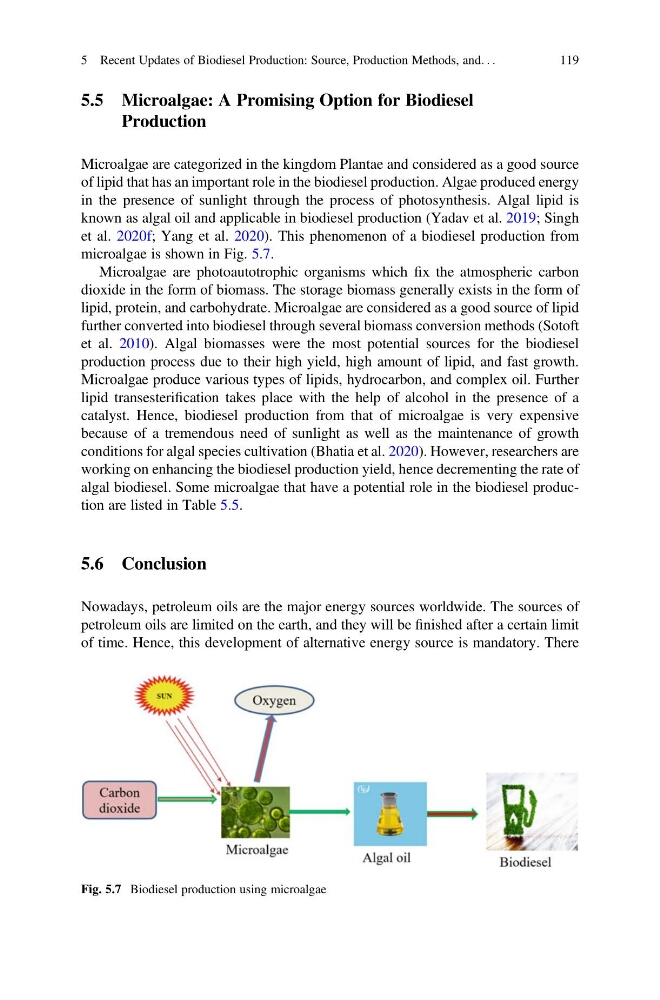
of lipid that has an important role in the biodiesel production. Algae produced energy
in the presence of sunlight through the process of photosynthesis. Algal lipid is
known as algal oil and applicable in biodiesel production (Yadav et al. 2019; Singh
et al. 2020f; Yang et al. 2020). This phenomenon of a biodiesel production from
microalgae is shown in Fig. 5.7.
Microalgae are photoautotrophic organisms which fix the atmospheric carbon
dioxide in the form of biomass. The storage biomass generally exists in the form of
lipid, protein, and carbohydrate. Microalgae are considered as a good source of lipid
further converted into biodiesel through several biomass conversion methods (Sotoft
et al. 2010). Algal biomasses were the most potential sources for the biodiesel
production process due to their high yield, high amount of lipid, and fast growth.
Microalgae produce various types of lipids, hydrocarbon, and complex oil. Further
lipid transesterification takes place with the help of alcohol in the presence of a
catalyst. Hence, biodiesel production from that of microalgae is very expensive
because of a tremendous need of sunlight as well as the maintenance of growth
conditions for algal species cultivation (Bhatia et al. 2020). However, researchers are
working on enhancing the biodiesel production yield, hence decrementing the rate of
algal biodiesel. Some microalgae that have a potential role in the biodiesel production are listed in Table 5.5.
5.6 Conclusion
Nowadays, petroleum oils are the major energy sources worldwide. The sources of
petroleum oils are limited on the earth, and they will be finished after a certain limit
of time. Hence, this development of alternative energy source is mandatory. There
Fig. 5.7 Biodiesel production using microalgae
5 Recent Updates of Biodiesel Production: Source, Production Methods, and. . .
119
Production
Microalgae are categorized in the kingdom Plantae and considered as a good source
of lipid that has an important role in the biodiesel production. Algae produced energy
in the presence of sunlight through the process of photosynthesis. Algal lipid is
known as algal oil and applicable in biodiesel production (Yadav et al. 2019; Singh
et al. 2020f; Yang et al. 2020). This phenomenon of a biodiesel production from
microalgae is shown in Fig. 5.7.
Microalgae are photoautotrophic organisms which fix the atmospheric carbon
dioxide in the form of biomass. The storage biomass generally exists in the form of
lipid, protein, and carbohydrate. Microalgae are considered as a good source of lipid
further converted into biodiesel through several biomass conversion methods (Sotoft
et al. 2010). Algal biomasses were the most potential sources for the biodiesel
production process due to their high yield, high amount of lipid, and fast growth.
Microalgae produce various types of lipids, hydrocarbon, and complex oil. Further
lipid transesterification takes place with the help of alcohol in the presence of a
catalyst. Hence, biodiesel production from that of microalgae is very expensive
because of a tremendous need of sunlight as well as the maintenance of growth
conditions for algal species cultivation (Bhatia et al. 2020). However, researchers are
working on enhancing the biodiesel production yield, hence decrementing the rate of
algal biodiesel. Some microalgae that have a potential role in the biodiesel production are listed in Table 5.5.
5.6 Conclusion
Nowadays, petroleum oils are the major energy sources worldwide. The sources of
petroleum oils are limited on the earth, and they will be finished after a certain limit
of time. Hence, this development of alternative energy source is mandatory. There
Fig. 5.7 Biodiesel production using microalgae
5 Recent Updates of Biodiesel Production: Source, Production Methods, and. . .
119