

pollution as well as affects living creatures, and there is no space nowadays to dump
all these wastes. So an ecofriendly alternative or solution has to be found for these
problems. So a biogas plant was introduced for methane production, and later this
caused the pollution issue (Kapdan and Kargi 2006). The most used bioreactor for
biohydrogen production is batch as well as continuous stirred-tank reactor (CSTR)
(Ntaikou et al. 2010). There are difficulties in dumping these solid wastes. The soil
contains gases which can be used in the production of biohydrogen (Ghimire et al.
2015). This helps in controlling the pollution level in the atmosphere. The bioreactors can be used to scale up the yield, but there will be difficulty in supplying the
feedstock. New reactors are also introduced in order to make the process more
efficient with pipes and pumps to supply the raw materials.
The integrated methods are best compared to the separate ones. In this, the use of
bioreactor plays an important role. A system that can combine dark fermentation
with photofermentation can increase the amount of clean fuel produced. This waste
contains a large amount of biomolecules which improves the process, and the
refining is done as the pretreatment to improve the process (Han and Shin 2004).
Hydrogen which is produced from the soil is much easy to handle. This can be used
as a replacement for fossil fuels. Various properties, like texture, pH, etc., have to be
maintained to optimum conditions. Since this has a large number of microorganisms,
the process will be easier as they can break down the complex molecules into simple
ones to release hydrogen.
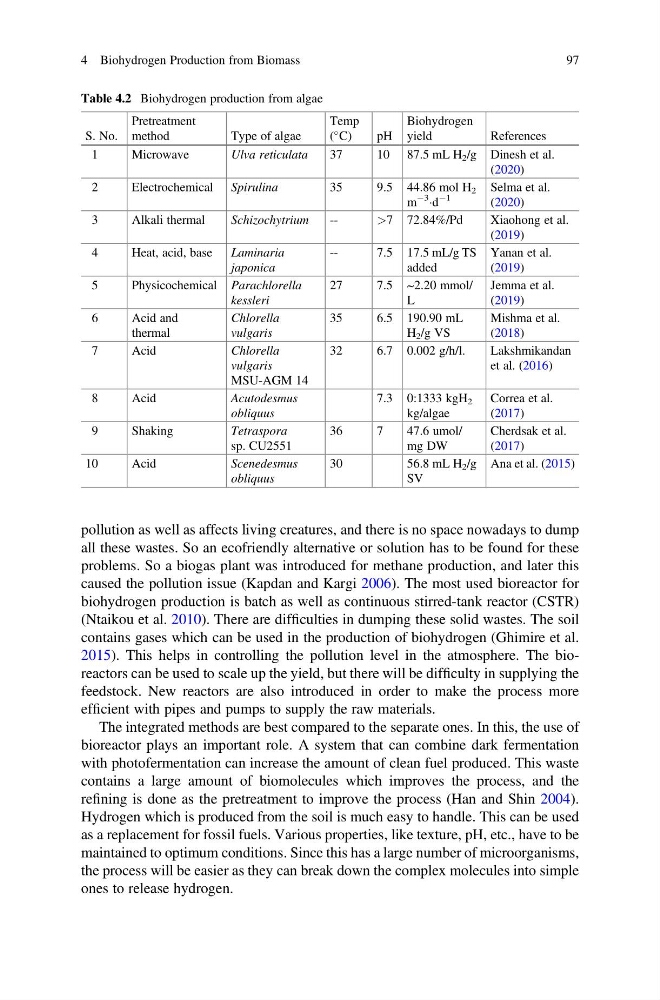
Table 4.2 Biohydrogen production from algae
S. No.
Pretreatment
method
Type of algae
Temp
(
C)
pH
Biohydrogen
yield
References
1
Microwave
Ulva reticulata
37
10 87.5 mL H 2 /g Dinesh et al.
(2020)
2
Electrochemical Spirulina
35
9.5 44.86 mol H 2
m
À3
Ád
À1
Selma et al.
(2020)
3
Alkali thermal
Schizochytrium
->7 72.84%/Pd
Xiaohong et al.
(2019)
4
Heat, acid, base Laminaria
japonica
-7.5 17.5 mL/g TS
added
Yanan et al.
(2019)
5
Physicochemical Parachlorella
kessleri
27
7.5 ~2.20 mmol/
L
Jemma et al.
(2019)
6
Acid and
thermal
Chlorella
vulgaris
35
6.5 190.90 mL
H 2 /g VS
Mishma et al.
(2018)
7
Acid
Chlorella
vulgaris
MSU-AGM 14
32
6.7 0.002 g/h/l.
Lakshmikandan
et al. (2016)
8
Acid
Acutodesmus
obliquus
7.3 0:1333 kgH 2
kg/algae
Correa et al.
(2017)
9
Shaking
Tetraspora
sp. CU2551
36
7
47.6 umol/
mg DW
Cherdsak et al.
(2017)
10
Acid
Scenedesmus
obliquus
30
56.8 mL H 2 /g
SV
Ana et al. (2015)
4 Biohydrogen Production from Biomass
97
all these wastes. So an ecofriendly alternative or solution has to be found for these
problems. So a biogas plant was introduced for methane production, and later this
caused the pollution issue (Kapdan and Kargi 2006). The most used bioreactor for
biohydrogen production is batch as well as continuous stirred-tank reactor (CSTR)
(Ntaikou et al. 2010). There are difficulties in dumping these solid wastes. The soil
contains gases which can be used in the production of biohydrogen (Ghimire et al.
2015). This helps in controlling the pollution level in the atmosphere. The bioreactors can be used to scale up the yield, but there will be difficulty in supplying the
feedstock. New reactors are also introduced in order to make the process more
efficient with pipes and pumps to supply the raw materials.
The integrated methods are best compared to the separate ones. In this, the use of
bioreactor plays an important role. A system that can combine dark fermentation
with photofermentation can increase the amount of clean fuel produced. This waste
contains a large amount of biomolecules which improves the process, and the
refining is done as the pretreatment to improve the process (Han and Shin 2004).
Hydrogen which is produced from the soil is much easy to handle. This can be used
as a replacement for fossil fuels. Various properties, like texture, pH, etc., have to be
maintained to optimum conditions. Since this has a large number of microorganisms,
the process will be easier as they can break down the complex molecules into simple
ones to release hydrogen.
Table 4.2 Biohydrogen production from algae
S. No.
Pretreatment
method
Type of algae
Temp
(
C)
pH
Biohydrogen
yield
References
1
Microwave
Ulva reticulata
37
10 87.5 mL H 2 /g Dinesh et al.
(2020)
2
Electrochemical Spirulina
35
9.5 44.86 mol H 2
m
À3
Ád
À1
Selma et al.
(2020)
3
Alkali thermal
Schizochytrium
->7 72.84%/Pd
Xiaohong et al.
(2019)
4
Heat, acid, base Laminaria
japonica
-7.5 17.5 mL/g TS
added
Yanan et al.
(2019)
5
Physicochemical Parachlorella
kessleri
27
7.5 ~2.20 mmol/
L
Jemma et al.
(2019)
6
Acid and
thermal
Chlorella
vulgaris
35
6.5 190.90 mL
H 2 /g VS
Mishma et al.
(2018)
7
Acid
Chlorella
vulgaris
MSU-AGM 14
32
6.7 0.002 g/h/l.
Lakshmikandan
et al. (2016)
8
Acid
Acutodesmus
obliquus
7.3 0:1333 kgH 2
kg/algae
Correa et al.
(2017)
9
Shaking
Tetraspora
sp. CU2551
36
7
47.6 umol/
mg DW
Cherdsak et al.
(2017)
10
Acid
Scenedesmus
obliquus
30
56.8 mL H 2 /g
SV
Ana et al. (2015)
4 Biohydrogen Production from Biomass
97