

The effective potential at finite temperature
35
+ ~ (31n [I - exp ( _Jy 2 + T-2(M~)Q)] -In(l - e- Y »)
- 4 ~ In [I + exp ( -J y2 + T-2(MF)~) ] }.
(2.29)
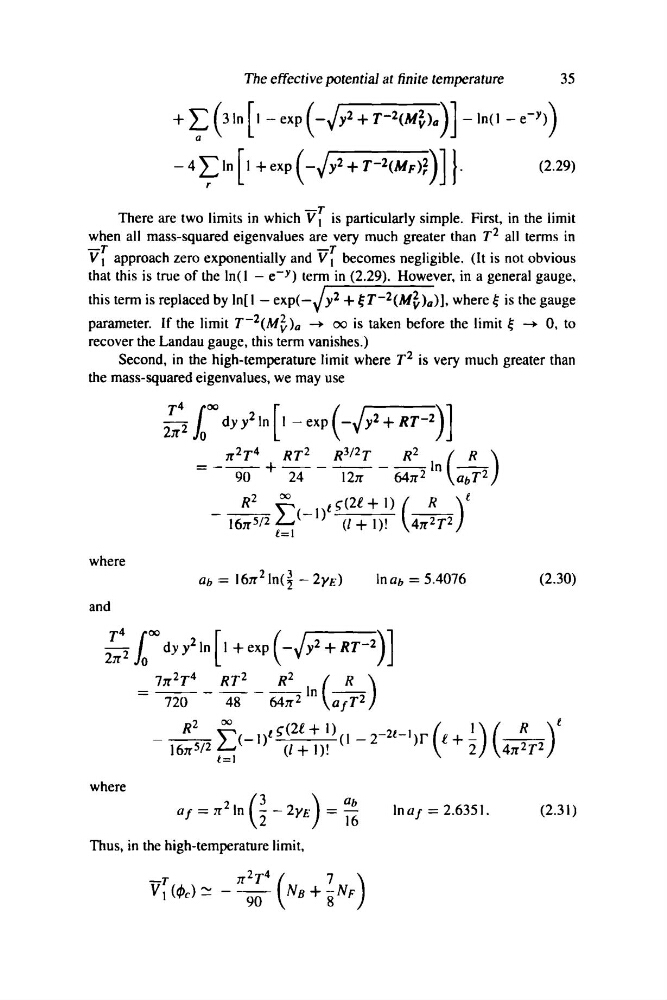
There are two limits in which Vr is particularly simple. First, in the limit
when all mass-squared eigenvalues are very much greater than r2 all terms in
Vr approach zero exponentially and vr becomes negligible. (It is not obvious
that this is true of the In( I - e-Y) term in (2.29). However, in a general gauge,
this term is replaced by In[1 - exP(-Jy2 + fT-2(M~)a)l. where f is the gauge
parameter. If the limit r-2(M~)a -+ 00 is taken before the limit f -+ 0, to
recover the Landau gauge, this term vanishes.)
Second, in the high-temperature limit where r2 is very much greater than
the mass-squared eigenvalues, we may use
~42 10
00 dy y21n [I - exp ( -J y2 + RT-2) ]
= _ 7r 2 r4 + Rr2 _ R 3 / 2 r _ ~ In (~)
90
24
127r
647r 2
abr2
R2
00
t S"(21 + I) ( R )l
-167r5/2L)-I) (/+ I)!
47r 2r 2
l=1
where
ab = 167r2In(~ - 2YE)
In ab = 5.4076
(2.30)
and
~42 10
00 dy y21n [I + exp ( -J y2 + Rr- 2 ) ]
77r 2 r4
Rr2
R2
(R)
= 720 - 48 - 647r 2 In afr2
R2
00
(21 + I)
(I) ( R )t
_ _ _ "(_I)tS"
(I-2-2t- l >r l+- -
167r5/2~
(I+I)!
2
47r 2 r 2
t=1
where
(3 )
2
ab
Inaf = 2.635\.
(2.31)
a f = 7r In 2 - 2YE = 16
Thus, in the high-temperature limit,
-T
7r 2 r4 (
7)
VI (4)c) ~ - 9() NB + gNF
35
+ ~ (31n [I - exp ( _Jy 2 + T-2(M~)Q)] -In(l - e- Y »)
- 4 ~ In [I + exp ( -J y2 + T-2(MF)~) ] }.
(2.29)
There are two limits in which Vr is particularly simple. First, in the limit
when all mass-squared eigenvalues are very much greater than r2 all terms in
Vr approach zero exponentially and vr becomes negligible. (It is not obvious
that this is true of the In( I - e-Y) term in (2.29). However, in a general gauge,
this term is replaced by In[1 - exP(-Jy2 + fT-2(M~)a)l. where f is the gauge
parameter. If the limit r-2(M~)a -+ 00 is taken before the limit f -+ 0, to
recover the Landau gauge, this term vanishes.)
Second, in the high-temperature limit where r2 is very much greater than
the mass-squared eigenvalues, we may use
~42 10
00 dy y21n [I - exp ( -J y2 + RT-2) ]
= _ 7r 2 r4 + Rr2 _ R 3 / 2 r _ ~ In (~)
90
24
127r
647r 2
abr2
R2
00
t S"(21 + I) ( R )l
-167r5/2L)-I) (/+ I)!
47r 2r 2
l=1
where
ab = 167r2In(~ - 2YE)
In ab = 5.4076
(2.30)
and
~42 10
00 dy y21n [I + exp ( -J y2 + Rr- 2 ) ]
77r 2 r4
Rr2
R2
(R)
= 720 - 48 - 647r 2 In afr2
R2
00
(21 + I)
(I) ( R )t
_ _ _ "(_I)tS"
(I-2-2t- l >r l+- -
167r5/2~
(I+I)!
2
47r 2 r 2
t=1
where
(3 )
2
ab
Inaf = 2.635\.
(2.31)
a f = 7r In 2 - 2YE = 16
Thus, in the high-temperature limit,
-T
7r 2 r4 (
7)
VI (4)c) ~ - 9() NB + gNF