

34
Phase transitions in the early universe
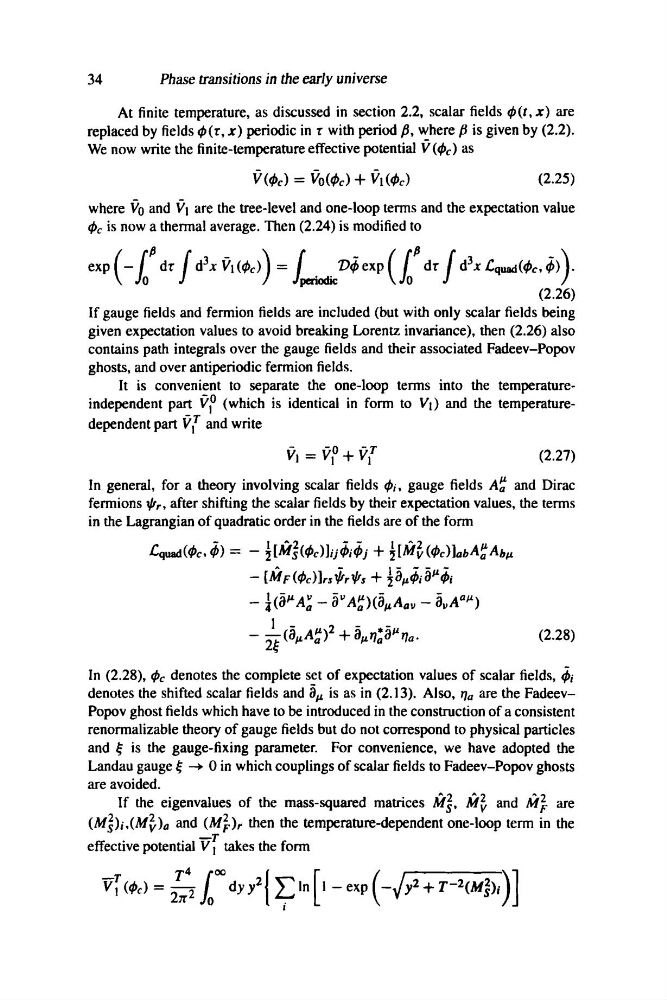
At finite temperature, as discussed in section 2.2, scalar fields ,p(t, x) are
replaced by fields ,p(r:, x) periodic in r: with period p, where fJ is given by (2.2).
We now write the finite-temperature effective potential V (,pc) as
V (t/Jc) = Vo( t/Jcl + VI (,pc)
(2.25)
where Vo and VI are the tree-level and one-loop terms and the expectation value
,pc is now a thermal average. Then (2.24) is modified to
exp (-foP dr: f d 3 x VI (,pcl) = Jperiodk1)~exp (foP dr: f d 3 x Cquad(t/Jc, ~»).
(2.26)
If gauge fields and fermion fields are included (but with only scalar fields being
given expectation values to avoid breaking Lorentz invariance), then (2.26) also
contains path integrals over the gauge fields and their associated Fadeev-Popov
ghosts. and over antiperiodic fermion fields.
It is convenient to separate the one-loop terms into the temperatureindependent part Vp (which is identical in form to VI) and the temperaturedependent part V{ and write
-
-0
-T
VI = VI + VI
(2.27)
In general, for a theory involving scalar fields ,pi, gauge fields A~ and Dirac
fermions tr. after shifting the scalar fields by their expectation values. the terms
in the Lagrangian of quadratic order in the fields are of the form
-
I A2
- -
I A2
£quad(t/Jc.,p) = - ,,[MS(,pc)]ij,pi,pj + ,,[Mv(,pc)]tlbA~Ab~
A
1 - - -
- [MF(,pcl1rstrts + "a~,pia~,pi
I -
-
-
- 4«W A; - a" A~)(a~AtI" - a"AtllL)
I (a- AII-}2 a- *0-11(2.28)
- 2~ 11- a + J.l.1]a 1]a'
In (2.28), ,pc denotes the complete set of expectation values of scalar fields, ~i
denotes the shifted scalar fields and aJ.l . is as in (2.13). Also, 1]a are the FadeevPopov ghost fields which have to be introduced in the construction of a consistent
renormalizable theory of gauge fields but do not correspond to physical particles
and ~ is the gauge-fixing parameter. For convenience, we have adopted the
Landau gauge ~ --+ 0 in which couplings of scalar fields to Fadeev-Popov ghosts
are avoided.
If the eigenvalues of the mass-squared matrices M~. M~ and M' f.. are
(M~)i.(M~)Q and (M'f..}r then the temperature-dependent one-loop term in the
effective potential vf takes the form
vf (,pc) = ~: 10
00 dy y2 { ~ I n [I -exp ( - / y2 + r- 2 (Mj);) ]
I
Phase transitions in the early universe
At finite temperature, as discussed in section 2.2, scalar fields ,p(t, x) are
replaced by fields ,p(r:, x) periodic in r: with period p, where fJ is given by (2.2).
We now write the finite-temperature effective potential V (,pc) as
V (t/Jc) = Vo( t/Jcl + VI (,pc)
(2.25)
where Vo and VI are the tree-level and one-loop terms and the expectation value
,pc is now a thermal average. Then (2.24) is modified to
exp (-foP dr: f d 3 x VI (,pcl) = Jperiodk1)~exp (foP dr: f d 3 x Cquad(t/Jc, ~»).
(2.26)
If gauge fields and fermion fields are included (but with only scalar fields being
given expectation values to avoid breaking Lorentz invariance), then (2.26) also
contains path integrals over the gauge fields and their associated Fadeev-Popov
ghosts. and over antiperiodic fermion fields.
It is convenient to separate the one-loop terms into the temperatureindependent part Vp (which is identical in form to VI) and the temperaturedependent part V{ and write
-
-0
-T
VI = VI + VI
(2.27)
In general, for a theory involving scalar fields ,pi, gauge fields A~ and Dirac
fermions tr. after shifting the scalar fields by their expectation values. the terms
in the Lagrangian of quadratic order in the fields are of the form
-
I A2
- -
I A2
£quad(t/Jc.,p) = - ,,[MS(,pc)]ij,pi,pj + ,,[Mv(,pc)]tlbA~Ab~
A
1 - - -
- [MF(,pcl1rstrts + "a~,pia~,pi
I -
-
-
- 4«W A; - a" A~)(a~AtI" - a"AtllL)
I (a- AII-}2 a- *0-11(2.28)
- 2~ 11- a + J.l.1]a 1]a'
In (2.28), ,pc denotes the complete set of expectation values of scalar fields, ~i
denotes the shifted scalar fields and aJ.l . is as in (2.13). Also, 1]a are the FadeevPopov ghost fields which have to be introduced in the construction of a consistent
renormalizable theory of gauge fields but do not correspond to physical particles
and ~ is the gauge-fixing parameter. For convenience, we have adopted the
Landau gauge ~ --+ 0 in which couplings of scalar fields to Fadeev-Popov ghosts
are avoided.
If the eigenvalues of the mass-squared matrices M~. M~ and M' f.. are
(M~)i.(M~)Q and (M'f..}r then the temperature-dependent one-loop term in the
effective potential vf takes the form
vf (,pc) = ~: 10
00 dy y2 { ~ I n [I -exp ( - / y2 + r- 2 (Mj);) ]
I