

26
The standard model of cosmology
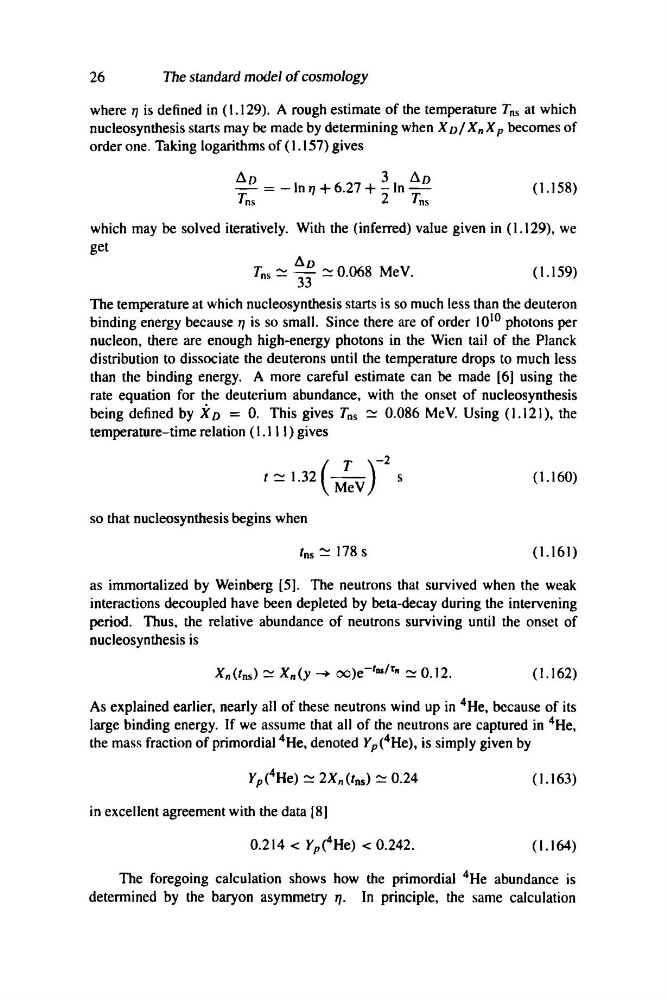
where 71 is defined in (1.129). A rough estimate of the temperature Tns at which
nucleosynthesis starts may be made by detenniningwhen XD/ XnXp becomes of
order one. Taking logarithms of (1.157) gives
-
~D
=
3 ~D
-ln7l+6.27+ - I n
(1.158)
Tns
2 Tns
which may be solved iteratively. With the (inferred) value given in (1.129), we
get
~D
Tns ~ 33 ~ 0.068 MeV.
( \.159)
The temperature at which nucleosynthesis starts is so much less than the deuteron
binding energy because 71 is so small. Since there are of order 1010 photons per
nucleon, there are enough high-energy photons in the Wien tail of the Planck
distribution to dissociate the deuterons until the temperature drops to much less
than the binding energy. A more careful estimate can be made [6] using the
rate equation for the deuterium abundance, with the onset of nucleosynthesis
being defined by XD = O. This gives Tns ~ 0.086 MeV. Using (1.I2l). the
temperature-time relation ( 1.111) gives
I ~ 1.32 ( _T
(1.I60)
MeV
)-2 s
so that nucleosynthesis begins when
Ins ~ 178 s
(1.161)
as immortalized by Weinberg [5]. The neutrons that survived when the weak
interactions decoupled have been depleted by beta-decay during the intervening
period. Thus, the relative abundance of neutrons surviving until the onset of
nucleosynthesis is
Xn(tns) ~ Xn(Y - oo)e- tDl TII
/
~ 0.12.
(1.162)
As explained earlier, nearly all of these neutrons wind up in 4He, because of its
large binding energy. If we assume that all of the neutrons are captured in 4He,
the mass fraction ofprimordial 4 He, denoted Yp (4He), is simply given by
Yp (4He) ~ 2Xn(tns) ~ 0.24
(1.163)
in excellent agreement with the data (8]
0.214 < Yp(4He) < 0.242.
(1.164)
The foregoing calculation shows how the primordial 4He abundance is
determined by the baryon asymmetry,.,. In principle, the same calculation
The standard model of cosmology
where 71 is defined in (1.129). A rough estimate of the temperature Tns at which
nucleosynthesis starts may be made by detenniningwhen XD/ XnXp becomes of
order one. Taking logarithms of (1.157) gives
-
~D
=
3 ~D
-ln7l+6.27+ - I n
(1.158)
Tns
2 Tns
which may be solved iteratively. With the (inferred) value given in (1.129), we
get
~D
Tns ~ 33 ~ 0.068 MeV.
( \.159)
The temperature at which nucleosynthesis starts is so much less than the deuteron
binding energy because 71 is so small. Since there are of order 1010 photons per
nucleon, there are enough high-energy photons in the Wien tail of the Planck
distribution to dissociate the deuterons until the temperature drops to much less
than the binding energy. A more careful estimate can be made [6] using the
rate equation for the deuterium abundance, with the onset of nucleosynthesis
being defined by XD = O. This gives Tns ~ 0.086 MeV. Using (1.I2l). the
temperature-time relation ( 1.111) gives
I ~ 1.32 ( _T
(1.I60)
MeV
)-2 s
so that nucleosynthesis begins when
Ins ~ 178 s
(1.161)
as immortalized by Weinberg [5]. The neutrons that survived when the weak
interactions decoupled have been depleted by beta-decay during the intervening
period. Thus, the relative abundance of neutrons surviving until the onset of
nucleosynthesis is
Xn(tns) ~ Xn(Y - oo)e- tDl TII
/
~ 0.12.
(1.162)
As explained earlier, nearly all of these neutrons wind up in 4He, because of its
large binding energy. If we assume that all of the neutrons are captured in 4He,
the mass fraction ofprimordial 4 He, denoted Yp (4He), is simply given by
Yp (4He) ~ 2Xn(tns) ~ 0.24
(1.163)
in excellent agreement with the data (8]
0.214 < Yp(4He) < 0.242.
(1.164)
The foregoing calculation shows how the primordial 4He abundance is
determined by the baryon asymmetry,.,. In principle, the same calculation