

Big-bang nucJeosynthesis
25
where
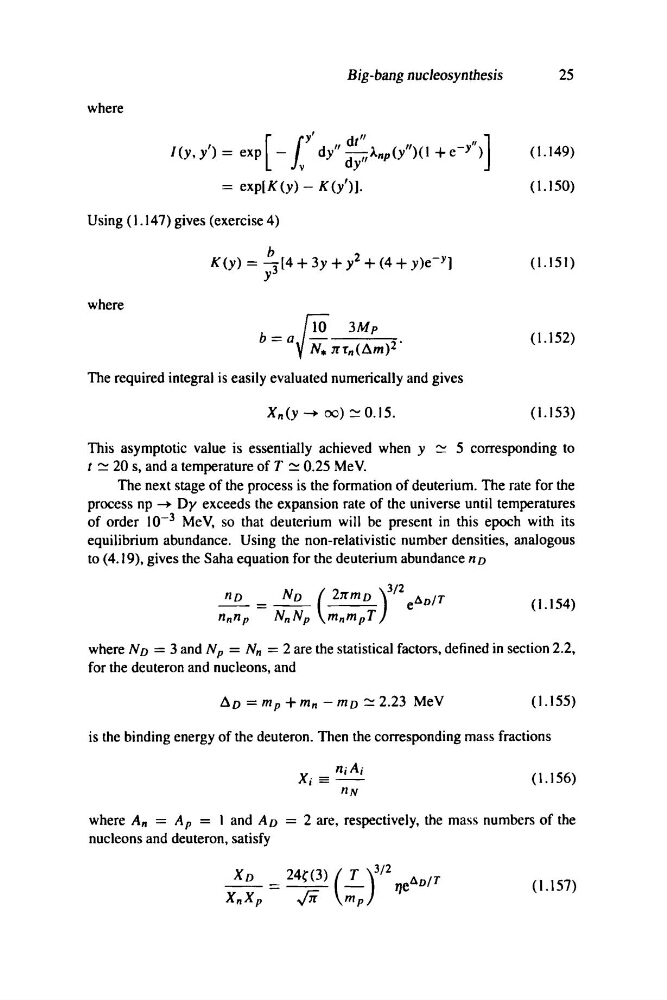
[ 1 ,' dt"
I(y, y'> = exp - v dy" dy"Anp(y")(1 + e- Y
/I ]
)
( 1.149)
= exp[K(y) - K(y')].
(1.150)
Using (1.147) gives (exercise 4)
b
K(y) = 3'[4 + 3y + i + (4 + y)e-']
(1.151)
y
where
b=a V
rw N. 1l'Tn(L\m)2'
3Mp _
( 1.152)
The required integral is easily evaluated numerically and gives
Xn(y ~ 00) ~ 0.15.
(1.153)
This asymptotic value is essentially achieved when y ~ 5 corresponding to
t ~ 20 s, and a temperature of T ~ 0.25 MeV.
The next stage of the process is the formation of deuterium. The rate for the
process np ~ Dy exceeds the expansion rate of the universe until temperatures
of order 10- 3 MeV, so that deuterium will be present in this epoch with its
eqUilibrium abundance. Using the non-relativistic number densities, analogous
to (4.19), gives the Saha equation for the deuterium abundance n D
3/2
nD
ND
21l'mD
4DIT
(1.154)
nnnp = NnN
(
)
p mnmpT
e
where N D = 3 and N p = Nn = 2 are the statistical factors, defined in section 2.2,
for the deuteron and nucleons, and
L\D=mp+mn-mD~2.23 MeV
(1.155)
is the binding energy of the deuteron. Then the corresponding mass fractions
X. _
.=-n;A;
(1.156)
nN
where All = Ap = I and AD = 2 are, respectively, the mass numbers of the
nucleons and deuteron, satisfy
3/2
~ = 24{(3) (!.... ) TJe40lT
(1.157)
XnXp
.fii mp
25
where
[ 1 ,' dt"
I(y, y'> = exp - v dy" dy"Anp(y")(1 + e- Y
/I ]
)
( 1.149)
= exp[K(y) - K(y')].
(1.150)
Using (1.147) gives (exercise 4)
b
K(y) = 3'[4 + 3y + i + (4 + y)e-']
(1.151)
y
where
b=a V
rw N. 1l'Tn(L\m)2'
3Mp _
( 1.152)
The required integral is easily evaluated numerically and gives
Xn(y ~ 00) ~ 0.15.
(1.153)
This asymptotic value is essentially achieved when y ~ 5 corresponding to
t ~ 20 s, and a temperature of T ~ 0.25 MeV.
The next stage of the process is the formation of deuterium. The rate for the
process np ~ Dy exceeds the expansion rate of the universe until temperatures
of order 10- 3 MeV, so that deuterium will be present in this epoch with its
eqUilibrium abundance. Using the non-relativistic number densities, analogous
to (4.19), gives the Saha equation for the deuterium abundance n D
3/2
nD
ND
21l'mD
4DIT
(1.154)
nnnp = NnN
(
)
p mnmpT
e
where N D = 3 and N p = Nn = 2 are the statistical factors, defined in section 2.2,
for the deuteron and nucleons, and
L\D=mp+mn-mD~2.23 MeV
(1.155)
is the binding energy of the deuteron. Then the corresponding mass fractions
X. _
.=-n;A;
(1.156)
nN
where All = Ap = I and AD = 2 are, respectively, the mass numbers of the
nucleons and deuteron, satisfy
3/2
~ = 24{(3) (!.... ) TJe40lT
(1.157)
XnXp
.fii mp