

Extreme black holes
291
Nevertheless, using a similar treatment, we shall see later that string theory can
account for the entropy but the associated microstates are non-perturbative. Even
then, the accounting has so far only been successful for certain special types of
black hole called 'extreme' black holes. We therefore first describe the features of
extreme black holes that are important for understanding the microscopic origin
of their entropy.
10.5 Extreme black holes
It might, in any case, be objected that associating perturbative string states with
black holes is absurd. The former are obtained by quantizing the string in
a flat background spacetime. How could they be equivalent to a black hole?
Nevertheless, certain perturbative states can be associated with 'extreme' black
holes. We have already noted the constraint M ~ IQI for the ReissnerNordstrom (RN) metrics (10.33). Metrics saturating this constraint are called
'extreme' (RN) black holes. The usual (supersymmetric) perturbative states in
string theory satisfy M ~ I Q\ and states saturating this inequality are called 'BPS
states' after Bogomolnyi [14] and Prasad and Sommerfield [15]. They have the
crucial property that their mass cannot receive quantum corrections and it is this
that allows their association with extreme black holes. As the string coupling
strength gs increases, the mass M of the perturbative state is unaltered, since
it is independent of gs classically. and because of supersymmetry, there are no
quantum corrections. However, the gravitational field of the state is determined by
G N M (in four dimensions) and G N is proportional to g;. Thus, as Cs increases,
the gravitational field increases, there is a back reaction on the perturbative state
and, eventually, it may be described by a curved spacetime with large curvature.
Thus, in principle at least, it might be possible to associate extreme black-hole
spacetimes with perturbative states.
The RN black hole looks like a natural starting place in the search for black
holes in string theory. We can think of the Einstein-Maxwell action (10.31) as the
bosonic part of the.N = 2 supergravity theory in four dimensions. The (massless)
gravity supermultiplet contains the graviton, two (fermionic) gravitinos and a
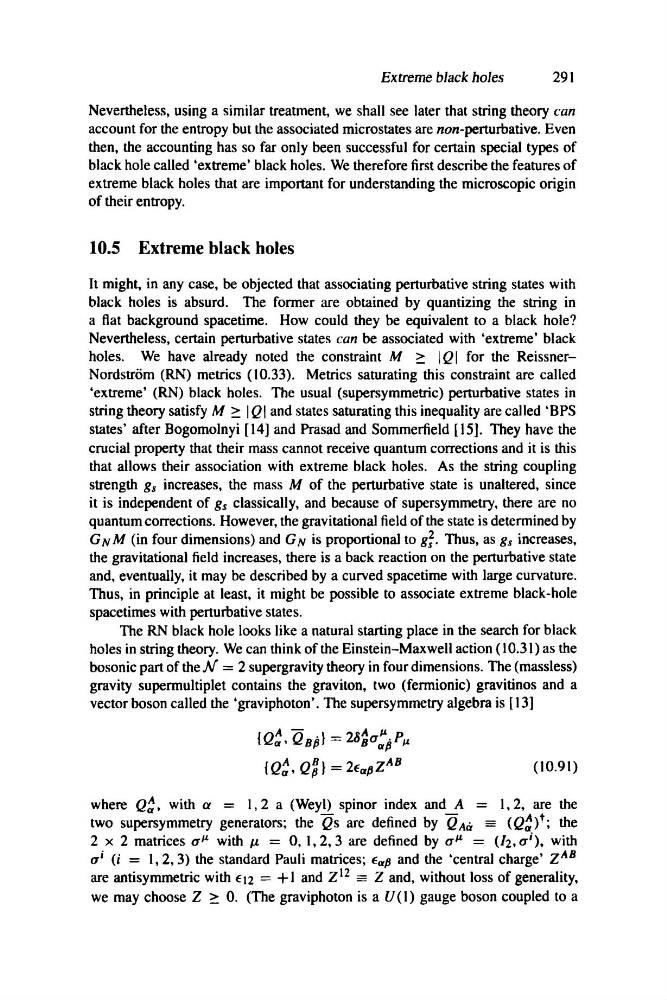
vector boson called the 'graviphoton'. The supersymmetry algebra is [13]
{Q:, QBP} = 28:a: p PIl
{Q:, Q:} = 2£a(JZAB
(10.91)
where Q:, with a = I, 2 a (Weyl) spinor index and A = I, 2, are the
two supersymmetry generators; the Qs are defined by QAa == (Q:)t; the
2 x 2 matrices all with IL = 0, 1,2,3 are defined by all = (h. ail, with
a; (i = 1,2,3) the standard Pauli matrices; £afj and the 'central charge' ZAB
are anti symmetric with £12 = +1 and Zl2 == Z and, without loss of generality,
we may choose Z ~ O. (The graviphoton is a U(l> gauge boson coupled to a
291
Nevertheless, using a similar treatment, we shall see later that string theory can
account for the entropy but the associated microstates are non-perturbative. Even
then, the accounting has so far only been successful for certain special types of
black hole called 'extreme' black holes. We therefore first describe the features of
extreme black holes that are important for understanding the microscopic origin
of their entropy.
10.5 Extreme black holes
It might, in any case, be objected that associating perturbative string states with
black holes is absurd. The former are obtained by quantizing the string in
a flat background spacetime. How could they be equivalent to a black hole?
Nevertheless, certain perturbative states can be associated with 'extreme' black
holes. We have already noted the constraint M ~ IQI for the ReissnerNordstrom (RN) metrics (10.33). Metrics saturating this constraint are called
'extreme' (RN) black holes. The usual (supersymmetric) perturbative states in
string theory satisfy M ~ I Q\ and states saturating this inequality are called 'BPS
states' after Bogomolnyi [14] and Prasad and Sommerfield [15]. They have the
crucial property that their mass cannot receive quantum corrections and it is this
that allows their association with extreme black holes. As the string coupling
strength gs increases, the mass M of the perturbative state is unaltered, since
it is independent of gs classically. and because of supersymmetry, there are no
quantum corrections. However, the gravitational field of the state is determined by
G N M (in four dimensions) and G N is proportional to g;. Thus, as Cs increases,
the gravitational field increases, there is a back reaction on the perturbative state
and, eventually, it may be described by a curved spacetime with large curvature.
Thus, in principle at least, it might be possible to associate extreme black-hole
spacetimes with perturbative states.
The RN black hole looks like a natural starting place in the search for black
holes in string theory. We can think of the Einstein-Maxwell action (10.31) as the
bosonic part of the.N = 2 supergravity theory in four dimensions. The (massless)
gravity supermultiplet contains the graviton, two (fermionic) gravitinos and a
vector boson called the 'graviphoton'. The supersymmetry algebra is [13]
{Q:, QBP} = 28:a: p PIl
{Q:, Q:} = 2£a(JZAB
(10.91)
where Q:, with a = I, 2 a (Weyl) spinor index and A = I, 2, are the
two supersymmetry generators; the Qs are defined by QAa == (Q:)t; the
2 x 2 matrices all with IL = 0, 1,2,3 are defined by all = (h. ail, with
a; (i = 1,2,3) the standard Pauli matrices; £afj and the 'central charge' ZAB
are anti symmetric with £12 = +1 and Zl2 == Z and, without loss of generality,
we may choose Z ~ O. (The graviphoton is a U(l> gauge boson coupled to a