

290
Black holes in string theory
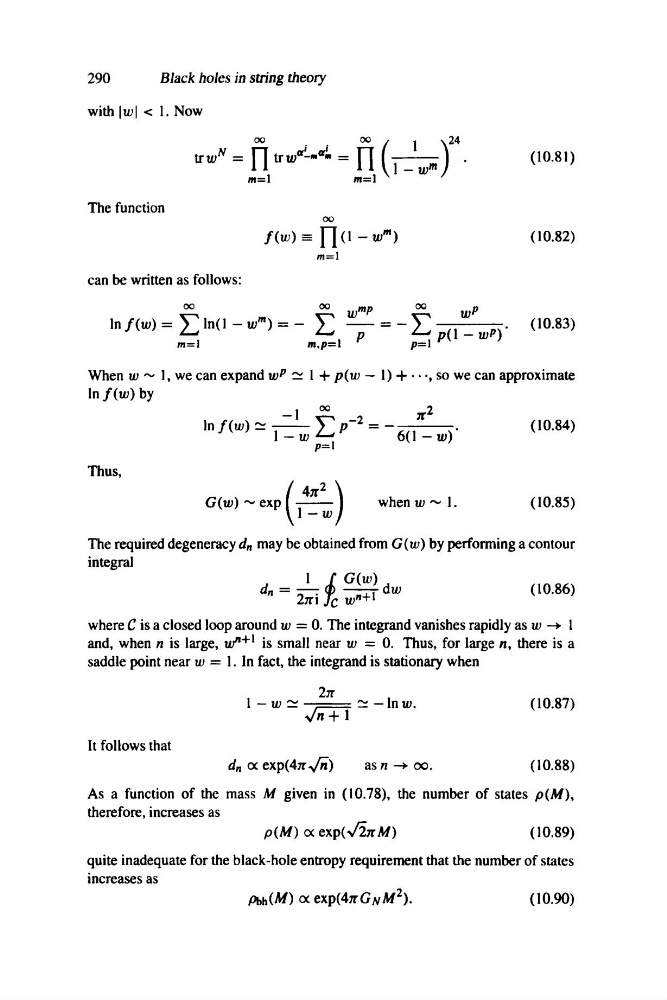
with Iwl < I. Now
00
n
00
trw N =
111=1
n trWcr'_cr~ =
(
111=1
I
)24
1 _ wm
(10.81)
The function
00
/(w) == n (I - Will)
(10.82)
111=1
can be written as follows:
00
P
In/(w) = ~In(l-wlll) = -
00
IIIp
00
~ ~ = - ~ w . (10.83)
~
~
p
~ p(l - wP)
111=)
lII,p=)
P=)
When w - I, we can expand w P ~ 1+ p(w - I) + ... , so we can approximate
In/(w) by
In /(w) ~ --=-!-. ~ p-2 = -~
(10.84)
I-w ~
-P=)
Thus,
411'2 )
G(w) - exp ( I _ w
when w - I.
(10.85)
The required degeneracy d,. may be obtained from G(w) by performing a contour
integral
d,. = _1_ 1. G(w)
(10.86)
21ri JC w,.+1 dw
where C is a closed loop around w = O. The integrand vanishes rapidly as w -+ I
and, when n is large, w"+) is small near w = O. Thus, for large n, there is a
saddle point near w = I. In fact, the integrand is stationary when
I-w- - .In+1 2rr ~ -Inw.
(10.87)
It follows that
d,. ex exp( 411' viii)
as n -+ 00.
(10.88)
As a function of the mass M given in (10.78). the number of states p(M),
therefore. increases as
p(M) ex exp(v'21rM)
(10.89)
quite inadequate for the black-hole entropy requirement that the number of states
increases as
Pbh(M) ex exp(4rrGNM 2 ).
(10.90)
Black holes in string theory
with Iwl < I. Now
00
n
00
trw N =
111=1
n trWcr'_cr~ =
(
111=1
I
)24
1 _ wm
(10.81)
The function
00
/(w) == n (I - Will)
(10.82)
111=1
can be written as follows:
00
P
In/(w) = ~In(l-wlll) = -
00
IIIp
00
~ ~ = - ~ w . (10.83)
~
~
p
~ p(l - wP)
111=)
lII,p=)
P=)
When w - I, we can expand w P ~ 1+ p(w - I) + ... , so we can approximate
In/(w) by
In /(w) ~ --=-!-. ~ p-2 = -~
(10.84)
I-w ~
-P=)
Thus,
411'2 )
G(w) - exp ( I _ w
when w - I.
(10.85)
The required degeneracy d,. may be obtained from G(w) by performing a contour
integral
d,. = _1_ 1. G(w)
(10.86)
21ri JC w,.+1 dw
where C is a closed loop around w = O. The integrand vanishes rapidly as w -+ I
and, when n is large, w"+) is small near w = O. Thus, for large n, there is a
saddle point near w = I. In fact, the integrand is stationary when
I-w- - .In+1 2rr ~ -Inw.
(10.87)
It follows that
d,. ex exp( 411' viii)
as n -+ 00.
(10.88)
As a function of the mass M given in (10.78). the number of states p(M),
therefore. increases as
p(M) ex exp(v'21rM)
(10.89)
quite inadequate for the black-hole entropy requirement that the number of states
increases as
Pbh(M) ex exp(4rrGNM 2 ).
(10.90)