

280
Black holes in string theory
For a general discussion of what can be seen from infinity and. therefore, of
the event horizon, we need to determine the light cone structure of spacetime. For
this purpose, it is useful to do a conformal transformation of the metric
g",,, -+ Q2gll,,·
(10.23)
Such a transformation leaves the light-cone structure unaffected but can be chosen
so as to compress everything near infinity and bring it to a finite distance. For
Minkowski space, the line element is
ds 2 = dt 2 - dr 2 - r2 dQ~.
(10.24)
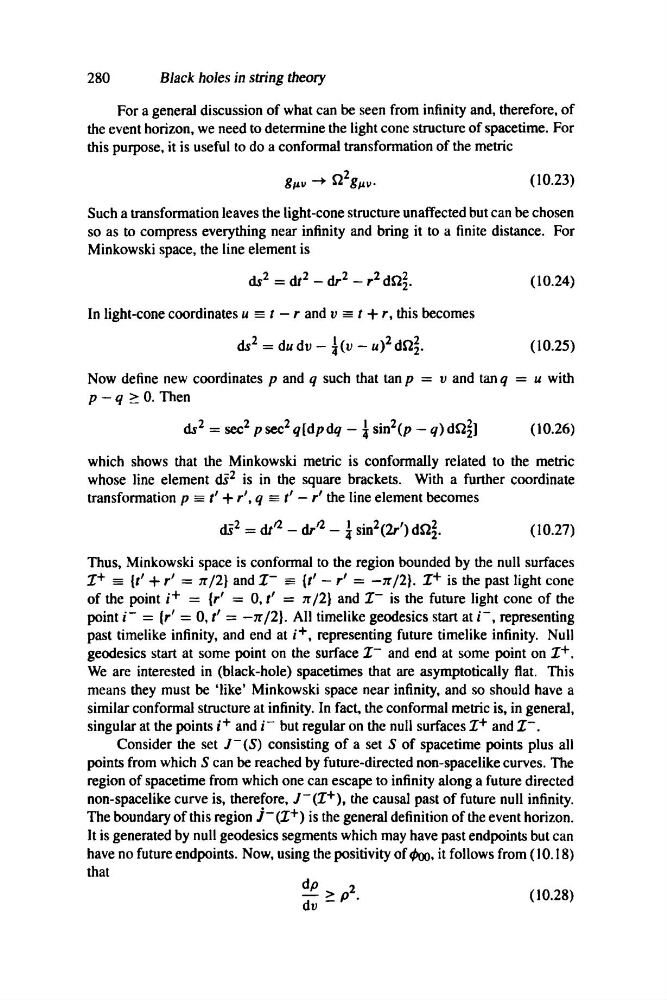
In light-cone coordinates u == t - r and v == t + r. this becomes
ds 2 = du dv - i(v - u)2 dQ~.
(10.25)
Now define new coordinates p and q such that tan p = v and tan q = u with
p-q ~ O. Then
ds 2 = sec 2 P sec 2 q[dpdq - ! sin2(p - q) dQ~]
(10.26)
which shows that the Minkowski metric is conformally related to the metric
whose line element dS 2 is in the square brackets. With a further coordinate
transformation p == t' + r'. q == t' - r' the line element becomes
dS 2 = dt f2 - dr f2 - i sin 2 (lr') d~.
(10.27)
Thus, Minkowski space is conformal to the region bounded by the null surfaces
Z+ == It' + r' = '!r/2} and Z- == It' - r' = -'!r/2}. Z+ is the past light cone
of the point;+ = {r' = O. t' = '!r 12} and Z- is the future light cone of the
point;- = {r' = O. t' = -'!r/2}. All timelike geodesics start at;-. representing
past timelike infinity. and end at i+. representing future timelike infinity. Null
geodesics start at some point on the surface Z- and end at some point on Z+.
We are interested in (black-hole) spacetimes that are asymptotically flat. This
means they must be 'like' Minkowski space near infinity. and so should have a
similar conformal structure at infinity. In fact, the conformal metric is. in general,
singular at the points i + and i-but regular on the null surfaces Z+ and Z- .
Consider the set J-(S) consisting of a set S of spacetiJne points plus all
points from which S can be reached by future-directed non-space like curves. The
region of spacetime from which one can escape to infinity along a future directed
non-spacelike curve is. therefore. J-(Z+). the causal past of future null infinity.
The boundary of this region j- (Z+) is the general definition of the event horizon.
It is generated by null geodesics segments which may have past endpoints but can
have no futureendpoints. Now. using the positivity of 4>00. it follows from (10.18)
that
dp > p2.
(10.28)
dv
Black holes in string theory
For a general discussion of what can be seen from infinity and. therefore, of
the event horizon, we need to determine the light cone structure of spacetime. For
this purpose, it is useful to do a conformal transformation of the metric
g",,, -+ Q2gll,,·
(10.23)
Such a transformation leaves the light-cone structure unaffected but can be chosen
so as to compress everything near infinity and bring it to a finite distance. For
Minkowski space, the line element is
ds 2 = dt 2 - dr 2 - r2 dQ~.
(10.24)
In light-cone coordinates u == t - r and v == t + r. this becomes
ds 2 = du dv - i(v - u)2 dQ~.
(10.25)
Now define new coordinates p and q such that tan p = v and tan q = u with
p-q ~ O. Then
ds 2 = sec 2 P sec 2 q[dpdq - ! sin2(p - q) dQ~]
(10.26)
which shows that the Minkowski metric is conformally related to the metric
whose line element dS 2 is in the square brackets. With a further coordinate
transformation p == t' + r'. q == t' - r' the line element becomes
dS 2 = dt f2 - dr f2 - i sin 2 (lr') d~.
(10.27)
Thus, Minkowski space is conformal to the region bounded by the null surfaces
Z+ == It' + r' = '!r/2} and Z- == It' - r' = -'!r/2}. Z+ is the past light cone
of the point;+ = {r' = O. t' = '!r 12} and Z- is the future light cone of the
point;- = {r' = O. t' = -'!r/2}. All timelike geodesics start at;-. representing
past timelike infinity. and end at i+. representing future timelike infinity. Null
geodesics start at some point on the surface Z- and end at some point on Z+.
We are interested in (black-hole) spacetimes that are asymptotically flat. This
means they must be 'like' Minkowski space near infinity. and so should have a
similar conformal structure at infinity. In fact, the conformal metric is. in general,
singular at the points i + and i-but regular on the null surfaces Z+ and Z- .
Consider the set J-(S) consisting of a set S of spacetiJne points plus all
points from which S can be reached by future-directed non-space like curves. The
region of spacetime from which one can escape to infinity along a future directed
non-spacelike curve is. therefore. J-(Z+). the causal past of future null infinity.
The boundary of this region j- (Z+) is the general definition of the event horizon.
It is generated by null geodesics segments which may have past endpoints but can
have no futureendpoints. Now. using the positivity of 4>00. it follows from (10.18)
that
dp > p2.
(10.28)
dv