

Black-hole event horizons
279
Then
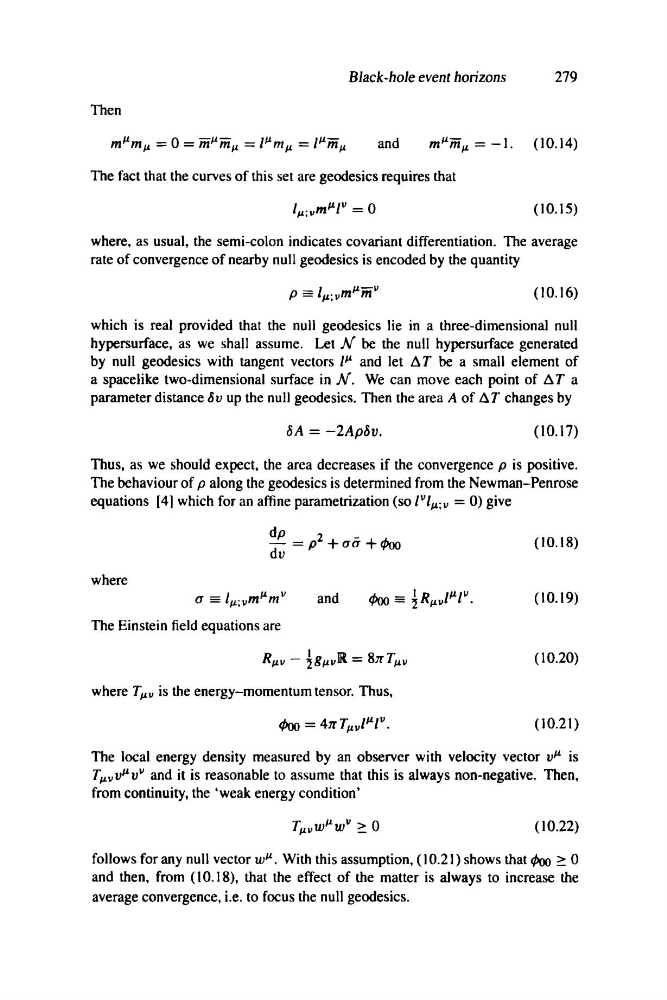
m"'m", = 0 = m"'m", = I"'m", = I"'m", and m"'m", = -I. (10.14)
The fact that the curves of this set are geodesics requires that
I",;vm"r' = 0
( 10.15)
where. as usual. the semi-colon indicates covariant differentiation. The average
rate of convergence of nearby null geodesics is encoded by the quantity
p == I,,;vm"'m v
(10.16)
which is real provided that the null geodesics lie in a three-dimensional null
hypersurface, as we shall assume. Let N be the null hypersurface generated
by null geodesics with tangent vectors I" and let AT be a small element of
a space like two-dimensional surface in N. We can move each point of AT a
parameter distance c5v up the null geodesics. Then the area A of AT changes by
Thus, as we should expect. the area decreases if the convergence p is positive.
The behaviour of p along the geodesics is determined from the Newman-Penrose
equations [4] which for an affine parametrization (so IVI,,;v = 0) give
dp = p2 + uu + l/Joo
(10.18)
dv
where
u == ',,;lIm"mv
and
l/Joo == ! R",II/" Ill.
(10.19)
The Einstein field equations are
R"v - ! g"IIR = 8rr T"II
(10.20)
where T"v is the energy-momentum tensor. Thus,
l/Joo = 4rrT"'II/"/II.
(10.21)
The local energy density measured by an observer with velocity vector vI' is
Tl'lIv"'vll and it is reasonable to assume that this is always non-negative. Then.
from continuity, the 'weak energy condition'
Tl'v wl'w ll ::: 0
(10.22)
follows for any null vector w"'. With this assumption. (10.21) shows that l/Joo ::: 0
and then, from (10.18), that the effect of the matter is always to increase the
average convergence, i.e. to focus the null geodesics.
279
Then
m"'m", = 0 = m"'m", = I"'m", = I"'m", and m"'m", = -I. (10.14)
The fact that the curves of this set are geodesics requires that
I",;vm"r' = 0
( 10.15)
where. as usual. the semi-colon indicates covariant differentiation. The average
rate of convergence of nearby null geodesics is encoded by the quantity
p == I,,;vm"'m v
(10.16)
which is real provided that the null geodesics lie in a three-dimensional null
hypersurface, as we shall assume. Let N be the null hypersurface generated
by null geodesics with tangent vectors I" and let AT be a small element of
a space like two-dimensional surface in N. We can move each point of AT a
parameter distance c5v up the null geodesics. Then the area A of AT changes by
Thus, as we should expect. the area decreases if the convergence p is positive.
The behaviour of p along the geodesics is determined from the Newman-Penrose
equations [4] which for an affine parametrization (so IVI,,;v = 0) give
dp = p2 + uu + l/Joo
(10.18)
dv
where
u == ',,;lIm"mv
and
l/Joo == ! R",II/" Ill.
(10.19)
The Einstein field equations are
R"v - ! g"IIR = 8rr T"II
(10.20)
where T"v is the energy-momentum tensor. Thus,
l/Joo = 4rrT"'II/"/II.
(10.21)
The local energy density measured by an observer with velocity vector vI' is
Tl'lIv"'vll and it is reasonable to assume that this is always non-negative. Then.
from continuity, the 'weak energy condition'
Tl'v wl'w ll ::: 0
(10.22)
follows for any null vector w"'. With this assumption. (10.21) shows that l/Joo ::: 0
and then, from (10.18), that the effect of the matter is always to increase the
average convergence, i.e. to focus the null geodesics.