

Pre-big-bang cosmology
271
H
t
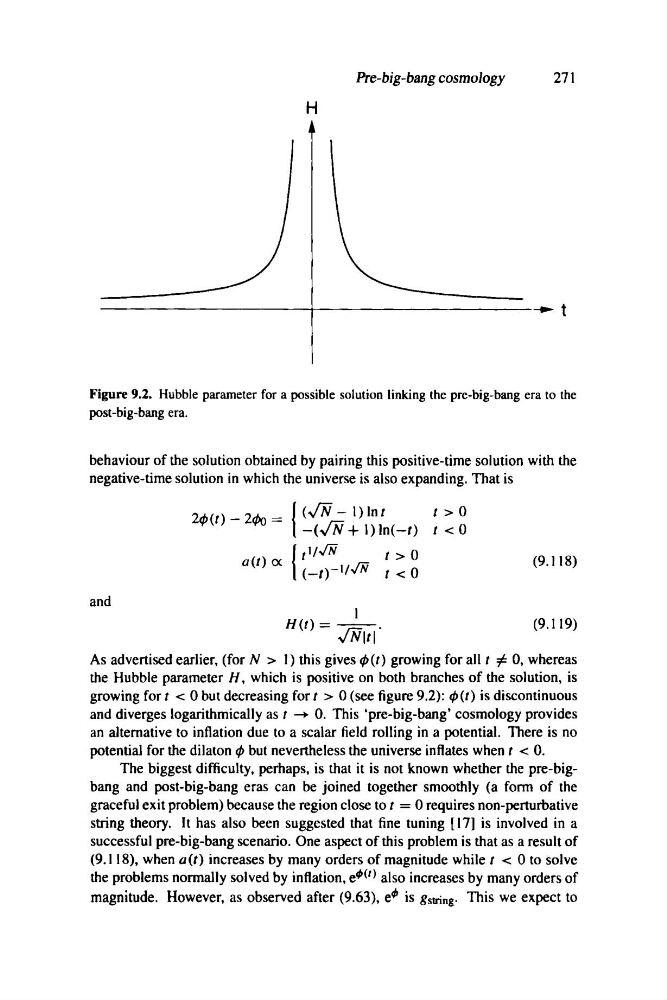
Figure 9.2. Hubble parameter for a possible solution linking the pre-big-bang era to the
post-big-bang era.
behaviour of the solution obtained by pairing this positive-time solution with the
negative-time solution in which the universe is also expanding. That is
{ (.IN - I) In I
I> 0
2tfJ(l) - 24>0 =
-(.IN + 1)ln(-I) 1<0
II/./N
I > 0
{
(9.118)
a(l) QC
(_t)-I/./N 1<0
and
H(I) = r.:;
I
.
(9.119)
",NIII
As advertised earlier, (for N > I) this gives tfJ(l) growing for all I =F 0, whereas
the Hubble parameter H, which is positive on both branches of the solution, is
growing for I < 0 but decreasing for I > 0 (see figure 9.2): tfJ(l) is discontinuous
and diverges logarithmically as I -+ O. This 'pre-big-bang' cosmology provides
an alternative to inflation due to a scalar field rolling in a potential. There is no
potential for the dilaton tfJ but nevertheless the universe inflates when I < O.
The biggest difficulty, perhaps, is that it is not known whether the pre-bigbang and post-big-bang eras can be joined together smoothly (a form of the
graceful exit problem) because the region close to I = 0 requires non-perturbative
string theory. It has also been suggested that fine tuning [17] is involved in a
successful pre-big-bang scenario. One aspect of this problem is that as a result of
(9.118), when a(t) increases by many orders of magnitude while I < 0 to solve
the problems nonnally solved by inflation, e~(') also increases by many orders of
magnitude. However, as observed after (9.63), e~ is gsbing' This we expect to
271
H
t
Figure 9.2. Hubble parameter for a possible solution linking the pre-big-bang era to the
post-big-bang era.
behaviour of the solution obtained by pairing this positive-time solution with the
negative-time solution in which the universe is also expanding. That is
{ (.IN - I) In I
I> 0
2tfJ(l) - 24>0 =
-(.IN + 1)ln(-I) 1<0
II/./N
I > 0
{
(9.118)
a(l) QC
(_t)-I/./N 1<0
and
H(I) = r.:;
I
.
(9.119)
",NIII
As advertised earlier, (for N > I) this gives tfJ(l) growing for all I =F 0, whereas
the Hubble parameter H, which is positive on both branches of the solution, is
growing for I < 0 but decreasing for I > 0 (see figure 9.2): tfJ(l) is discontinuous
and diverges logarithmically as I -+ O. This 'pre-big-bang' cosmology provides
an alternative to inflation due to a scalar field rolling in a potential. There is no
potential for the dilaton tfJ but nevertheless the universe inflates when I < O.
The biggest difficulty, perhaps, is that it is not known whether the pre-bigbang and post-big-bang eras can be joined together smoothly (a form of the
graceful exit problem) because the region close to I = 0 requires non-perturbative
string theory. It has also been suggested that fine tuning [17] is involved in a
successful pre-big-bang scenario. One aspect of this problem is that as a result of
(9.118), when a(t) increases by many orders of magnitude while I < 0 to solve
the problems nonnally solved by inflation, e~(') also increases by many orders of
magnitude. However, as observed after (9.63), e~ is gsbing' This we expect to