

270
Superstring cosmology
three dimensions to follow, e.g. cosmology could start with the full nine spatial
dimensions of the heterotic string. With the ansatz of (9.65) and (9.64), the action
is given by (9.69) leading to the field equations (9.72) to (9.74). Making the
simple assumption that the universe starts empty, the thennal contributions may
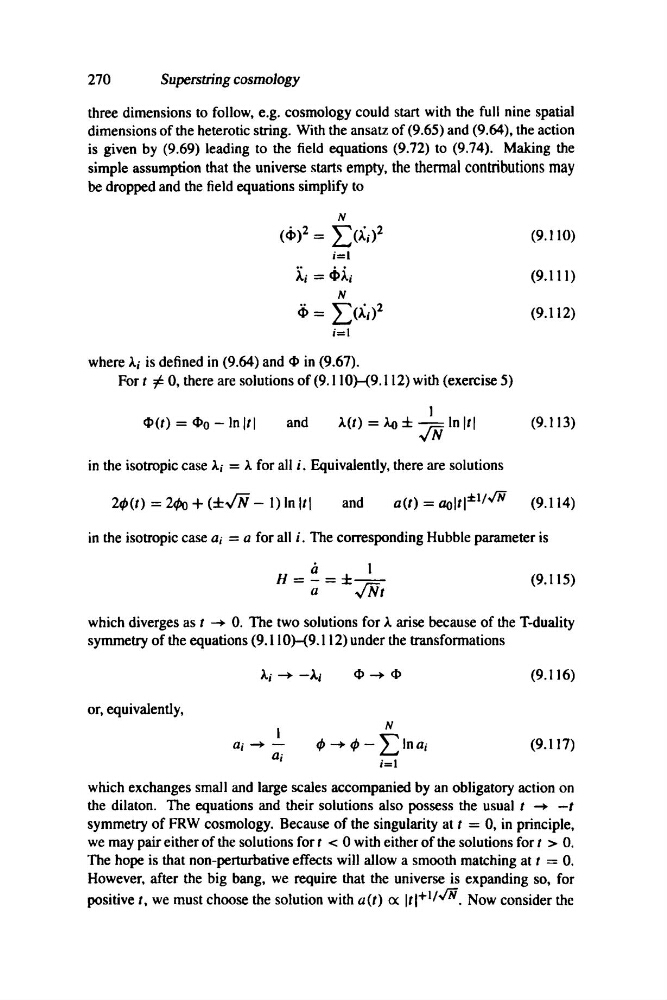
be dropped and the field equations simplify to
N
(ti»2 = LO:;)2
(9.110)
;=1
i , = ti>il
(9.111)
N
ii> = L(A;)2
(9.112)
i=1
where Ai is defined in (9.64) and <1> in (9.67).
For t =1= 0, there are solutions of (9.110)-(9.112) with (exercise 5)
<1>(t) = <1>0 -In It I and A(t) = l() ± _1_lnltl ./N
(9.113)
in the isotropic case Ai = A for all ;. Equivalently, there are solutions
2I;(t) = 2t/Jo + (±,.,/N - 1) In It I and a(t) = aoltl±l/JN (9.114)
in the isotropic case aj = a for all i. The corresponding Hubble parameter is
a
I
H=-=±(9.115)
a
./Nt
which diverges as t -+ O. The two solutions for A arise because of the T-duality
symmetry of the equations (9.110)-(9.112) under the transformations
A; -+ -AI
<1>-+<1>
(9.116)
or, equivalently,
N
aj -+tP -+ tP -
aj
L In aj
(9.117)
1=1
which exchanges small and large scales accompanied by an obligatory action on
the dilaton. The equations and their solutions also possess the usual t -+ -t
symmetry of FRW cosmology. Because of the singularity at t = 0, in principle,
we may pair either of the solutions for t < 0 with either of the solutions for t > O.
The hope is that non-perturbative effects will allow a smooth matching at t = O.
However, after the big bang, we require that the universe is expanding so, for
positive t, we must choose the solution with a(t) ex Itl+ I / JN . Now consider the
Superstring cosmology
three dimensions to follow, e.g. cosmology could start with the full nine spatial
dimensions of the heterotic string. With the ansatz of (9.65) and (9.64), the action
is given by (9.69) leading to the field equations (9.72) to (9.74). Making the
simple assumption that the universe starts empty, the thennal contributions may
be dropped and the field equations simplify to
N
(ti»2 = LO:;)2
(9.110)
;=1
i , = ti>il
(9.111)
N
ii> = L(A;)2
(9.112)
i=1
where Ai is defined in (9.64) and <1> in (9.67).
For t =1= 0, there are solutions of (9.110)-(9.112) with (exercise 5)
<1>(t) = <1>0 -In It I and A(t) = l() ± _1_lnltl ./N
(9.113)
in the isotropic case Ai = A for all ;. Equivalently, there are solutions
2I;(t) = 2t/Jo + (±,.,/N - 1) In It I and a(t) = aoltl±l/JN (9.114)
in the isotropic case aj = a for all i. The corresponding Hubble parameter is
a
I
H=-=±(9.115)
a
./Nt
which diverges as t -+ O. The two solutions for A arise because of the T-duality
symmetry of the equations (9.110)-(9.112) under the transformations
A; -+ -AI
<1>-+<1>
(9.116)
or, equivalently,
N
aj -+tP -+ tP -
aj
L In aj
(9.117)
1=1
which exchanges small and large scales accompanied by an obligatory action on
the dilaton. The equations and their solutions also possess the usual t -+ -t
symmetry of FRW cosmology. Because of the singularity at t = 0, in principle,
we may pair either of the solutions for t < 0 with either of the solutions for t > O.
The hope is that non-perturbative effects will allow a smooth matching at t = O.
However, after the big bang, we require that the universe is expanding so, for
positive t, we must choose the solution with a(t) ex Itl+ I / JN . Now consider the