

230
Inflation in supergravity
To allow for quantum fluctations V"(tPi) should be evaluated at tPi ,.." Ho rather
than tPi ,.." O. (See, for example, [3].) A rough estimate may be made by keeping
only the term linear in tP in V'(tP). Then,
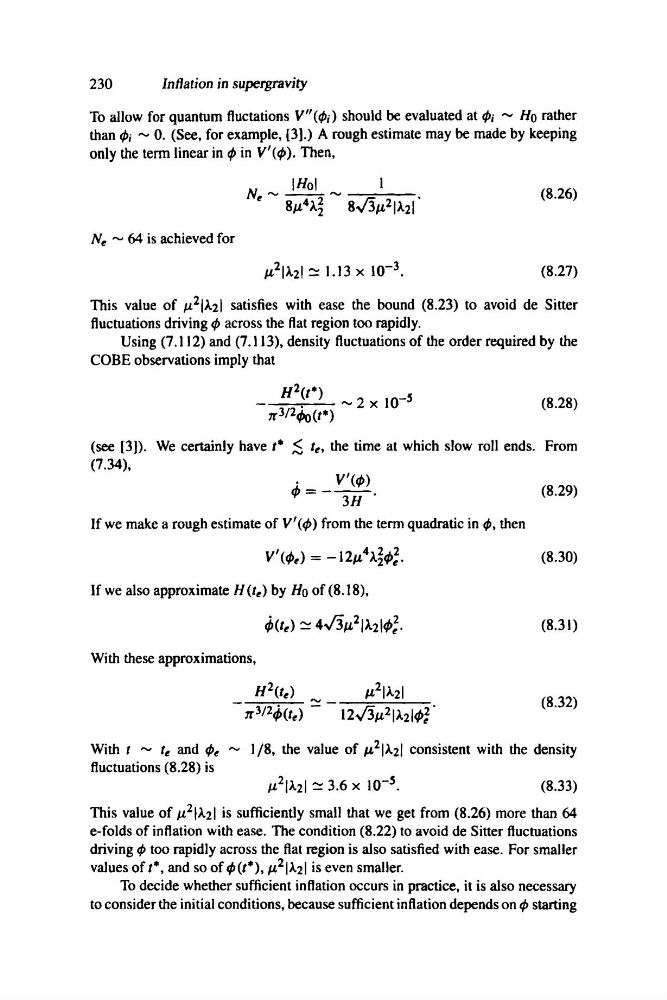
N~"'" IHol,.."
1
(S.26)
SIL4A~
SJ31L2IA21'
N~ ,.." 64 is achieved for
1L 2 1A21:::::: 1.13 x 10- 3 •
(S.27)
This value of 1L21A21 satisfies with ease the bound (S.23) to avoid de Sitter
fluctuations driving tP across the flat region too rapidly.
Using (7.112) and (7.113), density fluctuations of the order required by the
COBE observations imply that
H2~t·) ,.." 2 x 10-'
(8.28)
7r 3 / 2 t/)o(t·)
(see [3]). We certainly have t· ~ t~, the time at which slow roll ends. From
(7.34),
;. = _ V'(tP)
' *'
(8.29)
3H .
If we make a rough estimate of V' (tP) from the tenn quadratic in tP, then
V'(tP~) = -121L4A~tP:.
(8.30)
If we also approximate H (t~) by Ho of (S.18),
•
';;2
2
tP{t~) :::::: 4v31L IA2ItP~.
(8.31)
With these approximations,
H2(t~)
1L21A21
7r3/2~(t~)
(8.32)
:::::: - 12J31L2IA21q;~'
With t ,.." t~ and tPe
1/8, the value of 1L21A21 consistent with the density
fluctuations (S.28) is
1L21A21 :::::: 3.6 x 10-'.
(8.33)
This value of 1L21A21 is sufficiently small that we get from (S.26) more than 64
e-folds of inflation with ease. The condition (8.22) to avoid de Sitter fluctuations
driving tP too rapidly across the flat region is also satisfied with ease. For smaller
values of '., and so of tP('·), 1L21A21 is even smaller.
To decide whether sufficient inflation occurs in practice, it is also necessary
to consider the initial conditions, because sufficient inflation depends on tP starting
Inflation in supergravity
To allow for quantum fluctations V"(tPi) should be evaluated at tPi ,.." Ho rather
than tPi ,.." O. (See, for example, [3].) A rough estimate may be made by keeping
only the term linear in tP in V'(tP). Then,
N~"'" IHol,.."
1
(S.26)
SIL4A~
SJ31L2IA21'
N~ ,.." 64 is achieved for
1L 2 1A21:::::: 1.13 x 10- 3 •
(S.27)
This value of 1L21A21 satisfies with ease the bound (S.23) to avoid de Sitter
fluctuations driving tP across the flat region too rapidly.
Using (7.112) and (7.113), density fluctuations of the order required by the
COBE observations imply that
H2~t·) ,.." 2 x 10-'
(8.28)
7r 3 / 2 t/)o(t·)
(see [3]). We certainly have t· ~ t~, the time at which slow roll ends. From
(7.34),
;. = _ V'(tP)
' *'
(8.29)
3H .
If we make a rough estimate of V' (tP) from the tenn quadratic in tP, then
V'(tP~) = -121L4A~tP:.
(8.30)
If we also approximate H (t~) by Ho of (S.18),
•
';;2
2
tP{t~) :::::: 4v31L IA2ItP~.
(8.31)
With these approximations,
H2(t~)
1L21A21
7r3/2~(t~)
(8.32)
:::::: - 12J31L2IA21q;~'
With t ,.." t~ and tPe
1/8, the value of 1L21A21 consistent with the density
fluctuations (S.28) is
1L21A21 :::::: 3.6 x 10-'.
(8.33)
This value of 1L21A21 is sufficiently small that we get from (S.26) more than 64
e-folds of inflation with ease. The condition (8.22) to avoid de Sitter fluctuations
driving tP too rapidly across the flat region is also satisfied with ease. For smaller
values of '., and so of tP('·), 1L21A21 is even smaller.
To decide whether sufficient inflation occurs in practice, it is also necessary
to consider the initial conditions, because sufficient inflation depends on tP starting