

Models of super gravity inflation
229
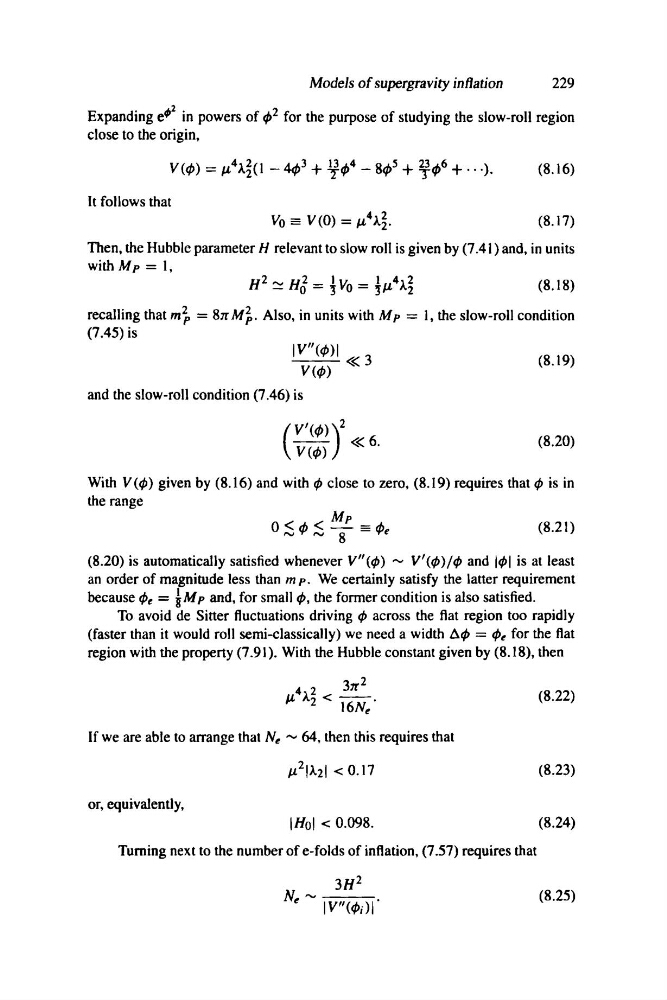
Expanding e~ in powers of t/J2 for the purpose of studying the slow-roll region
close to the origin,
V(t/J) = #lh.~(l - 44>3 + ¥t/J4 - &/>s + ¥t/J6 + ... ).
(8.16)
It follows that
Vo == V(O) = IL4}.~.
(8.17)
Then, the Hubble parameter H relevant to slow roll is given by (7.41) and, in units
with Mp = I,
H 2 ..... H2 _ 1 Vi _ 1 4,2
(8.18)
-
0 - J 0 - JIL 11.2
recalling that m~ = 8:rr M~. Also, in units with Mp = I, the slow-roll condition
(7.45) is
IV" (t/J)I
(8.19)
V(t/J) «3
and the slow-roll condition (7.46) is
V'(t/J»)2
(
(8.20)
V(t/J)
«6.
With V (t/J) given by (8.16) and with t/J close to zero, (8.19) requires that t/J is in
the range
Mp
O~t/J ~ 8 ==t/Je
(8.21)
(8.20) is automatically satisfied whenever V"(t/J) ..... V'(t/J)/t/J and It/JI is at least
an order of magnitude less than m p. We certainly satisfy the latter requirement
because t/Je = iMp and, for small t/J, the former condition is also satisfied.
To avoid de Sitter fluctuations driving t/J across the flat region too rapidly
(faster than it would roll semi-classically) we need a width !1t/J = t/Je for the flat
region with the property (7.91). With the Hubble constant given by (8.18), then
3:rr 2
,,4}.2 < __ .
(8.22)
,... 2
16N e
If we are able to arrange that Ne ..... 64, then this requires that
J.L 2 1}.21 < 0.17
(8.23)
or, equivalently,
IHol < 0.098.
(8.24)
Turning next to the number of e-folds of inflation, (7.57) requires that
Ne ..... _ 3H
2
(8.25)
229
Expanding e~ in powers of t/J2 for the purpose of studying the slow-roll region
close to the origin,
V(t/J) = #lh.~(l - 44>3 + ¥t/J4 - &/>s + ¥t/J6 + ... ).
(8.16)
It follows that
Vo == V(O) = IL4}.~.
(8.17)
Then, the Hubble parameter H relevant to slow roll is given by (7.41) and, in units
with Mp = I,
H 2 ..... H2 _ 1 Vi _ 1 4,2
(8.18)
-
0 - J 0 - JIL 11.2
recalling that m~ = 8:rr M~. Also, in units with Mp = I, the slow-roll condition
(7.45) is
IV" (t/J)I
(8.19)
V(t/J) «3
and the slow-roll condition (7.46) is
V'(t/J»)2
(
(8.20)
V(t/J)
«6.
With V (t/J) given by (8.16) and with t/J close to zero, (8.19) requires that t/J is in
the range
Mp
O~t/J ~ 8 ==t/Je
(8.21)
(8.20) is automatically satisfied whenever V"(t/J) ..... V'(t/J)/t/J and It/JI is at least
an order of magnitude less than m p. We certainly satisfy the latter requirement
because t/Je = iMp and, for small t/J, the former condition is also satisfied.
To avoid de Sitter fluctuations driving t/J across the flat region too rapidly
(faster than it would roll semi-classically) we need a width !1t/J = t/Je for the flat
region with the property (7.91). With the Hubble constant given by (8.18), then
3:rr 2
,,4}.2 < __ .
(8.22)
,... 2
16N e
If we are able to arrange that Ne ..... 64, then this requires that
J.L 2 1}.21 < 0.17
(8.23)
or, equivalently,
IHol < 0.098.
(8.24)
Turning next to the number of e-folds of inflation, (7.57) requires that
Ne ..... _ 3H
2
(8.25)