

220
Inflationary cosmology
For 18p/ pi '" 10- 5 and Ne(~(t·» = 50, we have
A:::: 3 x 10- 14 •
(7.171)
The spectral index discussed in section 7.12 has the value given by
n(k) - I = -0.06
(7.172)
7.11 Hybrid inflation
In the slow-roll inflation models discussed so far, the inflaton ~ which is
undergoing slow roll is also responsible for the vacuum energy density that drives
the inflationary expansion of the universe. In 'hybrid' inflation [20], two (real)
scalar fields ~ and '" are involved. The field ~ undergoes slow roll but most of
the vacuum energy is due to the presence of",. When the value of", drops below
some critical value ~c. the field", is destabilized and it rolls from a vacuum with
positive energy density to the vacuum with zero energy density. so that inflation
ends.
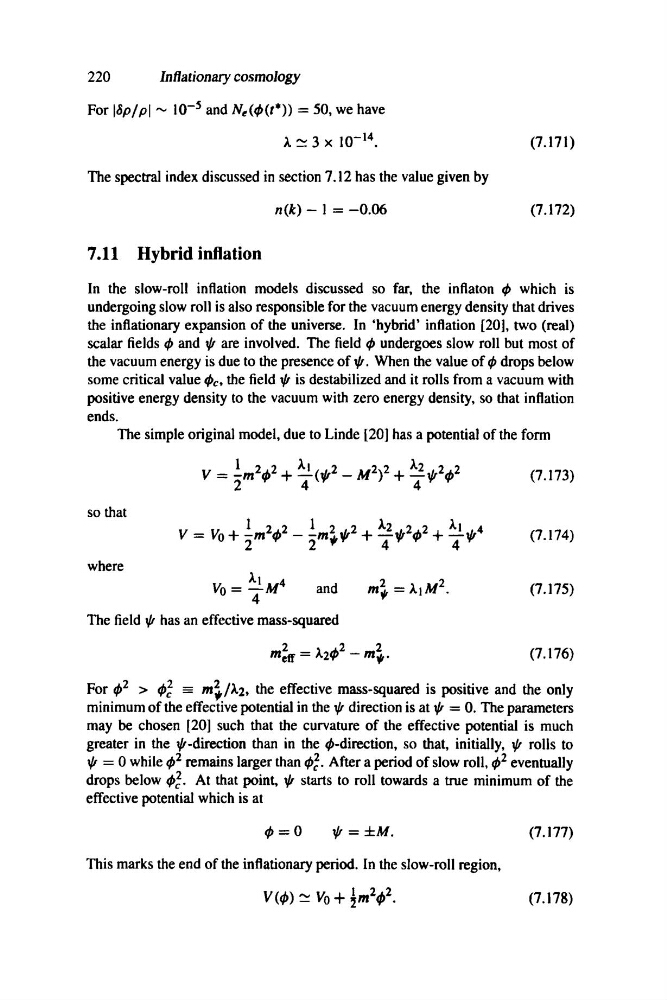
The simple original model, due to Linde [20] has a potential of the form
v = !m2~2 + Al (",2 _ M2)2 + A2 ",2~2
(7.173)
2
4
4
so that
v = Vo + !m2~2 _ !m3. ",2 + 12 ",2~2 + ~",4
(7.174)
2
2"
4
4
where
Al 4
Vo=-M
and
m~ = AIM2.
(7.175)
4
The field '" has an effective mass-squared
2
2
2
melJ = A2~ - mt·
(7.176)
For",2 > ~; == m~/A2. the effective mass-squared is positive and the only
minimum of the effective potential in the '" direction is at '" = O. The parameters
may be chosen [20] such that the curvature of the effective potential is much
greater in the ",-direction than in the ~-direction. so that, initially, '" rolls to
'" = 0 while ",2 remains larger than ~;. After a period of slow roll, ~2 eventually
drops below ~;. At that point, '" starts to roll towards a true minimum of the
effective potential which is at
~=o
(7.177)
'" = ±M.
This marks the end of the inflationary period. In the slow-roll region,
V(",) :::: Vo + !m2~2.
(7.178)
Inflationary cosmology
For 18p/ pi '" 10- 5 and Ne(~(t·» = 50, we have
A:::: 3 x 10- 14 •
(7.171)
The spectral index discussed in section 7.12 has the value given by
n(k) - I = -0.06
(7.172)
7.11 Hybrid inflation
In the slow-roll inflation models discussed so far, the inflaton ~ which is
undergoing slow roll is also responsible for the vacuum energy density that drives
the inflationary expansion of the universe. In 'hybrid' inflation [20], two (real)
scalar fields ~ and '" are involved. The field ~ undergoes slow roll but most of
the vacuum energy is due to the presence of",. When the value of", drops below
some critical value ~c. the field", is destabilized and it rolls from a vacuum with
positive energy density to the vacuum with zero energy density. so that inflation
ends.
The simple original model, due to Linde [20] has a potential of the form
v = !m2~2 + Al (",2 _ M2)2 + A2 ",2~2
(7.173)
2
4
4
so that
v = Vo + !m2~2 _ !m3. ",2 + 12 ",2~2 + ~",4
(7.174)
2
2"
4
4
where
Al 4
Vo=-M
and
m~ = AIM2.
(7.175)
4
The field '" has an effective mass-squared
2
2
2
melJ = A2~ - mt·
(7.176)
For",2 > ~; == m~/A2. the effective mass-squared is positive and the only
minimum of the effective potential in the '" direction is at '" = O. The parameters
may be chosen [20] such that the curvature of the effective potential is much
greater in the ",-direction than in the ~-direction. so that, initially, '" rolls to
'" = 0 while ",2 remains larger than ~;. After a period of slow roll, ~2 eventually
drops below ~;. At that point, '" starts to roll towards a true minimum of the
effective potential which is at
~=o
(7.177)
'" = ±M.
This marks the end of the inflationary period. In the slow-roll region,
V(",) :::: Vo + !m2~2.
(7.178)