

Chaotic inflation
219
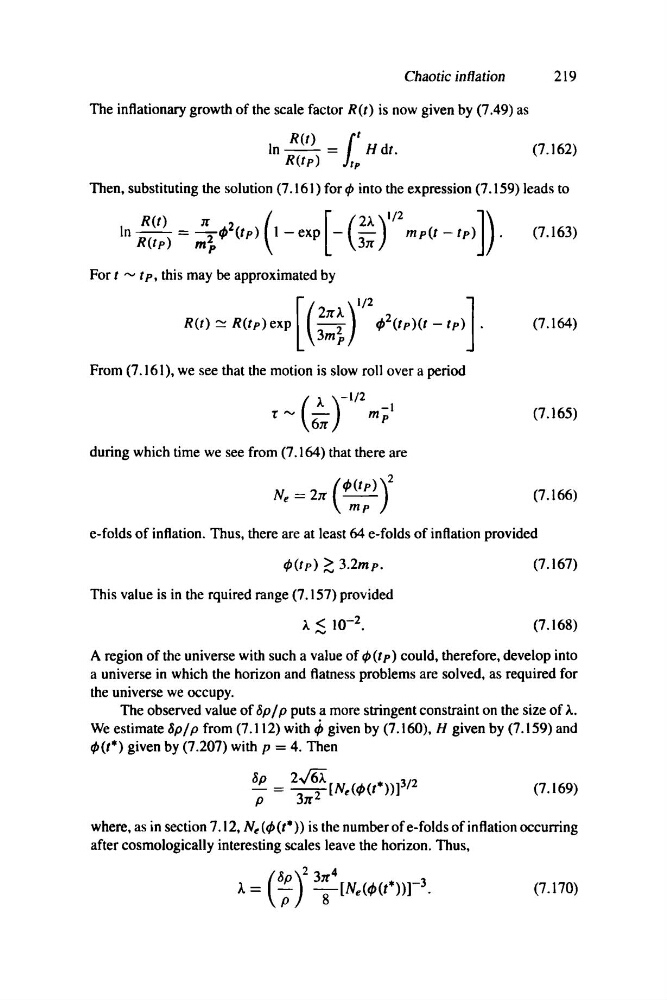
The inflationary growth of the scale factor R(t) is now given by (7.49) as
In R(t) = H dt.
(7.162)
R(tp)
tp
Then, substituting the solution (7.161 )for tf> into the expression (7.159) leads to
R(t)
- = 1r
(
[ ( 2A
In
2tf>2(tp) 1- exp - - )1/2 mp(t tp) ]) . (7.163)
R~)
mp
~
For I ,..., lp, this may be approximated by
R(I) '" R(I,) exp [ (:~)'" .'(1,)(1 ")] . (7.164)
From (7.161). we see that the motion is slow roll over a period
A
(
)-1 /
T'" -
2 m _ 1
(7.165)
61r
p
during which time we see from (7.164) that there are
Ne = 21r (tf>~;)y
(7.166)
e-folds of inflation. Thus, there are at least 64 e-folds of inflation provided
tf>(lp) ~ 3.2mp.
(7.167)
This value is in the rquired range (7.157) provided
A ~ 10- 2 •
(7.168)
A region of the universe with such a value of tf> (t p ) could. therefore. develop into
a universe in which the horizon and flatness problems are solved, as required for
the universe we occupy.
The observed value of !Jp / p puts a more stringent constraint on the size of A.
We estimate !Jp / p from (7.112) with tb given by (7.160). H given by (7.159) and
tf>(t*) given by (7.207) with p = 4. Then
!Jp = 2J6I [Ne (tf>(t*))]3 / 2
(7.169)
p
31r 2
where. as in section 7.12. Ne (tf>(t*» is the number of e-folds of inflation occurring
after cosmologically interesting
e:
scales leave the horizon. Thus.
A = Y 3:
4 [Ne (t/>(t*))]-3 .
(7.l70)
1t
219
The inflationary growth of the scale factor R(t) is now given by (7.49) as
In R(t) = H dt.
(7.162)
R(tp)
tp
Then, substituting the solution (7.161 )for tf> into the expression (7.159) leads to
R(t)
- = 1r
(
[ ( 2A
In
2tf>2(tp) 1- exp - - )1/2 mp(t tp) ]) . (7.163)
R~)
mp
~
For I ,..., lp, this may be approximated by
R(I) '" R(I,) exp [ (:~)'" .'(1,)(1 ")] . (7.164)
From (7.161). we see that the motion is slow roll over a period
A
(
)-1 /
T'" -
2 m _ 1
(7.165)
61r
p
during which time we see from (7.164) that there are
Ne = 21r (tf>~;)y
(7.166)
e-folds of inflation. Thus, there are at least 64 e-folds of inflation provided
tf>(lp) ~ 3.2mp.
(7.167)
This value is in the rquired range (7.157) provided
A ~ 10- 2 •
(7.168)
A region of the universe with such a value of tf> (t p ) could. therefore. develop into
a universe in which the horizon and flatness problems are solved, as required for
the universe we occupy.
The observed value of !Jp / p puts a more stringent constraint on the size of A.
We estimate !Jp / p from (7.112) with tb given by (7.160). H given by (7.159) and
tf>(t*) given by (7.207) with p = 4. Then
!Jp = 2J6I [Ne (tf>(t*))]3 / 2
(7.169)
p
31r 2
where. as in section 7.12. Ne (tf>(t*» is the number of e-folds of inflation occurring
after cosmologically interesting
e:
scales leave the horizon. Thus.
A = Y 3:
4 [Ne (t/>(t*))]-3 .
(7.l70)
1t