

Chaotic inflation
217
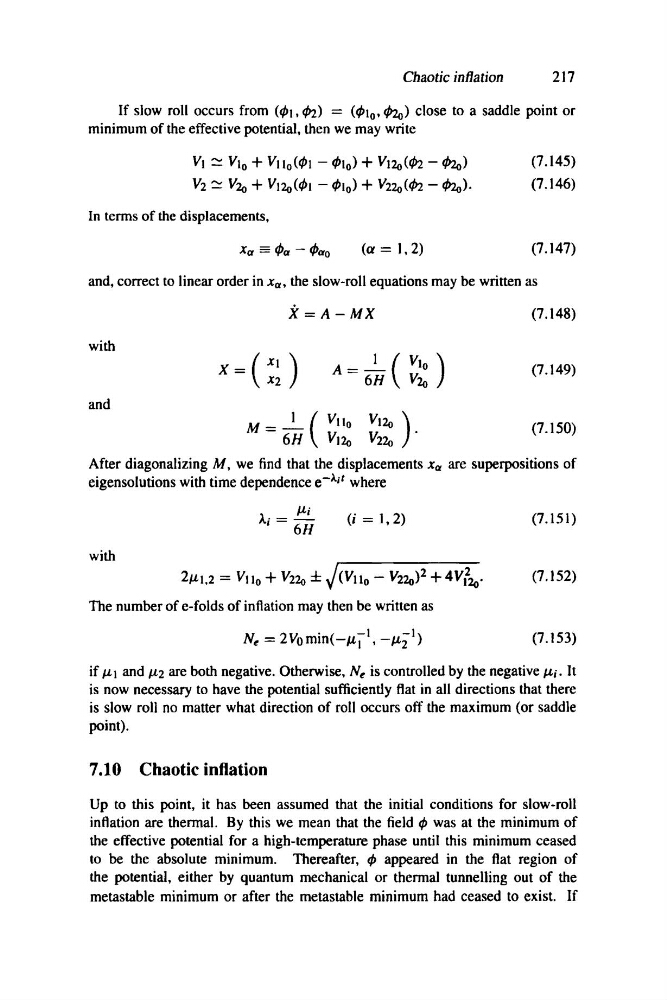
If slow roll occurs from (tPl. 4>2) = (tPlo.4>20) close to a saddle point or
minimum of the effective potential. then we may write
VI ::::::: Vlo + Vllo(tPl - 4>10) + VI20(4)2 - 4>20)
(7.145)
V2 ::::::: V20 + VI20(tPl - tPlo) + V220(4)2 - 4>20).
(7.146)
In terms of the displacements,
Xa=tPa-tPao
(a = 1.2)
(7.147)
and. correct to linear order in Xa. the slow-roll equations may be written as
X=A-MX
(7.148)
with
X= (~~) A = _1 (Vlo)
(7.149)
6H
V20
and
M = _1_ (VIIO VI20).
(7.150)
6H
VI20 V220
After diagonalizing M. we find that the displacements Xa are superpositions of
eigensolutions with time dependence e- A,t where
ILi
(i = 1.2)
(7.151)
A.i = 6H
with
2ILI.2 = Vllo + V220 ± J(Vllo - V220)2 +4vf 20 •
(7.152)
The number of e-folds of inflation may then be written as
Nt = 2Vomin(-ILII. -IL2"I)
(7.153)
if ILl and IL2 are both negative. Otherwise. Nt is controlled by the negative IL;. It
is now necessary to have the potential sufficiently flat in all directions that there
is slow roll no matter what direction of rolJ occurs off the maximum (or saddle
point),
7.10 Chaotic inflation
Up to this point. it has been assumed that the initial conditions for slow-roll
inflation are thermal. By this we mean that the field tP was at the minimum of
the effective potential for a high-temperature phase until this minimum ceased
to be the absolute minimum. Thereafter, tP appeared in the flat region of
the potential. either by quantum mechanical or thermal tunnelling out of the
metastable minimum or after the metastable minimum had ceased to exist. If
217
If slow roll occurs from (tPl. 4>2) = (tPlo.4>20) close to a saddle point or
minimum of the effective potential. then we may write
VI ::::::: Vlo + Vllo(tPl - 4>10) + VI20(4)2 - 4>20)
(7.145)
V2 ::::::: V20 + VI20(tPl - tPlo) + V220(4)2 - 4>20).
(7.146)
In terms of the displacements,
Xa=tPa-tPao
(a = 1.2)
(7.147)
and. correct to linear order in Xa. the slow-roll equations may be written as
X=A-MX
(7.148)
with
X= (~~) A = _1 (Vlo)
(7.149)
6H
V20
and
M = _1_ (VIIO VI20).
(7.150)
6H
VI20 V220
After diagonalizing M. we find that the displacements Xa are superpositions of
eigensolutions with time dependence e- A,t where
ILi
(i = 1.2)
(7.151)
A.i = 6H
with
2ILI.2 = Vllo + V220 ± J(Vllo - V220)2 +4vf 20 •
(7.152)
The number of e-folds of inflation may then be written as
Nt = 2Vomin(-ILII. -IL2"I)
(7.153)
if ILl and IL2 are both negative. Otherwise. Nt is controlled by the negative IL;. It
is now necessary to have the potential sufficiently flat in all directions that there
is slow roll no matter what direction of rolJ occurs off the maximum (or saddle
point),
7.10 Chaotic inflation
Up to this point. it has been assumed that the initial conditions for slow-roll
inflation are thermal. By this we mean that the field tP was at the minimum of
the effective potential for a high-temperature phase until this minimum ceased
to be the absolute minimum. Thereafter, tP appeared in the flat region of
the potential. either by quantum mechanical or thermal tunnelling out of the
metastable minimum or after the metastable minimum had ceased to exist. If