

216
Inflationary cosmology
7.9 Complex inflaton field
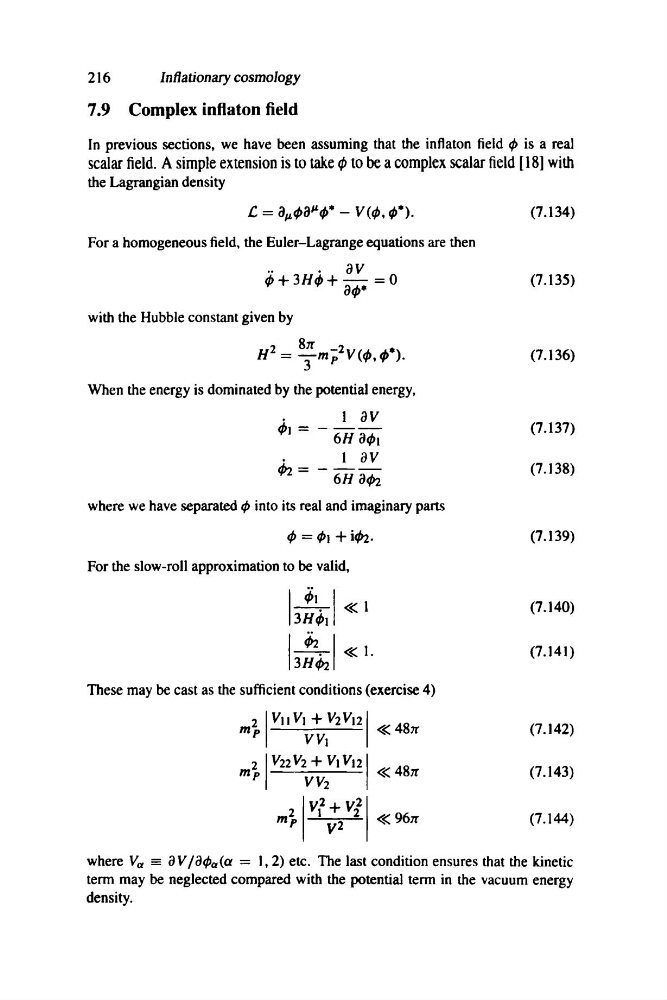
In previous sections. we have been assuming that the inflaton field f/J is a real
scalar field. A simple extension is to take r/J to be a complex scalar field [18] with
the Lagrangian density
c = aJLf/JaJLf/J* - V (f/J. f/J*).
(7.134)
For a homogeneous field. the Euler-Lagrange equations are then
..
. av
f/J+3Hf/J+-=O
(7.135)
af/J*
with the Hubble constant given by
H2 = 81r m;2 V (f/J, f/J*).
(7.136)
3
When the energy is dominated by the potential energy,
.
I av
f/JI = - - -
(7.137)
6H af/JI
.
I av
f/J2 = - - -
(7.138)
6H af/J2
where we have separated f/J into its real and imaginary parts
f/J = ~I + if/J2.
(7.139)
For the slow-roll approximation to be valid,
~I «I
(7.140)
I 3H~1
(7.141)
1 -£1 «l.
3Hf/J2
These may be cast as the sufficient conditions (exercise 4)
21 VII VI + V2 VI21 48
(7.142)
mp
VVI
«1r
21 V22 V2 + VI Vl21 48
(7.143)
mp
VV2
«1r
V2 + \1,21
m 2 1
2 « 961r
(7.144)
p 1 V2
where Va == av /a~a(a = 1,2) etc. The last condition ensures that the kinetic
tenn may be neglected compared with the potential tenn in the vacuum energy
density.
Inflationary cosmology
7.9 Complex inflaton field
In previous sections. we have been assuming that the inflaton field f/J is a real
scalar field. A simple extension is to take r/J to be a complex scalar field [18] with
the Lagrangian density
c = aJLf/JaJLf/J* - V (f/J. f/J*).
(7.134)
For a homogeneous field. the Euler-Lagrange equations are then
..
. av
f/J+3Hf/J+-=O
(7.135)
af/J*
with the Hubble constant given by
H2 = 81r m;2 V (f/J, f/J*).
(7.136)
3
When the energy is dominated by the potential energy,
.
I av
f/JI = - - -
(7.137)
6H af/JI
.
I av
f/J2 = - - -
(7.138)
6H af/J2
where we have separated f/J into its real and imaginary parts
f/J = ~I + if/J2.
(7.139)
For the slow-roll approximation to be valid,
~I «I
(7.140)
I 3H~1
(7.141)
1 -£1 «l.
3Hf/J2
These may be cast as the sufficient conditions (exercise 4)
21 VII VI + V2 VI21 48
(7.142)
mp
VVI
«1r
21 V22 V2 + VI Vl21 48
(7.143)
mp
VV2
«1r
V2 + \1,21
m 2 1
2 « 961r
(7.144)
p 1 V2
where Va == av /a~a(a = 1,2) etc. The last condition ensures that the kinetic
tenn may be neglected compared with the potential tenn in the vacuum energy
density.