

lnflaton field equations
209
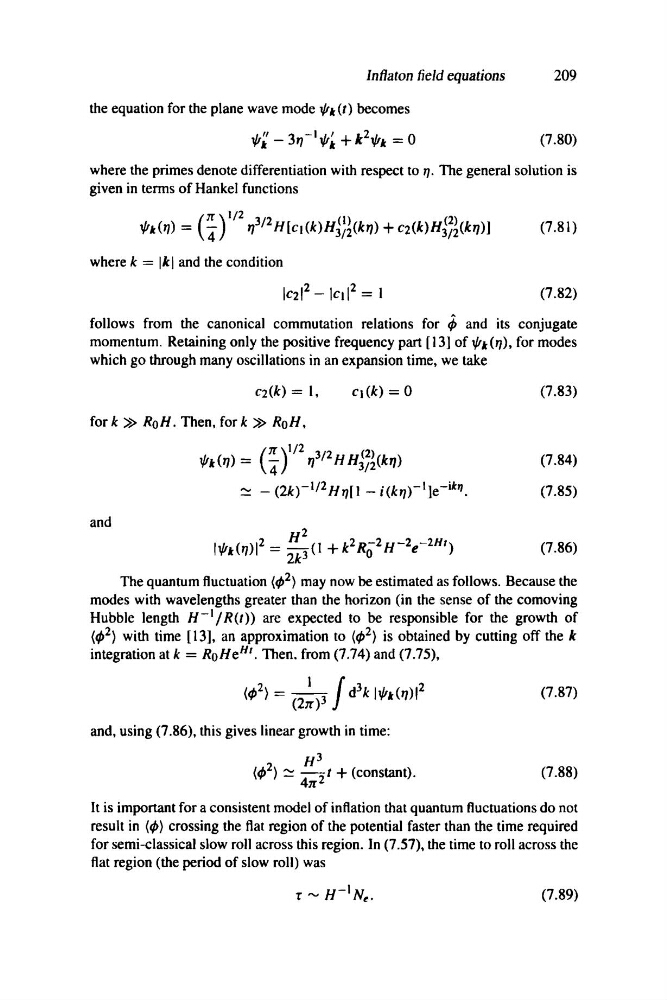
the equation for the plane wave mode 1/I/c (I) becomes
1/1; - 3" -11/I~ + k 2 1/1/c = 0
(7.80)
where the primes denote differentiation with respect to". The general solution is
given in terms of Hankel functions
1/I/c(,,) = (~f/2 ,,3/2 H[cl (k)Hm(k,,) + C2(k)H~;~(k")]
(7.81)
where k = Ik I and the condition
IC212 - ICI 12 = I
(7.82)
follows from the canonical commutation relations for ~ and its conjugate
momentum. Retaining only the positive frequency part [13] of 1/I/c(,,), for modes
which go through many oscillations in an expansion time, we take
c2(k) = I, ct(k) =0
(7.83)
for k » RoH. Then, for k » RoH,
( 1r )1/2
2
1/I/c(,,) = 4" ,,3/2 H H~/~(kr1>
(7.84)
'" - (2k)-1/2H,,[l - i(k")-I]e- ilc ,,.
(7.85)
and
H2
11/I/c(1/)1 2 = 21 3 (1 + k 2 R02 H- 2 e- 2Ht )
(7.86)
The quantum fluctuation (4)2) may now be estimated as follows. Because the
modes with wavelengths greater than the horizon (in the sense of the comoving
Hubble length H -\ / R(t» are expected to be responsible for the growth of
(4)2) with time [13], an approximation to (4)2) is obtained by cutting off the k
integration at k = RoHe Ht • Then. from (7.74) and (7.75),
(4)2) = _1-3 f d 3 k 11/I/c(,,)1 2
(7.87)
(21r)
and, using (7.86), this gives linear growth in time:
H3
(4)2) : : : : : : : : 41r2 I + (constant).
(7.88)
It is important for a consistent model of inflation that quantum fluctuations do not
result in (4)) crossing the flat region of the potential faster than the time required
for semi-classical slow roll across this region. In (7.57), the time to roll across the
flat region (the period of slow roll) was
t' '" H- I N~.
(7.89)
209
the equation for the plane wave mode 1/I/c (I) becomes
1/1; - 3" -11/I~ + k 2 1/1/c = 0
(7.80)
where the primes denote differentiation with respect to". The general solution is
given in terms of Hankel functions
1/I/c(,,) = (~f/2 ,,3/2 H[cl (k)Hm(k,,) + C2(k)H~;~(k")]
(7.81)
where k = Ik I and the condition
IC212 - ICI 12 = I
(7.82)
follows from the canonical commutation relations for ~ and its conjugate
momentum. Retaining only the positive frequency part [13] of 1/I/c(,,), for modes
which go through many oscillations in an expansion time, we take
c2(k) = I, ct(k) =0
(7.83)
for k » RoH. Then, for k » RoH,
( 1r )1/2
2
1/I/c(,,) = 4" ,,3/2 H H~/~(kr1>
(7.84)
'" - (2k)-1/2H,,[l - i(k")-I]e- ilc ,,.
(7.85)
and
H2
11/I/c(1/)1 2 = 21 3 (1 + k 2 R02 H- 2 e- 2Ht )
(7.86)
The quantum fluctuation (4)2) may now be estimated as follows. Because the
modes with wavelengths greater than the horizon (in the sense of the comoving
Hubble length H -\ / R(t» are expected to be responsible for the growth of
(4)2) with time [13], an approximation to (4)2) is obtained by cutting off the k
integration at k = RoHe Ht • Then. from (7.74) and (7.75),
(4)2) = _1-3 f d 3 k 11/I/c(,,)1 2
(7.87)
(21r)
and, using (7.86), this gives linear growth in time:
H3
(4)2) : : : : : : : : 41r2 I + (constant).
(7.88)
It is important for a consistent model of inflation that quantum fluctuations do not
result in (4)) crossing the flat region of the potential faster than the time required
for semi-classical slow roll across this region. In (7.57), the time to roll across the
flat region (the period of slow roll) was
t' '" H- I N~.
(7.89)