

208
Inflationary cosmology
Since all pre-existing baryon asymmetry will be diluted exponentially by the
inflationary period, the baryon asymmetry we observe now must be generated
after reheating has occurred or during reheating. If the reheating temperature T R
is sufficiently high, then the baryon asymmetry may be produced in the usual way
by the decay of leptoquark bosons in a GUT. Lower reheating temperatures will
suffice if the sphaleron mechanism applies instead. A further possibility is that
the baryon asymmetry is produced by the decay of the oscillating vacuum state
which exists after slow roll has ceased, i.e. by the decay of particles associated
with the inflaton field t/J. This is the situation discussed in section 4.6 where all of
the entropy of the universe is produced by the decay of particles whose decay is
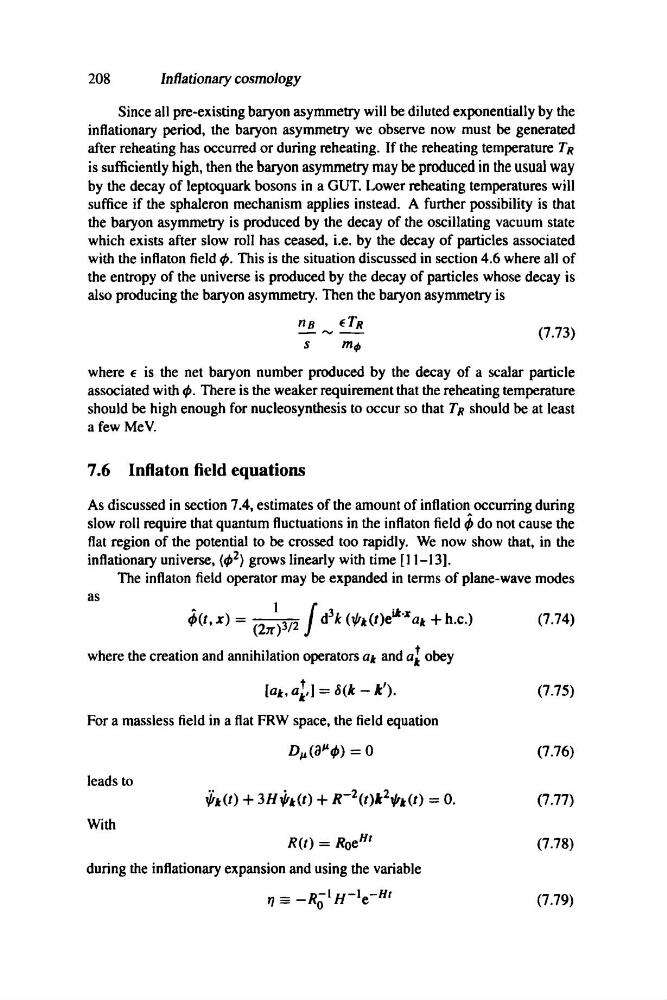
also producing the baryon asymmetry. Then the baryon asymmetry is
nB
ETR
- " " -
(7.73)
s
m~
where E is the net baryon number produced by the decay of a scalar particle
associated with t/J. There is the weaker requirement that the reheating temperature
should be high enough for nucleosynthesis to occur so that TR should be at least
a few MeV.
7.6 Inflaton field equations
As discussed in section 7.4, estimates of the amount of inflation occurring during
slow roll require that quantum fluctuations in the inflaton field j, do not cause the
flat region of the potential to be crossed too rapidly. We now show that, in the
inflationary universe, (t/J2) grows linearly with time [It-13].
The inflaton field operator may be expanded in tenns of plane-wave modes
as
A
I
jl·z
t/J(t, x) = ,,.,'2,') J d 3 k (1/It(t)e at + h.c.) (7.74)
where the creation and annihilation operators at and aZ obey
[al, a!,] = 8(k - k').
(7.7S)
For a massless field in a flat FRW space, the field equation
D,.,,(a"'t/J) = 0
(7.76)
leads to
tl(t) + 3H~t(t) + R- 2 (t)k 2 1/1t(t) = O.
(7.77)
With
R(I) = Roe Ht
(7.78)
during the inflationary expansion and using the variable
-
R-1H-1 -Ht
'1=-0
e
(7.79)
Inflationary cosmology
Since all pre-existing baryon asymmetry will be diluted exponentially by the
inflationary period, the baryon asymmetry we observe now must be generated
after reheating has occurred or during reheating. If the reheating temperature T R
is sufficiently high, then the baryon asymmetry may be produced in the usual way
by the decay of leptoquark bosons in a GUT. Lower reheating temperatures will
suffice if the sphaleron mechanism applies instead. A further possibility is that
the baryon asymmetry is produced by the decay of the oscillating vacuum state
which exists after slow roll has ceased, i.e. by the decay of particles associated
with the inflaton field t/J. This is the situation discussed in section 4.6 where all of
the entropy of the universe is produced by the decay of particles whose decay is
also producing the baryon asymmetry. Then the baryon asymmetry is
nB
ETR
- " " -
(7.73)
s
m~
where E is the net baryon number produced by the decay of a scalar particle
associated with t/J. There is the weaker requirement that the reheating temperature
should be high enough for nucleosynthesis to occur so that TR should be at least
a few MeV.
7.6 Inflaton field equations
As discussed in section 7.4, estimates of the amount of inflation occurring during
slow roll require that quantum fluctuations in the inflaton field j, do not cause the
flat region of the potential to be crossed too rapidly. We now show that, in the
inflationary universe, (t/J2) grows linearly with time [It-13].
The inflaton field operator may be expanded in tenns of plane-wave modes
as
A
I
jl·z
t/J(t, x) = ,,.,'2,') J d 3 k (1/It(t)e at + h.c.) (7.74)
where the creation and annihilation operators at and aZ obey
[al, a!,] = 8(k - k').
(7.7S)
For a massless field in a flat FRW space, the field equation
D,.,,(a"'t/J) = 0
(7.76)
leads to
tl(t) + 3H~t(t) + R- 2 (t)k 2 1/1t(t) = O.
(7.77)
With
R(I) = Roe Ht
(7.78)
during the inflationary expansion and using the variable
-
R-1H-1 -Ht
'1=-0
e
(7.79)