

198
Inflationary cosmology
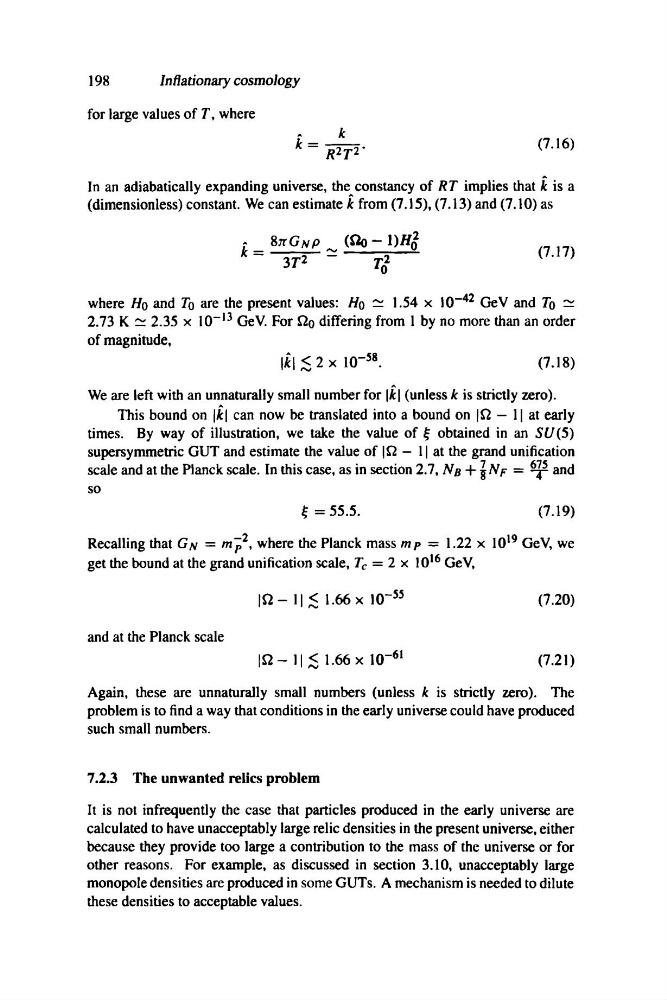
for large values of T, where
k
k = R2T2'
(7.16)
In an adiabatically expanding universe, the constancy of RT implies that k is a
(dimensionless) constant. We can estimate k from (7.15), (7.13) and (7.10) as
A
8rrGNP
(no -1)u 2
k=
'"
0
(7.17)
-
2
To
where Ho and To are the present values: Ho ~ 1.54 x 10-42 GeV and To ~
2.73 K ~ 2.35 x 10- 13 GeV. For 00 differing from I by no more than an order
of magnitude,
Ikl < 2
'" x IQ-S8 .
(7.18)
We are left with an unnaturally small number for III (unless k is strictly zero).
This bound on Ikl can now be translated into a bound on 10 - I1 at early
times. By way of illustration, we take the value of ~ obtained in an SU(5)
supersymmetric GUT and estimate the value of 10 - 11 at the grand unification
scale and at the Planck scale. In this case, as in section 2.7, NB + ~NF = ~ and
so
~ = 55.5.
(7.19)
Recalling that GN = mp2, where the Planck mass mp = 1.22 x 10 19 GeV, we
get the bound at the grand unification scale, Tc = 2 x 10 16 GeV,
10 11 :s 1.66 x IQ-SS
(7.20)
and at the Planck scale
10 11 :s 1.66 x 10- 61
(7.21)
Again, these are unnaturally small numbers (unless k is strictly zero). The
problem is to find a way that conditions in the early universe could have produced
such small numbers.
7.2.3 The unwanted relics problem
It is not infrequently the case that particles produced in the early universe are
calculated to have unacceptably large relic densities in the present universe, either
because they provide too large a contribution to the mass of the universe or for
other reasons. For example, as discussed in section 3.10, unacceptably large
monopole densities are produced in some GUTs. A mechanism is needed to dilute
these densities to acceptable values.
Inflationary cosmology
for large values of T, where
k
k = R2T2'
(7.16)
In an adiabatically expanding universe, the constancy of RT implies that k is a
(dimensionless) constant. We can estimate k from (7.15), (7.13) and (7.10) as
A
8rrGNP
(no -1)u 2
k=
'"
0
(7.17)
-
2
To
where Ho and To are the present values: Ho ~ 1.54 x 10-42 GeV and To ~
2.73 K ~ 2.35 x 10- 13 GeV. For 00 differing from I by no more than an order
of magnitude,
Ikl < 2
'" x IQ-S8 .
(7.18)
We are left with an unnaturally small number for III (unless k is strictly zero).
This bound on Ikl can now be translated into a bound on 10 - I1 at early
times. By way of illustration, we take the value of ~ obtained in an SU(5)
supersymmetric GUT and estimate the value of 10 - 11 at the grand unification
scale and at the Planck scale. In this case, as in section 2.7, NB + ~NF = ~ and
so
~ = 55.5.
(7.19)
Recalling that GN = mp2, where the Planck mass mp = 1.22 x 10 19 GeV, we
get the bound at the grand unification scale, Tc = 2 x 10 16 GeV,
10 11 :s 1.66 x IQ-SS
(7.20)
and at the Planck scale
10 11 :s 1.66 x 10- 61
(7.21)
Again, these are unnaturally small numbers (unless k is strictly zero). The
problem is to find a way that conditions in the early universe could have produced
such small numbers.
7.2.3 The unwanted relics problem
It is not infrequently the case that particles produced in the early universe are
calculated to have unacceptably large relic densities in the present universe, either
because they provide too large a contribution to the mass of the universe or for
other reasons. For example, as discussed in section 3.10, unacceptably large
monopole densities are produced in some GUTs. A mechanism is needed to dilute
these densities to acceptable values.