

Horizon, flatness and unwanted relics problems
197
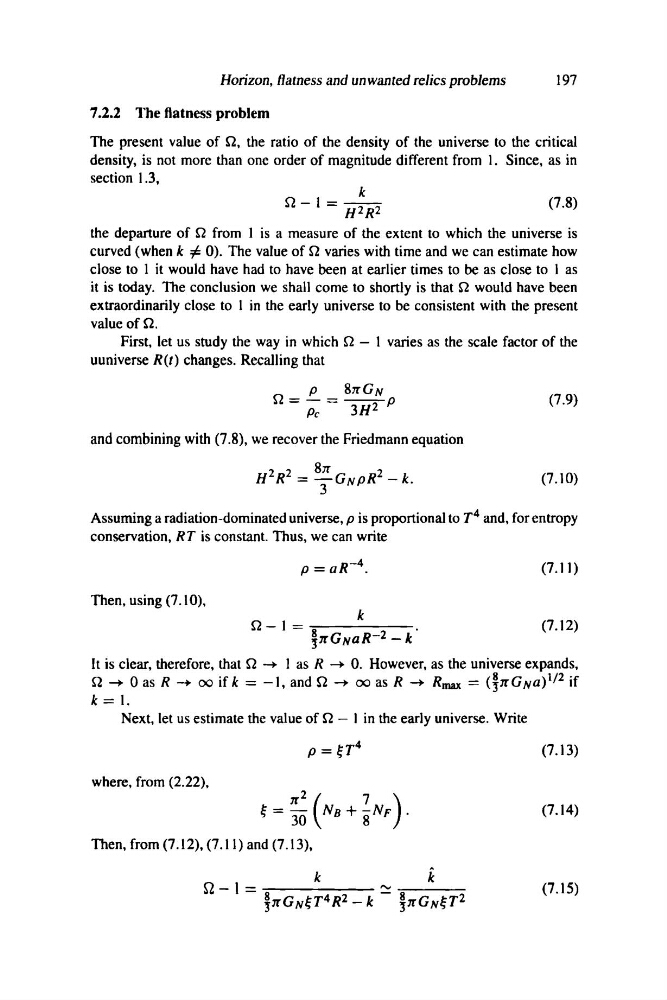
7.2.2 The flatness problem
The present value of r2, the ratio of the density of the universe to the critical
density, is not more than one order of magnitude different from 1. Since, as in
section 1.3,
k
(7.8)
r2 - 1 = H2R2
the departure of r2 from 1 is a measure of the extent to which the universe is
curved (when k ¥: 0). The value of r2 varies with time and we can estimate how
close to 1 it would have had to have been at earlier times to be as close to I as
it is today. The conclusion we shall come to shortly is that r2 would have been
extraordinarily close to I in the early universe to be consistent with the present
value ofr2.
First, let us study the way in which r2 - 1 varies as the scale factor of the
uuniverse R(t) changes. Recalling that
P
8rrGN
r2=-=--p
(7.9)
Pc
3H2
and combining with (7.8), we recover the Friedmann equation
H2R2 = 8; GNpR 2 _ k.
(7.10)
Assuming a radiation-dominated universe, p is proportional to T4 and, for entropy
conservation, RT is constant. Thus, we can write
p = aR- 4 •
(7.11)
Then, using (7.10),
k
r2-1=8
- - .
(7.12)
jrrGNaR-2 k
It is clear, therefore, that r2 -+ 1 as R -+ O. However, as the universe expands.
r2 -+ 0 as R -+ 00 if k = -I, and r2 -+ 00 as R -+ Rmax = (JrrGNa)1/2 if
k=1.
Next. let us estimate the value of r2 - 1 in the early universe. Write
P =~T4
(7.13)
where, from (2.22),
rr2 (
~ = 30 NB + gNF 7) .
(7.14)
Then, from (7.12), (7.11) and (7.13),
Q _ 1 -
k
'" -::--_k_"'7
(7.15)
- JrrGN~T4R2 - k - J1rGN~T2
197
7.2.2 The flatness problem
The present value of r2, the ratio of the density of the universe to the critical
density, is not more than one order of magnitude different from 1. Since, as in
section 1.3,
k
(7.8)
r2 - 1 = H2R2
the departure of r2 from 1 is a measure of the extent to which the universe is
curved (when k ¥: 0). The value of r2 varies with time and we can estimate how
close to 1 it would have had to have been at earlier times to be as close to I as
it is today. The conclusion we shall come to shortly is that r2 would have been
extraordinarily close to I in the early universe to be consistent with the present
value ofr2.
First, let us study the way in which r2 - 1 varies as the scale factor of the
uuniverse R(t) changes. Recalling that
P
8rrGN
r2=-=--p
(7.9)
Pc
3H2
and combining with (7.8), we recover the Friedmann equation
H2R2 = 8; GNpR 2 _ k.
(7.10)
Assuming a radiation-dominated universe, p is proportional to T4 and, for entropy
conservation, RT is constant. Thus, we can write
p = aR- 4 •
(7.11)
Then, using (7.10),
k
r2-1=8
- - .
(7.12)
jrrGNaR-2 k
It is clear, therefore, that r2 -+ 1 as R -+ O. However, as the universe expands.
r2 -+ 0 as R -+ 00 if k = -I, and r2 -+ 00 as R -+ Rmax = (JrrGNa)1/2 if
k=1.
Next. let us estimate the value of r2 - 1 in the early universe. Write
P =~T4
(7.13)
where, from (2.22),
rr2 (
~ = 30 NB + gNF 7) .
(7.14)
Then, from (7.12), (7.11) and (7.13),
Q _ 1 -
k
'" -::--_k_"'7
(7.15)
- JrrGN~T4R2 - k - J1rGN~T2