

182
Supersymmetric dark matter
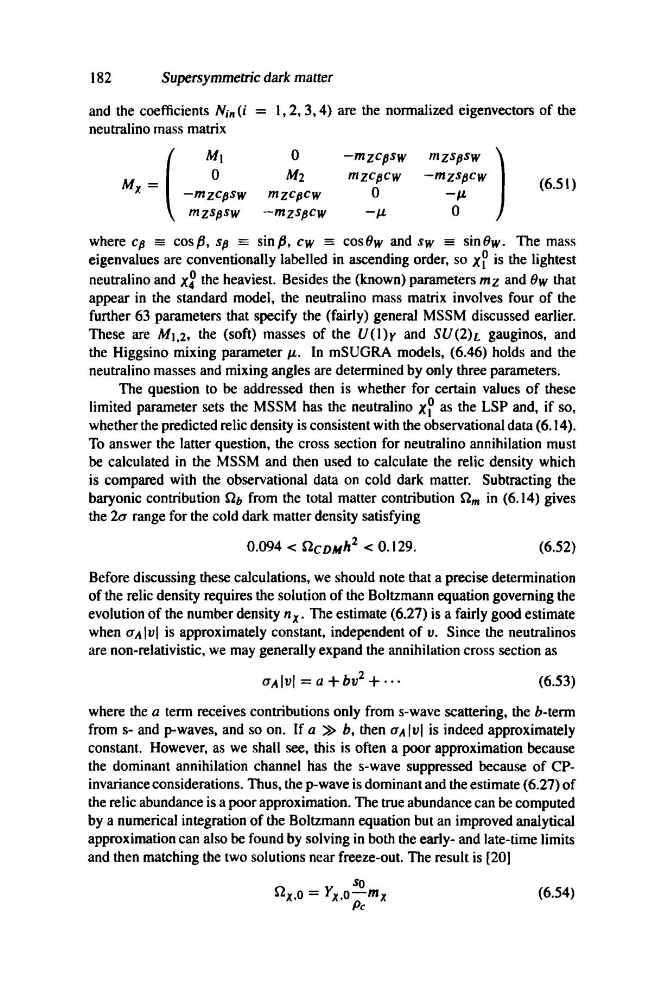
and the coefficients Nin (; = I, 2. 3, 4) are the normalized eigenvectors of the
neutralino mass matrix
MI
o
-mzc/lsw
mZSfJSW)
(
M2
mzcllcw
-mzsllcw
(6.51)
Mx = -mZ~IlSW
o
mzcllcw
-IJ.
mzsllsw
-mzsfJcw
-IJ.
0
where cll == cosp, sll == sinp, Cw == cos9w and Sw == sin9w. The mass
eigenvalues are conventionally labelled in ascending order, so xP is the lightest
neutralino and x2 the heaviest. Besides the (known) parameters mz and 8w that
appear in the standard model, the neutralino mass matrix involves four of the
further 63 parameters that specify the (fairly) general MSSM discussed earlier.
These are MI.2, the (soft) masses of the U(1)y and SU(2)L gauginos, and
the Higgsino mixing parameter IJ.. In mSUGRA models, (6.46) holds and the
neutralino masses and mixing angles are determined by only three parameters.
The question to be addressed then is whether for certain values of these
limited parameter sets the MSSM has the neutralino xP as the LSP and, if so,
whether the predicted relic density is consistent with the observational data (6.14).
To answer the latter question, the cross section for neutralino annihilation must
be calculated in the MSSM and then used to calculate the relic density which
is compared with the observational data on cold dark matter. Subtracting the
baryonic contribution Ob from the total matter contribution Om in (6.14) gives
the 2n range for the cold dark matter density satisfying
0.094 < OCDMh 2 < 0.129.
(6.52)
Before discussing these calculations, we should note that a precise determination
of the relic density requires the solution of the Boltzmann equation governing the
evolution of the number density n x' The estimate (6.27) is a fairly good estimate
when C1A Ivl is approximately constant, independent of v. Since the neutralinos
are non-relativistic, we may generally expand the annihilation cross section as
C1Alvl =a+bv 2 + ...
(6.53)
where the a term receives contributions only from s-wave scattering, the b-term
from s- and p-waves, and so on. If a » b, then C1A Ivl is indeed approximately
constant. However, as we shall see, this is often a poor approximation because
the dominant annihilation channel has the s-wave suppressed because of CPinvariance considerations. Thus, the p-wave is dominant and the estimate (6.27) of
the relic abundance is a poor approximation. The true abundance can be computed
by a numerical integration of the Boltzmann equation but an improved analytical
approximation can also be found by solving in both the early- and late-time limits
and then matching the two solutions near freeze-out. The result is [20]
so
(6.54)
°x.o = Yx.o Pc mx
Supersymmetric dark matter
and the coefficients Nin (; = I, 2. 3, 4) are the normalized eigenvectors of the
neutralino mass matrix
MI
o
-mzc/lsw
mZSfJSW)
(
M2
mzcllcw
-mzsllcw
(6.51)
Mx = -mZ~IlSW
o
mzcllcw
-IJ.
mzsllsw
-mzsfJcw
-IJ.
0
where cll == cosp, sll == sinp, Cw == cos9w and Sw == sin9w. The mass
eigenvalues are conventionally labelled in ascending order, so xP is the lightest
neutralino and x2 the heaviest. Besides the (known) parameters mz and 8w that
appear in the standard model, the neutralino mass matrix involves four of the
further 63 parameters that specify the (fairly) general MSSM discussed earlier.
These are MI.2, the (soft) masses of the U(1)y and SU(2)L gauginos, and
the Higgsino mixing parameter IJ.. In mSUGRA models, (6.46) holds and the
neutralino masses and mixing angles are determined by only three parameters.
The question to be addressed then is whether for certain values of these
limited parameter sets the MSSM has the neutralino xP as the LSP and, if so,
whether the predicted relic density is consistent with the observational data (6.14).
To answer the latter question, the cross section for neutralino annihilation must
be calculated in the MSSM and then used to calculate the relic density which
is compared with the observational data on cold dark matter. Subtracting the
baryonic contribution Ob from the total matter contribution Om in (6.14) gives
the 2n range for the cold dark matter density satisfying
0.094 < OCDMh 2 < 0.129.
(6.52)
Before discussing these calculations, we should note that a precise determination
of the relic density requires the solution of the Boltzmann equation governing the
evolution of the number density n x' The estimate (6.27) is a fairly good estimate
when C1A Ivl is approximately constant, independent of v. Since the neutralinos
are non-relativistic, we may generally expand the annihilation cross section as
C1Alvl =a+bv 2 + ...
(6.53)
where the a term receives contributions only from s-wave scattering, the b-term
from s- and p-waves, and so on. If a » b, then C1A Ivl is indeed approximately
constant. However, as we shall see, this is often a poor approximation because
the dominant annihilation channel has the s-wave suppressed because of CPinvariance considerations. Thus, the p-wave is dominant and the estimate (6.27) of
the relic abundance is a poor approximation. The true abundance can be computed
by a numerical integration of the Boltzmann equation but an improved analytical
approximation can also be found by solving in both the early- and late-time limits
and then matching the two solutions near freeze-out. The result is [20]
so
(6.54)
°x.o = Yx.o Pc mx