

Neutralino dark matter
181
This happens (in supergravity models) if the origin of the supersymmetry
breaking is a 'hidden' sector which shares only gravitational interactions with
the 'observable' sector that we inhabit. (The unification scale, as well as the
value of the unified gauge coupling strength, is determined from the measured
low-energy values of the coupling constants using the renormalization group
equations.) An advantage of this approach is that one of the diagonal Higgs
mass-squared parameters is typically driven negative by the renormalization
group running, so electroweak symmetry breaking is thereby generated radiatively
and the scale at which this happens is intimately connected to the low-energy
supersymmetry breaking. The minimal supergravity (mSUGRA) model starts
with seven parameters (if we allow for a non-minimal Kabler potential), namely
mr, m~, IL{mx), A, B, m1/2, m5. Using the re normalization group equations,
these determine mz, tan /J (and m~): it is customary to choose tan /J as an input
parameter and mz is, of course, fixed. Then IILI and B are outputs and the
remaining unknowns are m~, m~. ~(IL(mx», tan/J, m1/2, moo When mr = m~ =
m5, the model is called the 'constrained' MSSM or CMSSM.
Since R = + I for all particles in the standard model and R = -1 for all
of their supersymmetric partners (sparticles), it is easy to see that the lightest
supersymmetric particle (LSP) must be stable. To be a WIMP candidate, the LSP
must also be a colour-singlet and electrically neutral and there are relatively few
sparticles with these properties. One posiibility is a sneutrino ii. However, this
possibility has been excluded. An accelerator-based limit from the 'invisible'
width of the Z boson requires mjj ;:: 44.7 GeV [17] but, in this case, direct relic
searches in low-background experiments require mjj ;:: 20 TeV [18]. Another
possibility that arises in supergravity models is the gravitino, which is essentially
undetectable. Also, as we saw in section 6.3, gravitino dark matter might raise
theoretical problems that supersymmetry is supposed to have solved. However, in
most supergravity models, the gravitino is not the LSP and is unstable. The most
popular candidate by far is that the LSP is a neulralino [ 19].
6.S Neutralino dark matter
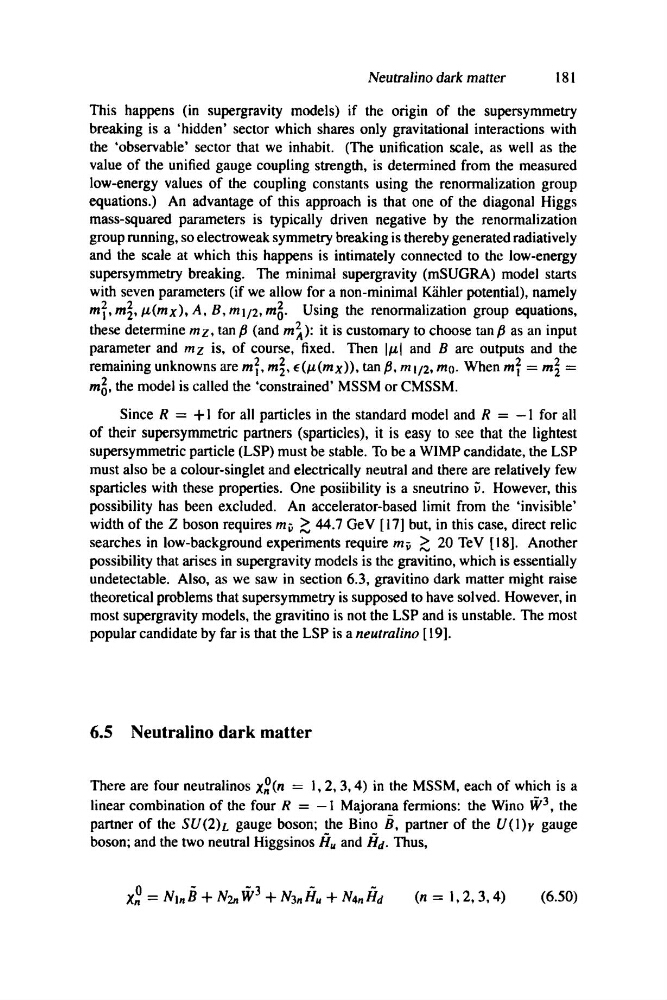
There are four neutralinos x2(n = 1,2,3,4) in the MSSM, each of which is a
linear combination of the four R = -I Majorana fermions: the Wino W 3 , the
partner of the SU(2)L gauge boson; the Bino 8, partner of the U(l)y gauge
boson; and the two neutral Higgsinos Hu and Hd. Thus,
o
-
-3
-
Xn = NlnB + N2n W + N3nHu + N4n Hd (n = 1,2,3,4)
(6.50)
181
This happens (in supergravity models) if the origin of the supersymmetry
breaking is a 'hidden' sector which shares only gravitational interactions with
the 'observable' sector that we inhabit. (The unification scale, as well as the
value of the unified gauge coupling strength, is determined from the measured
low-energy values of the coupling constants using the renormalization group
equations.) An advantage of this approach is that one of the diagonal Higgs
mass-squared parameters is typically driven negative by the renormalization
group running, so electroweak symmetry breaking is thereby generated radiatively
and the scale at which this happens is intimately connected to the low-energy
supersymmetry breaking. The minimal supergravity (mSUGRA) model starts
with seven parameters (if we allow for a non-minimal Kabler potential), namely
mr, m~, IL{mx), A, B, m1/2, m5. Using the re normalization group equations,
these determine mz, tan /J (and m~): it is customary to choose tan /J as an input
parameter and mz is, of course, fixed. Then IILI and B are outputs and the
remaining unknowns are m~, m~. ~(IL(mx», tan/J, m1/2, moo When mr = m~ =
m5, the model is called the 'constrained' MSSM or CMSSM.
Since R = + I for all particles in the standard model and R = -1 for all
of their supersymmetric partners (sparticles), it is easy to see that the lightest
supersymmetric particle (LSP) must be stable. To be a WIMP candidate, the LSP
must also be a colour-singlet and electrically neutral and there are relatively few
sparticles with these properties. One posiibility is a sneutrino ii. However, this
possibility has been excluded. An accelerator-based limit from the 'invisible'
width of the Z boson requires mjj ;:: 44.7 GeV [17] but, in this case, direct relic
searches in low-background experiments require mjj ;:: 20 TeV [18]. Another
possibility that arises in supergravity models is the gravitino, which is essentially
undetectable. Also, as we saw in section 6.3, gravitino dark matter might raise
theoretical problems that supersymmetry is supposed to have solved. However, in
most supergravity models, the gravitino is not the LSP and is unstable. The most
popular candidate by far is that the LSP is a neulralino [ 19].
6.S Neutralino dark matter
There are four neutralinos x2(n = 1,2,3,4) in the MSSM, each of which is a
linear combination of the four R = -I Majorana fermions: the Wino W 3 , the
partner of the SU(2)L gauge boson; the Bino 8, partner of the U(l)y gauge
boson; and the two neutral Higgsinos Hu and Hd. Thus,
o
-
-3
-
Xn = NlnB + N2n W + N3nHu + N4n Hd (n = 1,2,3,4)
(6.50)