

Minimal supersymmetric standard model (MSSM)
179
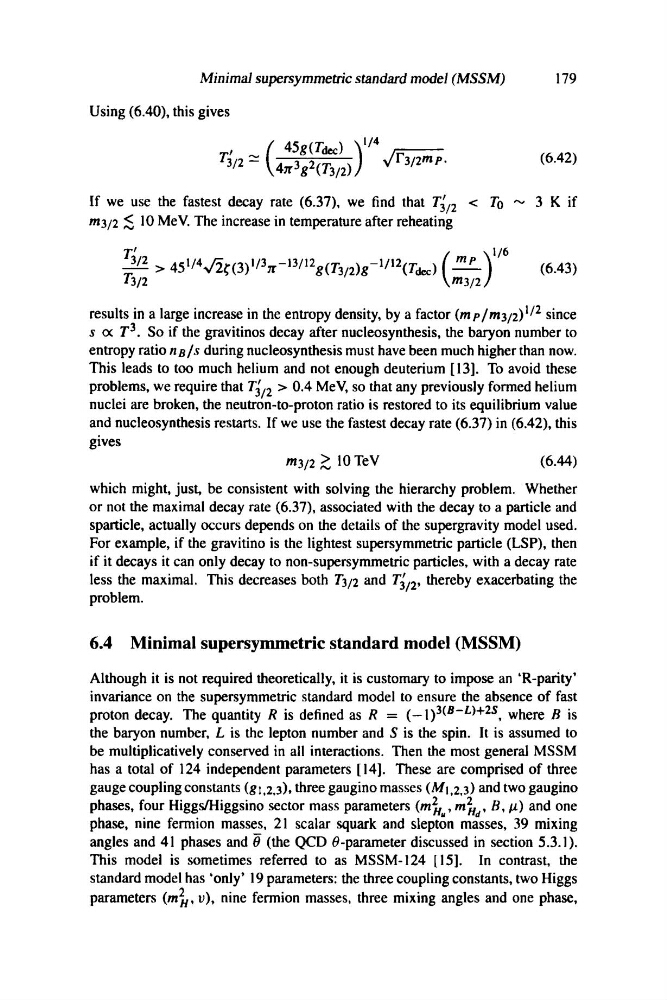
Using (6.40), this gives
,
(45 g (Tdec) )1/4
T3/2 ::::::
3 2
r3/2m p.
(6.42)
411' g (T3/2)
J
If we use the fastest decay rate (6.37), we find that T3/2 < To '" 3 K if
m3/2 ~ 10 MeV. The increase in temperature after reheating
T.' 3/2 > 45 1 / 4 J2('(3)1/311'-13/12 g (T3/2)g-1/12(Tdcc) (m _P )1/6 (6.43)
~
mm
results in a large increase in the entropy density, by a factor (mplm3/2)1/2 since
s
This leads to too much helium and not enough deuterium [13]. To avoid these
problems, we require that T3/2 > 0.4 MeV, so that any previously formed helium
nuclei are broken, the neutron-ta-proton ratio is restored to its equilibrium value
and nucleosynthesis restarts. If we use the fastest decay rate (6.37) in (6.42), this
gives
m3/2 ;:: 10 TeV
(6.44)
which might, just, be consistent with solving the hierarchy problem. Whether
or not the maximal decay rate (6.37), associated with the decay to a particle and
sparticle, actually occurs depends on the details of the supergravity model used.
For example, if the gravitino is the lightest supersymmetric particle (LSP), then
if it decays it can only decay to non-supersymmetric particles, with a decay rate
less the maximal. This decreases both T3/2 and T3/2' thereby exacerbating the
problem.
6.4 Minimal supersymmetric standard model (MSSM)
Although it is not required theoretically, it is customary to impose an 'R-parity'
invariance on the supersymmetric standard model to ensure the absence of fast
proton decay. The quantity R is defined as R = (_1)3(B-L)+2S, where B is
the baryon number, L is the lepton number and S is the spin. It is assumed to
be multiplicatively conserved in all interactions. Then the most general MSSM
has a total of 124 independent parameters [14]. These are comprised of three
gauge coupling constants (gl,2,3), three gaugino masses (MI.2,3) and two gaugino
phases, four HiggslHiggsino sector mass parameters (m~", m~d' B, IJ.) and one
phase, nine fermi on masses, 21 scalar squark and slepton masses, 39 mixing
angles and 41 phases and (j (the QCD 9-parameter discussed in section 5.3.1),
This model is sometimes referred to as MSSM-124 [15]. In contrast, the
standard model has 'only' 19 parameters: the three coupling constants, two Higgs
parameters (m~, v), nine fermion masses, three mixing angles and one phase,
179
Using (6.40), this gives
,
(45 g (Tdec) )1/4
T3/2 ::::::
3 2
r3/2m p.
(6.42)
411' g (T3/2)
J
If we use the fastest decay rate (6.37), we find that T3/2 < To '" 3 K if
m3/2 ~ 10 MeV. The increase in temperature after reheating
T.' 3/2 > 45 1 / 4 J2('(3)1/311'-13/12 g (T3/2)g-1/12(Tdcc) (m _P )1/6 (6.43)
~
mm
results in a large increase in the entropy density, by a factor (mplm3/2)1/2 since
s
This leads to too much helium and not enough deuterium [13]. To avoid these
problems, we require that T3/2 > 0.4 MeV, so that any previously formed helium
nuclei are broken, the neutron-ta-proton ratio is restored to its equilibrium value
and nucleosynthesis restarts. If we use the fastest decay rate (6.37) in (6.42), this
gives
m3/2 ;:: 10 TeV
(6.44)
which might, just, be consistent with solving the hierarchy problem. Whether
or not the maximal decay rate (6.37), associated with the decay to a particle and
sparticle, actually occurs depends on the details of the supergravity model used.
For example, if the gravitino is the lightest supersymmetric particle (LSP), then
if it decays it can only decay to non-supersymmetric particles, with a decay rate
less the maximal. This decreases both T3/2 and T3/2' thereby exacerbating the
problem.
6.4 Minimal supersymmetric standard model (MSSM)
Although it is not required theoretically, it is customary to impose an 'R-parity'
invariance on the supersymmetric standard model to ensure the absence of fast
proton decay. The quantity R is defined as R = (_1)3(B-L)+2S, where B is
the baryon number, L is the lepton number and S is the spin. It is assumed to
be multiplicatively conserved in all interactions. Then the most general MSSM
has a total of 124 independent parameters [14]. These are comprised of three
gauge coupling constants (gl,2,3), three gaugino masses (MI.2,3) and two gaugino
phases, four HiggslHiggsino sector mass parameters (m~", m~d' B, IJ.) and one
phase, nine fermi on masses, 21 scalar squark and slepton masses, 39 mixing
angles and 41 phases and (j (the QCD 9-parameter discussed in section 5.3.1),
This model is sometimes referred to as MSSM-124 [15]. In contrast, the
standard model has 'only' 19 parameters: the three coupling constants, two Higgs
parameters (m~, v), nine fermion masses, three mixing angles and one phase,