

178
Supersymmetric dark matter
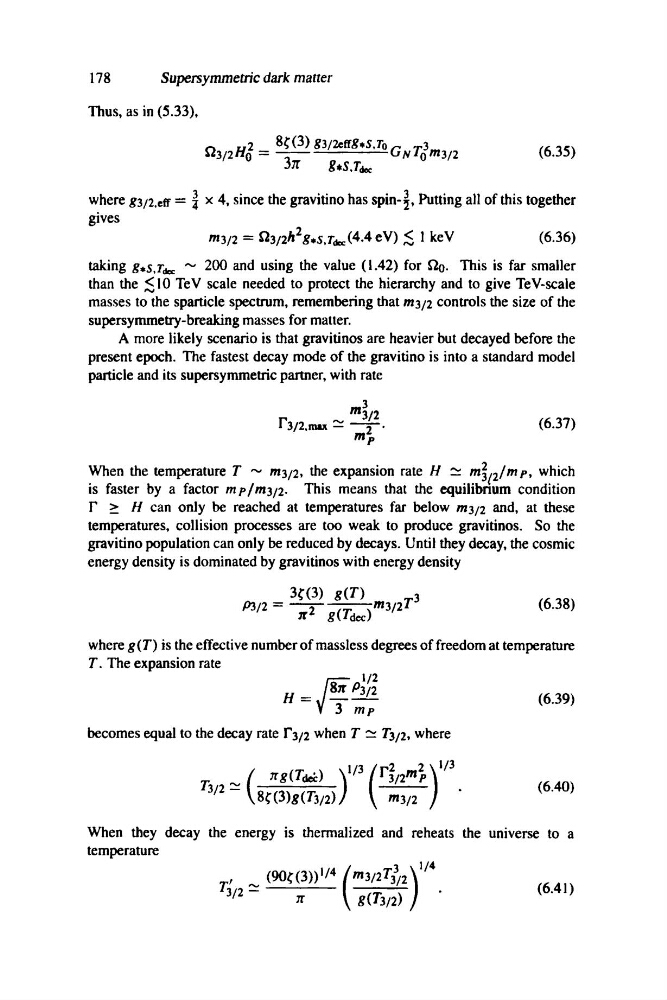
Thus, as in (5.33),
n
u2
=
8{(3) g3/2effg.S,To G T,3
""3/21"1:0
3
N 0 m3/2
(6.35)
1f
g.S.T ..
where g3/2,eff = i x 4, since the gravitino has spin-!. Putting all of this together
gives
m3/2 = n3/2h2g.S.T .. (4.4eV) ~ 1 keY
(6.36)
taking g.S.T .. ..... 200 and using the value (1.42) for no. This is far smaller
than the ~ \0 TeV scale needed to protect the hierarchy and to give TeV-scale
masses to the sparticle spectrum, remembering that m3/2 controls the size of the
supersymmetry-breaking masses for matter.
A more likely scenario is that gravitinos are heavier but decayed before the
present epoch. The fastest decay mode of the gravitino is into a standard model
particle and its supersymmetric partner, with rate
3
m3/ 2
r3/2.1D1X ~ -2-'
(6.37)
mp
When the temperature T ..... m3/2, the expansion rate H ~ m~(2/mp. which
is faster by a factor m p / m3/2. This means that the equilibrium condition
r ~ H can only be reached at temperatures far below m3/2 and, at these
temperatures, collision processes are too weak to produce gravitinos. So the
gravitino population can only be reduced by decays. Until they decay, the cosmic
energy density is dominated by gravitinos with energy density
3{(3) geT) m3/2 T3
(6.38)
P3/2 = -;rr g(Tdec)
where geT) is the effective number of massless degrees of freedom at temperature
T. The expansion rate
H = t;
1/2
811' P3/2
(6.39)
3 mp
becomes equal to the decay rate r3/2 when T ~ T3/2, where
(2 2 /
T3/2 ~
1l'g(Tclei:)
1/3 r3/2mp )1 3
(6.40)
(8{(3)g(T3I2J
m3/2
When they decay the energy is thermalized and reheats the universe to a
temperature
-rl
(90{(3»1/4 (m3/2T. 3 )114
~3/2 ~
3
/2
(6.41)
1l'
g(T3/2)
Supersymmetric dark matter
Thus, as in (5.33),
n
u2
=
8{(3) g3/2effg.S,To G T,3
""3/21"1:0
3
N 0 m3/2
(6.35)
1f
g.S.T ..
where g3/2,eff = i x 4, since the gravitino has spin-!. Putting all of this together
gives
m3/2 = n3/2h2g.S.T .. (4.4eV) ~ 1 keY
(6.36)
taking g.S.T .. ..... 200 and using the value (1.42) for no. This is far smaller
than the ~ \0 TeV scale needed to protect the hierarchy and to give TeV-scale
masses to the sparticle spectrum, remembering that m3/2 controls the size of the
supersymmetry-breaking masses for matter.
A more likely scenario is that gravitinos are heavier but decayed before the
present epoch. The fastest decay mode of the gravitino is into a standard model
particle and its supersymmetric partner, with rate
3
m3/ 2
r3/2.1D1X ~ -2-'
(6.37)
mp
When the temperature T ..... m3/2, the expansion rate H ~ m~(2/mp. which
is faster by a factor m p / m3/2. This means that the equilibrium condition
r ~ H can only be reached at temperatures far below m3/2 and, at these
temperatures, collision processes are too weak to produce gravitinos. So the
gravitino population can only be reduced by decays. Until they decay, the cosmic
energy density is dominated by gravitinos with energy density
3{(3) geT) m3/2 T3
(6.38)
P3/2 = -;rr g(Tdec)
where geT) is the effective number of massless degrees of freedom at temperature
T. The expansion rate
H = t;
1/2
811' P3/2
(6.39)
3 mp
becomes equal to the decay rate r3/2 when T ~ T3/2, where
(2 2 /
T3/2 ~
1l'g(Tclei:)
1/3 r3/2mp )1 3
(6.40)
(8{(3)g(T3I2J
m3/2
When they decay the energy is thermalized and reheats the universe to a
temperature
-rl
(90{(3»1/4 (m3/2T. 3 )114
~3/2 ~
3
/2
(6.41)
1l'
g(T3/2)