

Axions
157
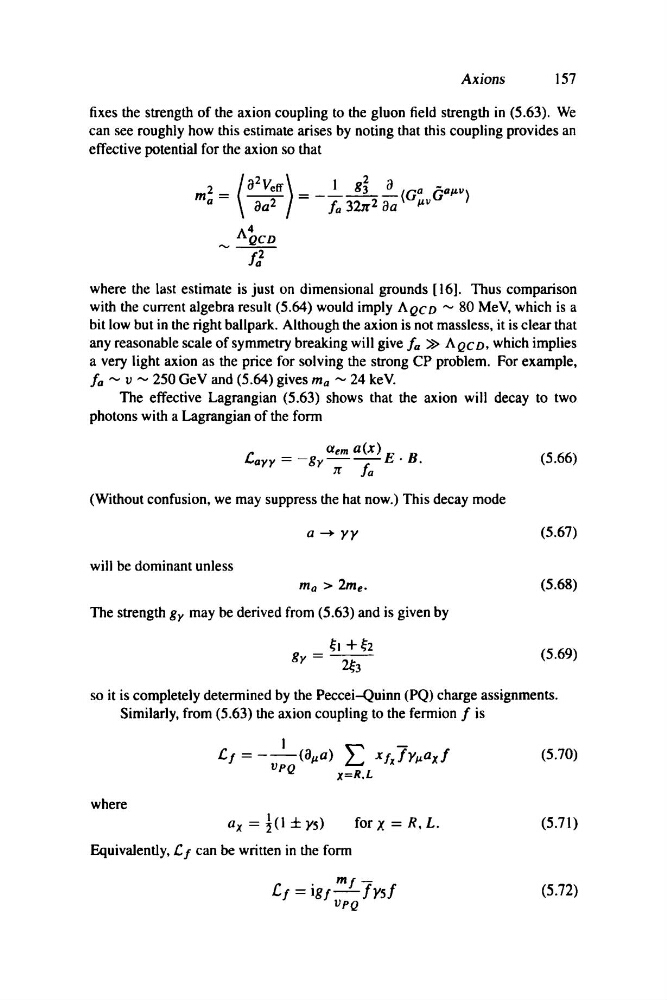
fixes the strength of the axion coupling to the gluon field strength in (5.63). We
can see roughly how this estimate arises by noting that this coupling provides an
effective potential for the axion so that
m2 = ( o2V eff) = _~ d i.(Ga f;a/Lv)
a
oa2
la 32;r2 oa /LI!
AtCD
"'a
where the last estimate is just on dimensional grounds [16]. Thus comparison
with the current algebra result (5.64) would imply AQCD '" 80 MeV, which is a
bit low but in the right ballpark. Although the axion is not massless, it is clear that
any reasonable scale of symmetry breaking will give la » A QC D, which implies
a very light axion as the price for solving the strong CP problem. For example,
la ..... V - 250 GeV and (5.64) gives ma '" 24 keY.
The effective Lagrangian (5.63) shows that the axion will decay to two
photons with a Lagrangian of the form
,.
aem a(x)
.&..ayy = - g y - - E . B
(5.66)
;r la
.
(Without confusion, we may suppress the hat now.) This decay mode
a~ YY
(5.67)
will be dominant unless
ma > 2me•
(5.68)
The strength gy may be derived from (5.63) and is given by
~I +~2
(5.69)
gy = 2~3
so it is completely determined by the Peccei-Quinn (PQ) charge assignments.
Similarly, from (5.63) the axion coupling to the fermion I is
I
, ,
Cf = --(0lta) ~ xfxlyltaxl
(5.70)
vPQ
x=R,L
where
a x = !(l ± YS) forx=R,L.
(5.71)
Equivalently, C f can be written in the form
mfIf = ig,-/ys/
(5.72)
vPQ
157
fixes the strength of the axion coupling to the gluon field strength in (5.63). We
can see roughly how this estimate arises by noting that this coupling provides an
effective potential for the axion so that
m2 = ( o2V eff) = _~ d i.(Ga f;a/Lv)
a
oa2
la 32;r2 oa /LI!
AtCD
"'a
where the last estimate is just on dimensional grounds [16]. Thus comparison
with the current algebra result (5.64) would imply AQCD '" 80 MeV, which is a
bit low but in the right ballpark. Although the axion is not massless, it is clear that
any reasonable scale of symmetry breaking will give la » A QC D, which implies
a very light axion as the price for solving the strong CP problem. For example,
la ..... V - 250 GeV and (5.64) gives ma '" 24 keY.
The effective Lagrangian (5.63) shows that the axion will decay to two
photons with a Lagrangian of the form
,.
aem a(x)
.&..ayy = - g y - - E . B
(5.66)
;r la
.
(Without confusion, we may suppress the hat now.) This decay mode
a~ YY
(5.67)
will be dominant unless
ma > 2me•
(5.68)
The strength gy may be derived from (5.63) and is given by
~I +~2
(5.69)
gy = 2~3
so it is completely determined by the Peccei-Quinn (PQ) charge assignments.
Similarly, from (5.63) the axion coupling to the fermion I is
I
, ,
Cf = --(0lta) ~ xfxlyltaxl
(5.70)
vPQ
x=R,L
where
a x = !(l ± YS) forx=R,L.
(5.71)
Equivalently, C f can be written in the form
mfIf = ig,-/ys/
(5.72)
vPQ