

148
Relic neutrinos and axions
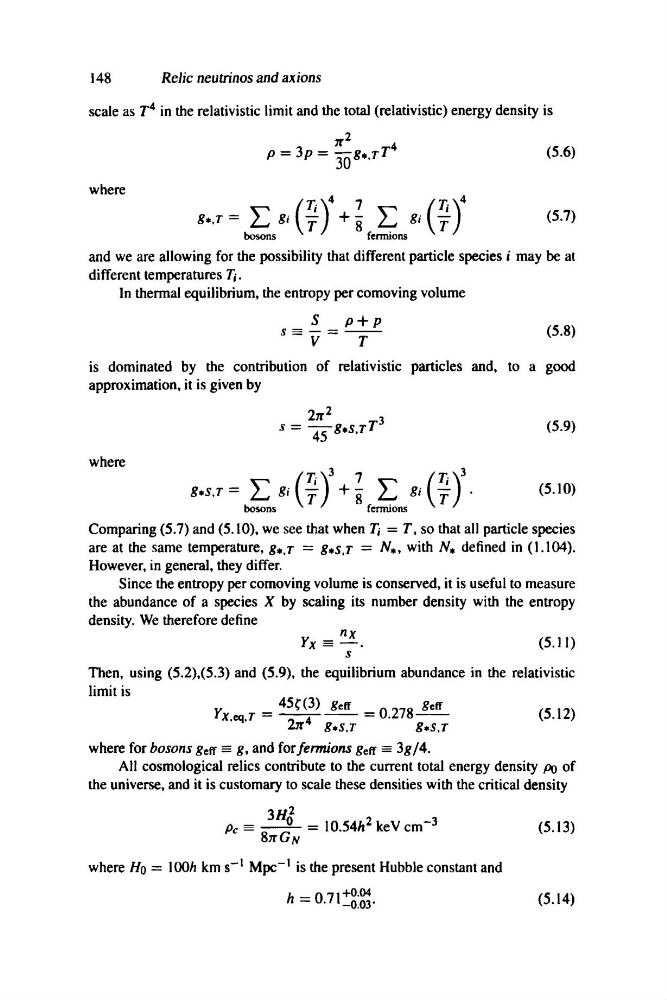
scale as r in the relativistic limit and the total (relativistic) energy density is
1f2
p = 3p = 30 g .,TT 4
(5.6)
where
( TI)4 7
(11)4
g.,T = L gl T +"8 ~ gi T
(5.7)
bosons
femuons
and we are allowing for the possibility that different particle species i may be at
different temperatures Ti'
In thermal equilibrium, the entropy per comoving volume
S
p+p
S = - = - -
(5.8)
- V
T
is dominated by the contribution of relativistic particles and, to a good
approximation, it is given by
271'2
s- - 45 g.s,TT 3
(5.9)
where
( 11)3 7
(11)3
g.S.T = L gi T +"8 ~ gi T
(5.10)
bosons
femuons
Comparing (5.7) and (5.10), we see that when 11 = T, so that all particle species
are at the same temperature. g •• T = g.S,T = N •• with N. defined in (1.104).
However. in general. they differ.
Since the entropy per comoving volume is conserved. it is useful to measure
the abundance of a species X by scaling its number density with the entropy
density. We therefore define
Yx == nx
(5. J1)
s
Then, using (5.2),(5.3) and (5.9), the equilibrium abundance in the relativistic
limit is
_ 45{(3) geff _ 0 278 geff
Y X.eq,T -
4
-
•
(5.12)
21f g.S,T
g.s,T
where for bosons geff == g, and forjermions 8eff == 3g/4.
All cosmological relics contribute to the current total energy density Po of
the universe. and it is customary to scale these densities with the critical density
3H2
Pc == __ 0_ = 1O.54h 2 keY cm- 3
(5.13)
81fGN
where Ho = lOOh km S-I Mpc-I is the present Hubble constant and
h = O.71~:g;,
(5.14)
Relic neutrinos and axions
scale as r in the relativistic limit and the total (relativistic) energy density is
1f2
p = 3p = 30 g .,TT 4
(5.6)
where
( TI)4 7
(11)4
g.,T = L gl T +"8 ~ gi T
(5.7)
bosons
femuons
and we are allowing for the possibility that different particle species i may be at
different temperatures Ti'
In thermal equilibrium, the entropy per comoving volume
S
p+p
S = - = - -
(5.8)
- V
T
is dominated by the contribution of relativistic particles and, to a good
approximation, it is given by
271'2
s- - 45 g.s,TT 3
(5.9)
where
( 11)3 7
(11)3
g.S.T = L gi T +"8 ~ gi T
(5.10)
bosons
femuons
Comparing (5.7) and (5.10), we see that when 11 = T, so that all particle species
are at the same temperature. g •• T = g.S,T = N •• with N. defined in (1.104).
However. in general. they differ.
Since the entropy per comoving volume is conserved. it is useful to measure
the abundance of a species X by scaling its number density with the entropy
density. We therefore define
Yx == nx
(5. J1)
s
Then, using (5.2),(5.3) and (5.9), the equilibrium abundance in the relativistic
limit is
_ 45{(3) geff _ 0 278 geff
Y X.eq,T -
4
-
•
(5.12)
21f g.S,T
g.s,T
where for bosons geff == g, and forjermions 8eff == 3g/4.
All cosmological relics contribute to the current total energy density Po of
the universe. and it is customary to scale these densities with the critical density
3H2
Pc == __ 0_ = 1O.54h 2 keY cm- 3
(5.13)
81fGN
where Ho = lOOh km S-I Mpc-I is the present Hubble constant and
h = O.71~:g;,
(5.14)