

Chapter 5
Relic neutrinos and axions
5.1 Introduction
We saw in chapter 1 that, for much of the time, the constituents of the early
universe were in approximate thermal equilibrium. This is because the rates for
the interactions of these constituents were large compared with the expansion
rate H. However, this thermal equilibrium was not maintained all of the time.
If it were. the current state of the universe would be entirely determined by its
temperature and we noted in the previous chapter the huge disparity between.
for example, the equilibrium baryon abundance and that actually observed.
Departures from equilibrium are, therefore, extremely important in determining
the abundance of the relics that can be observed today.
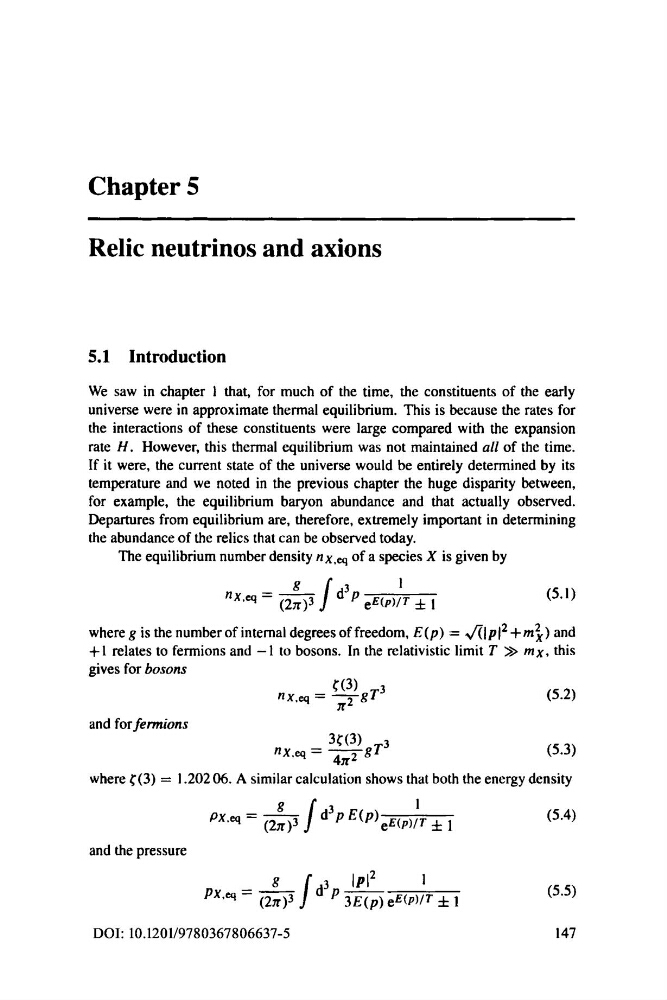
The equilibrium number density nX.eq of a species X is given by
n
-
X.eq -
-g-fd3 (21r)3 p eE(p)/T 1 ±
(5.1)
I
where g is the numberofintemal degrees offreedom. E(p) = .J
gives for bosons
nx.eq =
~(3)
3
1r2 gT
(5.2)
and for fermions
3~(3) T3
nX.eq = 41r2 g
(5.3)
where {(3) = 1.20206. A similar calculation shows that both the energy density
=
g f 3
I
PX.eq
(21r)3
d p E(p) eE(p)/T ±
(5.4)
1
and the pressure
--g-Jd 3 ~ I
PX.eq - (21r)3
P 3E(p) eE(p)/T ±
(5.5)
1
DOl: 10.1201/9780367806637-5
147
Relic neutrinos and axions
5.1 Introduction
We saw in chapter 1 that, for much of the time, the constituents of the early
universe were in approximate thermal equilibrium. This is because the rates for
the interactions of these constituents were large compared with the expansion
rate H. However, this thermal equilibrium was not maintained all of the time.
If it were. the current state of the universe would be entirely determined by its
temperature and we noted in the previous chapter the huge disparity between.
for example, the equilibrium baryon abundance and that actually observed.
Departures from equilibrium are, therefore, extremely important in determining
the abundance of the relics that can be observed today.
The equilibrium number density nX.eq of a species X is given by
n
-
X.eq -
-g-fd3 (21r)3 p eE(p)/T 1 ±
(5.1)
I
where g is the numberofintemal degrees offreedom. E(p) = .J
gives for bosons
nx.eq =
~(3)
3
1r2 gT
(5.2)
and for fermions
3~(3) T3
nX.eq = 41r2 g
(5.3)
where {(3) = 1.20206. A similar calculation shows that both the energy density
=
g f 3
I
PX.eq
(21r)3
d p E(p) eE(p)/T ±
(5.4)
1
and the pressure
--g-Jd 3 ~ I
PX.eq - (21r)3
P 3E(p) eE(p)/T ±
(5.5)
1
DOl: 10.1201/9780367806637-5
147