

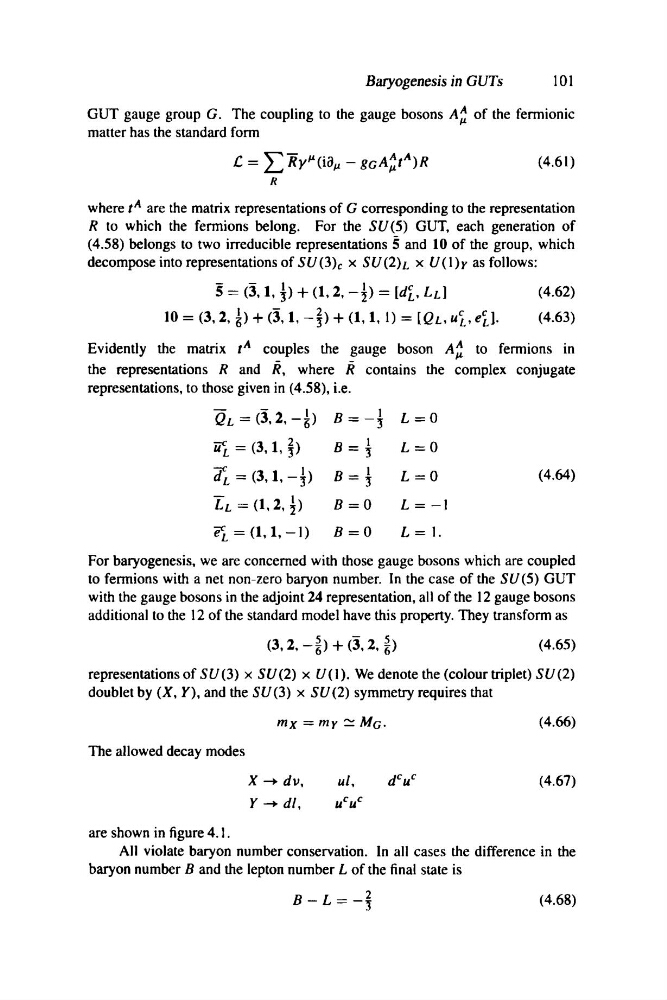
Baryogenesis in GUTs
101
GUT gauge group G. The coupling to the gauge bosons A~ of the fennionic
matter has the standard fonn
C = L Ry"'(iiJ ll - gGA~tA)R
(4.61)
R
where t A are the matrix representations of G corresponding to the representation
R to which the fennions belong. For the SU(5) GUT, each generation of
(4.58) belongs to two irreducible representations 5 and 10 of the group, which
decompose into representations of SU(3)c x SU(2)L x U(J)y as follows:
-
-
1
1
5 = (3, I, j) + (1,2, -I) = [df, Ld
(4.62)
10 = (3, 2, ~) + (3, 1. -j) + (I, I, I) = [QL, uL' ei.l.
(4.63)
Evidently the matrix t A couples the gauge boson A~ to fennions in
the representations Rand R, where R contains the complex conjugate
representations, to those given in (4.58), i.e.
-
-
I
QL = (3,2, -6) B=-~ L=O
ii£. = (3,1, j) B_1 L=O
-'J
~
I
d L = (3,1, -'J) B-1
L=O
(4.64)
-'J
-
1
LL = (1,2, I)
B=O
L =-1
et = (1, 1, -1) B=O L=l.
For baryogenesis, we are concerned with those gauge bosons which are coupled
to fennions with a net non-zero baryon number. In the case of the SU(5) GUT
with the gauge bosons in the adjoint 24 representation, all of the 12 gauge bosons
additional to the 12 of the standard model have this property. They transfonn as
5
-
5
(3,2, -6) + (3,2, 6)
(4.65)
representations of SU(3) x SU(2) x U(l). We denote the (colour triplet) SU(2)
doublet by (X, Y), and the SU(3) x SU(2) symmetry requires that
mx=my~MG.
(4.66)
The allowed decay modes
X - dv,
ui,
dCu C
(4.67)
Y _ dl,
uCuc
are shown in figure 4.1.
All violate baryon number conservation. In all cases the difference in the
baryon number B and the lepton number L of the final state is
B - L =-'J
2
(4.68)
101
GUT gauge group G. The coupling to the gauge bosons A~ of the fennionic
matter has the standard fonn
C = L Ry"'(iiJ ll - gGA~tA)R
(4.61)
R
where t A are the matrix representations of G corresponding to the representation
R to which the fennions belong. For the SU(5) GUT, each generation of
(4.58) belongs to two irreducible representations 5 and 10 of the group, which
decompose into representations of SU(3)c x SU(2)L x U(J)y as follows:
-
-
1
1
5 = (3, I, j) + (1,2, -I) = [df, Ld
(4.62)
10 = (3, 2, ~) + (3, 1. -j) + (I, I, I) = [QL, uL' ei.l.
(4.63)
Evidently the matrix t A couples the gauge boson A~ to fennions in
the representations Rand R, where R contains the complex conjugate
representations, to those given in (4.58), i.e.
-
-
I
QL = (3,2, -6) B=-~ L=O
ii£. = (3,1, j) B_1 L=O
-'J
~
I
d L = (3,1, -'J) B-1
L=O
(4.64)
-'J
-
1
LL = (1,2, I)
B=O
L =-1
et = (1, 1, -1) B=O L=l.
For baryogenesis, we are concerned with those gauge bosons which are coupled
to fennions with a net non-zero baryon number. In the case of the SU(5) GUT
with the gauge bosons in the adjoint 24 representation, all of the 12 gauge bosons
additional to the 12 of the standard model have this property. They transfonn as
5
-
5
(3,2, -6) + (3,2, 6)
(4.65)
representations of SU(3) x SU(2) x U(l). We denote the (colour triplet) SU(2)
doublet by (X, Y), and the SU(3) x SU(2) symmetry requires that
mx=my~MG.
(4.66)
The allowed decay modes
X - dv,
ui,
dCu C
(4.67)
Y _ dl,
uCuc
are shown in figure 4.1.
All violate baryon number conservation. In all cases the difference in the
baryon number B and the lepton number L of the final state is
B - L =-'J
2
(4.68)