

I ()()
Baryogenesis
priori, the GUT hypothesis can only be tested by starting from the values of the
coupling strengths measured at the electroweak scale and running to high energies
to see whether they converge to a single value (aG).
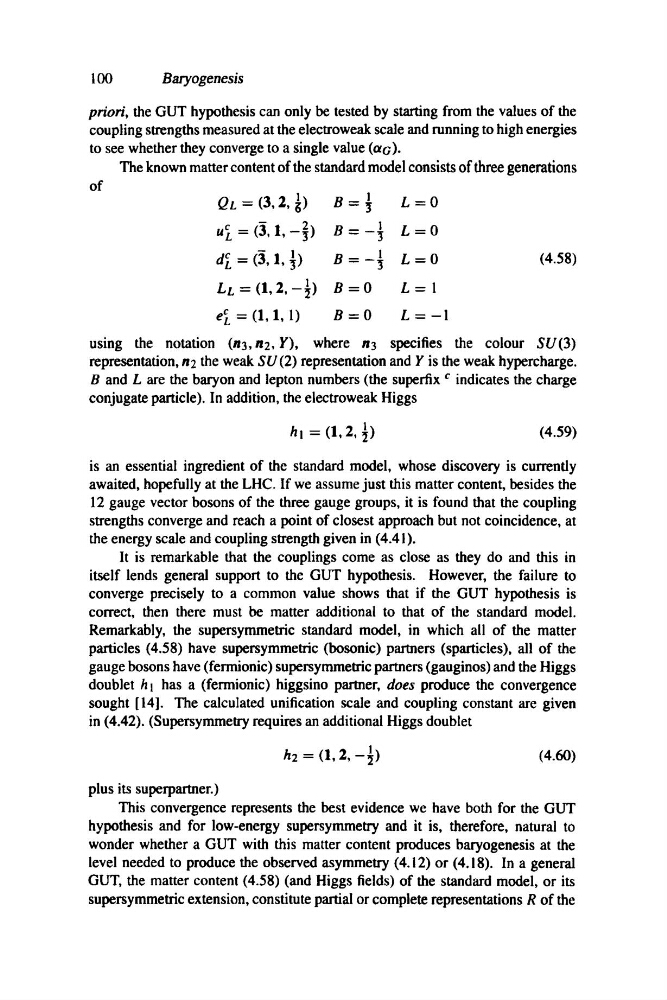
The known matter content of the standard model consists of three generations
of
QL = (3.l.~) B-1
L=O
-J
-
2
ui = (3.1. -J) B=-i L=O
df = (3.1, i) B=-i L=O
(4.58)
LL = (1.2. -!) B=O L=I
ei = (1.1. I) B=O L =-1
using the notation ("3. "2. Y), where "3 specifies the colour SU(3)
representation, "2 the weak S U (2) representation and Y is the weak hypercharge.
Band L are the baryon and lepton numbers (the superfix C indicates the charge
conjugate particle). In addition, the electroweak Higgs
hi = (l,l.!)
(4.59)
is an essential ingredient of the standard model, whose discovery is currently
awaited, hopefully at the LHC. If we assume just this matter content, besides the
12 gauge vector bosons of the three gauge groups, it is found that the coupling
strengths converge and reach a point of closest approach but not coincidence, at
the energy scale and coupling strength given in (4.41).
It is remarkable that the couplings come as close as they do and this in
itself lends general support to the GUT hypothesis. However, the failure to
converge precisely to a common value shows that if the GUT hypothesis is
correct, then there must be matter additional to that of the standard model.
Remarkably, the supersymmetric standard model, in which all of the matter
particles (4.58) have supersymmetric (bosonic) partners (sparticles), all of the
gauge bosons have (fermionic) supersymmetric partners (gauginos) and the Higgs
doublet h I has a (fermionic) higgsino partner, does produce the convergence
sought [14J. The calculated unification scale and coupling constant are given
in (4.42). (Supersymmetry requires an additional Higgs doublet
h2 = (l,l, -!)
(4.60)
plus its superpartner.)
This convergence represents the best evidence we have both for the GUT
hypothesis and for low-energy supersymmetry and it is, therefore, natural to
wonder whether a GUT with this matter content produces baryogenesis at the
level needed to produce the observed asymmetry (4.12) or (4.18). In a general
GUT, the matter content (4.58) (and Higgs fields) of the standard model. or its
supersymmetric extension, constitute partial or complete representations R of the
Baryogenesis
priori, the GUT hypothesis can only be tested by starting from the values of the
coupling strengths measured at the electroweak scale and running to high energies
to see whether they converge to a single value (aG).
The known matter content of the standard model consists of three generations
of
QL = (3.l.~) B-1
L=O
-J
-
2
ui = (3.1. -J) B=-i L=O
df = (3.1, i) B=-i L=O
(4.58)
LL = (1.2. -!) B=O L=I
ei = (1.1. I) B=O L =-1
using the notation ("3. "2. Y), where "3 specifies the colour SU(3)
representation, "2 the weak S U (2) representation and Y is the weak hypercharge.
Band L are the baryon and lepton numbers (the superfix C indicates the charge
conjugate particle). In addition, the electroweak Higgs
hi = (l,l.!)
(4.59)
is an essential ingredient of the standard model, whose discovery is currently
awaited, hopefully at the LHC. If we assume just this matter content, besides the
12 gauge vector bosons of the three gauge groups, it is found that the coupling
strengths converge and reach a point of closest approach but not coincidence, at
the energy scale and coupling strength given in (4.41).
It is remarkable that the couplings come as close as they do and this in
itself lends general support to the GUT hypothesis. However, the failure to
converge precisely to a common value shows that if the GUT hypothesis is
correct, then there must be matter additional to that of the standard model.
Remarkably, the supersymmetric standard model, in which all of the matter
particles (4.58) have supersymmetric (bosonic) partners (sparticles), all of the
gauge bosons have (fermionic) supersymmetric partners (gauginos) and the Higgs
doublet h I has a (fermionic) higgsino partner, does produce the convergence
sought [14J. The calculated unification scale and coupling constant are given
in (4.42). (Supersymmetry requires an additional Higgs doublet
h2 = (l,l, -!)
(4.60)
plus its superpartner.)
This convergence represents the best evidence we have both for the GUT
hypothesis and for low-energy supersymmetry and it is, therefore, natural to
wonder whether a GUT with this matter content produces baryogenesis at the
level needed to produce the observed asymmetry (4.12) or (4.18). In a general
GUT, the matter content (4.58) (and Higgs fields) of the standard model. or its
supersymmetric extension, constitute partial or complete representations R of the