

82
3. Relativistic Quantum Mechanics
how Dirac deduced the term (3.105), with the precise value g = 2, from his
equation.
To achieve a non-relativistic limit, we expect that we have somehow to
reduce the four-component Dirac equation to one involving just two components, since the desired term (3.105) is only a 2 × 2 matrix. Looking at the
explicit form (3.72) for the free-particle positive-energy solutions, we see that
the lower two components are of order v (i.e. v/c with c = 1) times the upper
two. This suggests that, to get a non-relativistic limit, we should regard the
lower two components of ψ as being small (at least in the specific representation we are using for α and β). However, since (3.102) includes the A
μ -field,
this will have to be demonstrated (see (3.112)). Also, if we write the total
energy operator as m + H ˆ 1 , we expect H ˆ 1 to be the non-relativistic energy
operator.
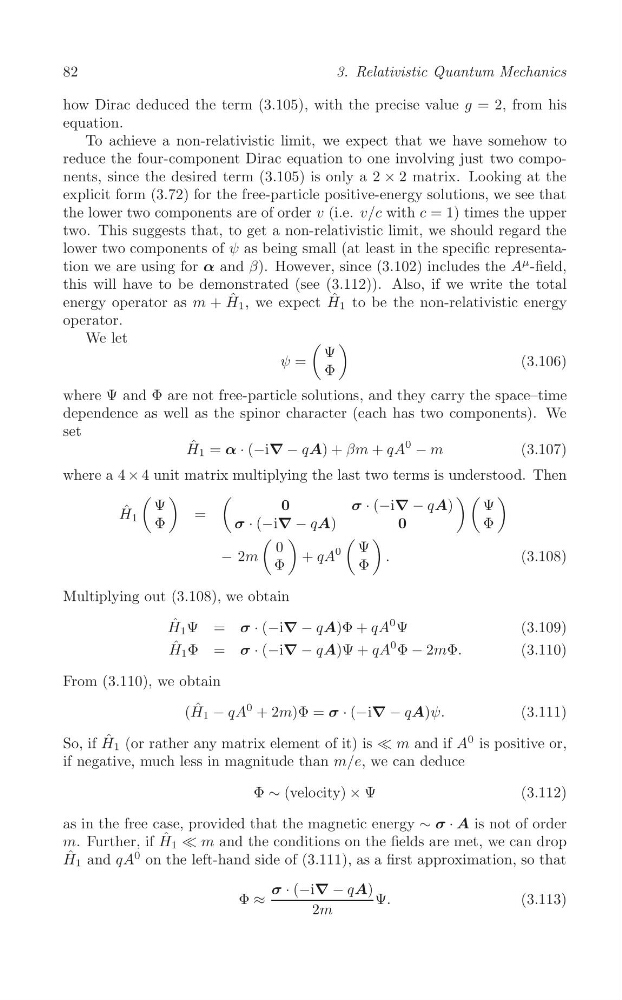
We let
( )
Ψ
ψ =
(3.106)
Φ
where Ψ and Φ are not free-particle solutions, and they carry the space–time
dependence as well as the spinor character (each has two components). We
set
H ˆ 1 = α · (−i∇ − qA) + βm + qA
0
− m
(3.107)
where a 4 × 4 unit matrix multiplying the last two terms is understood. Then
( )
(
) ( )
Ψ
0
σ · (−i∇ − qA)
Ψ
ˆ
H 1
=
Φ
σ · (−i∇ − qA)
0
Φ
( )
( )
− 2m
0 + qA
0
Ψ .
(3.108)
Φ
Φ
Multiplying out (3.108), we obtain
H ˆ 1 Ψ = σ · (−i∇ − qA)Φ + qA
0 Ψ
(3.109)
H ˆ 1 Φ = σ · (−i∇ − qA)Ψ + qA
0 Φ − 2mΦ.
(3.110)
From (3.110), we obtain
(H ˆ 1 − qA
0 + 2m)Φ = σ · (−i∇ − qA)ψ.
(3.111)
So, if H ˆ 1 (or rather any matrix element of it) is ≪ m and if A
0 is positive or,
if negative, much less in magnitude than m/e, we can deduce
Φ ∼ (velocity) × Ψ
(3.112)
as in the free case, provided that the magnetic energy ∼ σ · A is not of order
m. Further, if H ˆ 1 ≪ m and the conditions on the fields are met, we can drop
H ˆ 1 and qA
0 on the left-hand side of (3.111), as a first approximation, so that
σ · (−i∇ − qA)
Φ ≈
Ψ.
(3.113)
2m
3. Relativistic Quantum Mechanics
how Dirac deduced the term (3.105), with the precise value g = 2, from his
equation.
To achieve a non-relativistic limit, we expect that we have somehow to
reduce the four-component Dirac equation to one involving just two components, since the desired term (3.105) is only a 2 × 2 matrix. Looking at the
explicit form (3.72) for the free-particle positive-energy solutions, we see that
the lower two components are of order v (i.e. v/c with c = 1) times the upper
two. This suggests that, to get a non-relativistic limit, we should regard the
lower two components of ψ as being small (at least in the specific representation we are using for α and β). However, since (3.102) includes the A
μ -field,
this will have to be demonstrated (see (3.112)). Also, if we write the total
energy operator as m + H ˆ 1 , we expect H ˆ 1 to be the non-relativistic energy
operator.
We let
( )
Ψ
ψ =
(3.106)
Φ
where Ψ and Φ are not free-particle solutions, and they carry the space–time
dependence as well as the spinor character (each has two components). We
set
H ˆ 1 = α · (−i∇ − qA) + βm + qA
0
− m
(3.107)
where a 4 × 4 unit matrix multiplying the last two terms is understood. Then
( )
(
) ( )
Ψ
0
σ · (−i∇ − qA)
Ψ
ˆ
H 1
=
Φ
σ · (−i∇ − qA)
0
Φ
( )
( )
− 2m
0 + qA
0
Ψ .
(3.108)
Φ
Φ
Multiplying out (3.108), we obtain
H ˆ 1 Ψ = σ · (−i∇ − qA)Φ + qA
0 Ψ
(3.109)
H ˆ 1 Φ = σ · (−i∇ − qA)Ψ + qA
0 Φ − 2mΦ.
(3.110)
From (3.110), we obtain
(H ˆ 1 − qA
0 + 2m)Φ = σ · (−i∇ − qA)ψ.
(3.111)
So, if H ˆ 1 (or rather any matrix element of it) is ≪ m and if A
0 is positive or,
if negative, much less in magnitude than m/e, we can deduce
Φ ∼ (velocity) × Ψ
(3.112)
as in the free case, provided that the magnetic energy ∼ σ · A is not of order
m. Further, if H ˆ 1 ≪ m and the conditions on the fields are met, we can drop
H ˆ 1 and qA
0 on the left-hand side of (3.111), as a first approximation, so that
σ · (−i∇ − qA)
Φ ≈
Ψ.
(3.113)
2m