

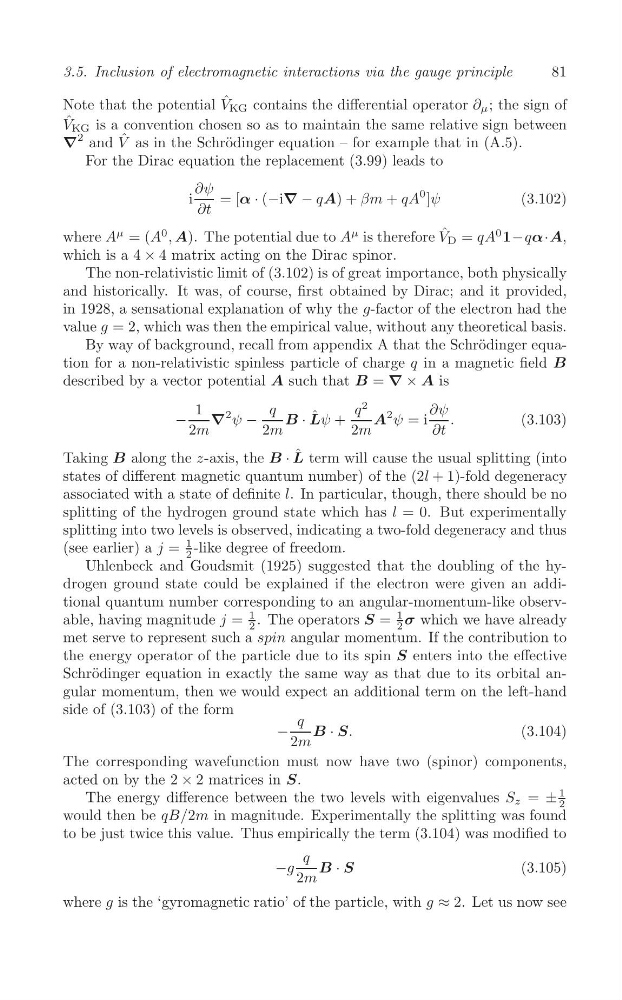
81
3.5. Inclusion of electromagnetic interactions via the gauge principle
Note that the potential V ˆ KG contains the differential operator ∂ μ ; the sign of
ˆ
V KG is a convention chosen so as to maintain the same relative sign between
∇
2 and V ˆ as in the Schr¨ odinger equation – for example that in (A.5).
For the Dirac equation the replacement (3.99) leads to
i
∂ψ = [α · (−i∇ − qA) + βm + qA
0 ]ψ
(3.102)
∂t
where A
μ = (A
0 , A). The potential due to A
μ is therefore V ˆ D = qA
0 1−qα·A,
which is a 4 × 4 matrix acting on the Dirac spinor.
The non-relativistic limit of (3.102) is of great importance, both physically
and historically. It was, of course, first obtained by Dirac; and it provided,
in 1928, a sensational explanation of why the g-factor of the electron had the
value g = 2, which was then the empirical value, without any theoretical basis.
By way of background, recall from appendix A that the Schr¨ odinger equation for a non-relativistic spinless particle of charge q in a magnetic field B
described by a vector potential A such that B = ∇ × A is
2
1
q
q
∂ψ
∇
2
ˆ
A
2
−
ψ −
B · Lψ +
ψ = i
.
(3.103)
2m
2m
2m
∂t
ˆ
Taking B along the z-axis, the B · L term will cause the usual splitting (into
states of different magnetic quantum number) of the (2l + 1)-fold degeneracy
associated with a state of definite l. In particular, though, there should be no
splitting of the hydrogen ground state which has l = 0. But experimentally
splitting into two levels is observed, indicating a two-fold degeneracy and thus
1
(see earlier) a j = -like degree of freedom.
2
Uhlenbeck and Goudsmit (1925) suggested that the doubling of the hydrogen ground state could be explained if the electron were given an additional quantum number corresponding to an angular-momentum-like observ1
1
able, having magnitude j = . The operators S = σ which we have already
2
2
met serve to represent such a spin angular momentum. If the contribution to
the energy operator of the particle due to its spin S enters into the effective
Schr¨ odinger equation in exactly the same way as that due to its orbital angular momentum, then we would expect an additional term on the left-hand
side of (3.103) of the form
q
−
B · S.
(3.104)
2m
The corresponding wavefunction must now have two (spinor) components,
acted on by the 2 × 2 matrices in S.
The energy difference between the two levels with eigenvalues S z = ±
1
would then be qB/2m in magnitude. Experimentally the splitting was found
to be just twice this value. Thus empirically the term (3.104) was modified to
q
−g
B · S
(3.105)
2m
where g is the ‘gyromagnetic ratio’ of the particle, with g ≈ 2. Let us now see
2
3.5. Inclusion of electromagnetic interactions via the gauge principle
Note that the potential V ˆ KG contains the differential operator ∂ μ ; the sign of
ˆ
V KG is a convention chosen so as to maintain the same relative sign between
∇
2 and V ˆ as in the Schr¨ odinger equation – for example that in (A.5).
For the Dirac equation the replacement (3.99) leads to
i
∂ψ = [α · (−i∇ − qA) + βm + qA
0 ]ψ
(3.102)
∂t
where A
μ = (A
0 , A). The potential due to A
μ is therefore V ˆ D = qA
0 1−qα·A,
which is a 4 × 4 matrix acting on the Dirac spinor.
The non-relativistic limit of (3.102) is of great importance, both physically
and historically. It was, of course, first obtained by Dirac; and it provided,
in 1928, a sensational explanation of why the g-factor of the electron had the
value g = 2, which was then the empirical value, without any theoretical basis.
By way of background, recall from appendix A that the Schr¨ odinger equation for a non-relativistic spinless particle of charge q in a magnetic field B
described by a vector potential A such that B = ∇ × A is
2
1
q
q
∂ψ
∇
2
ˆ
A
2
−
ψ −
B · Lψ +
ψ = i
.
(3.103)
2m
2m
2m
∂t
ˆ
Taking B along the z-axis, the B · L term will cause the usual splitting (into
states of different magnetic quantum number) of the (2l + 1)-fold degeneracy
associated with a state of definite l. In particular, though, there should be no
splitting of the hydrogen ground state which has l = 0. But experimentally
splitting into two levels is observed, indicating a two-fold degeneracy and thus
1
(see earlier) a j = -like degree of freedom.
2
Uhlenbeck and Goudsmit (1925) suggested that the doubling of the hydrogen ground state could be explained if the electron were given an additional quantum number corresponding to an angular-momentum-like observ1
1
able, having magnitude j = . The operators S = σ which we have already
2
2
met serve to represent such a spin angular momentum. If the contribution to
the energy operator of the particle due to its spin S enters into the effective
Schr¨ odinger equation in exactly the same way as that due to its orbital angular momentum, then we would expect an additional term on the left-hand
side of (3.103) of the form
q
−
B · S.
(3.104)
2m
The corresponding wavefunction must now have two (spinor) components,
acted on by the 2 × 2 matrices in S.
The energy difference between the two levels with eigenvalues S z = ±
1
would then be qB/2m in magnitude. Experimentally the splitting was found
to be just twice this value. Thus empirically the term (3.104) was modified to
q
−g
B · S
(3.105)
2m
where g is the ‘gyromagnetic ratio’ of the particle, with g ≈ 2. Let us now see
2