

471
P. Grassmann Variables
This time, only the term ψ
∗ ψ 2 in the expansion of the exponential will survive
1
the integration, and the result is just −M 12 . By exploring a similar integral
(still with the term ψ 1 ψ
∗ ) in the case of three complex Grassmann variables,
2
the reader should be convinced that the general result is
∫
∏
−ψ
∗T
dψ i
∗ dψ i ψ k ψ
∗ e
Mψ = (M
−1 ) kl detM.
(P.31)
l
i
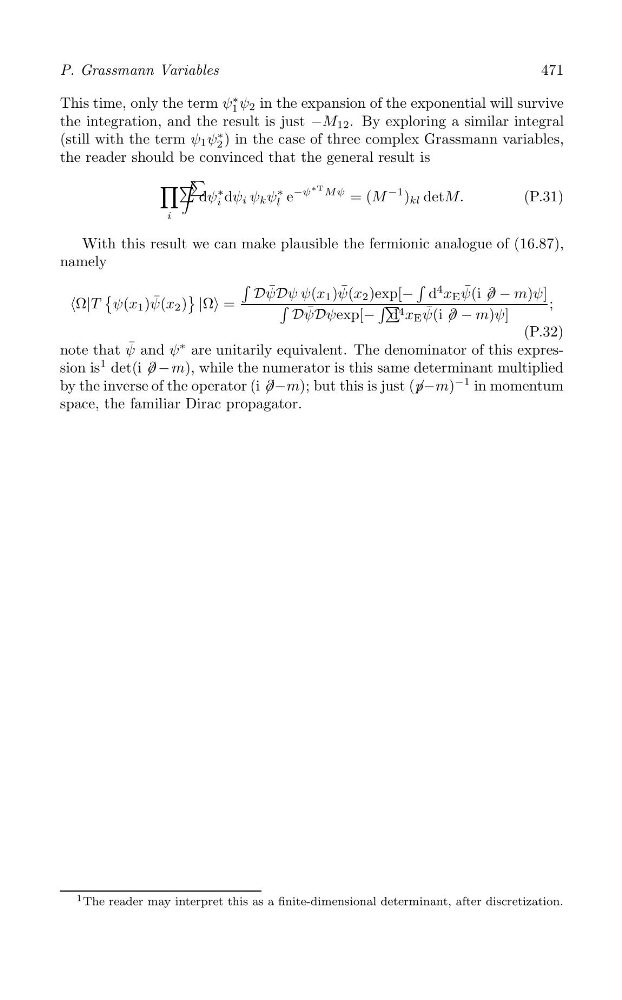
With this result we can make plausible the fermionic analogue of (16.87),
namely
∫
∫
¯
¯
d
4
¯
{
}
DψDψ ψ(x 1 )ψ(x 2 )exp[−
x E ψ(i / ∂ − m)ψ]
‹Ω|T ψ(x 1 )ψ ¯ (x 2 ) |Ω› =
∫
∫
;
¯
¯
DψDψexp[− d 4 x E ψ(i / ∂ − m)ψ]
(P.32)
note that ψ ¯ and ψ
∗ are unitarily equivalent. The denominator of this expression is
1 det(i / ∂ − m), while the numerator is this same determinant multiplied
by the inverse of the operator (i / ∂−m); but this is just (/ p−m)
−1 in momentum
space, the familiar Dirac propagator.
1 The reader may interpret this as a finite-dimensional determinant, after discretization.