

449
M.6. The Lorentz group
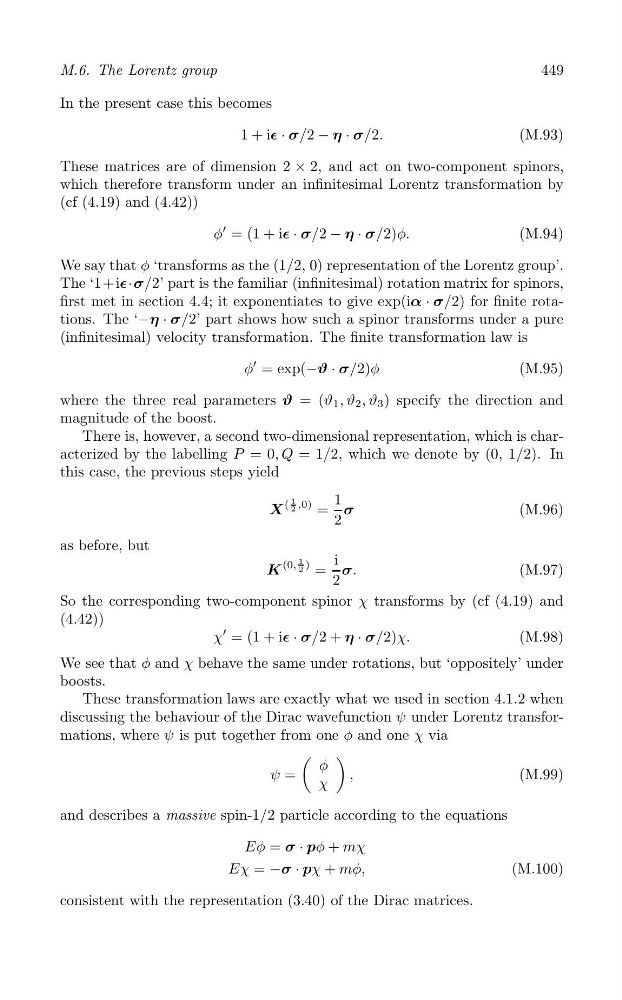
In the present case this becomes
1 + i∊ · σ/2 − η · σ/2.
(M.93)
These matrices are of dimension 2 × 2, and act on two-component spinors,
which therefore transform under an infinitesimal Lorentz transformation by
(cf (4.19) and (4.42))
′
φ = (1 + i∊ · σ/2 − η · σ/2)φ.
(M.94)
We say that φ ‘transforms as the (1/2, 0) representation of the Lorentz group’.
The ‘1+i∊·σ/2’ part is the familiar (infinitesimal) rotation matrix for spinors,
first met in section 4.4; it exponentiates to give exp(iα · σ/2) for finite rotations. The ‘−η · σ/2’ part shows how such a spinor transforms under a pure
(infinitesimal) velocity transformation. The finite transformation law is
′
φ = exp(−ϑ · σ/2)φ
(M.95)
where the three real parameters ϑ = (ϑ 1 , ϑ 2 , ϑ 3 ) specify the direction and
magnitude of the boost.
There is, however, a second two-dimensional representation, which is characterized by the labelling P = 0, Q = 1/2, which we denote by (0, 1/2). In
this case, the previous steps yield
1
= σ
(M.96)
2
1
2
X
( ,0)
as before, but
i
= σ.
(M.97)
2
1
2
K
(0, )
So the corresponding two-component spinor χ transforms by (cf (4.19) and
(4.42))
χ
′ = (1 + i∊ · σ/2 + η · σ/2)χ.
(M.98)
We see that φ and χ behave the same under rotations, but ‘oppositely’ under
boosts.
These transformation laws are exactly what we used in section 4.1.2 when
discussing the behaviour of the Dirac wavefunction ψ under Lorentz transformations, where ψ is put together from one φ and one χ via
(
)
φ
ψ =
,
(M.99)
χ
and describes a massive spin-1/2 particle according to the equations
Eφ = σ · pφ + mχ
Eχ = −σ · pχ + mφ,
(M.100)
consistent with the representation (3.40) of the Dirac matrices.