

M.6. The Lorentz group
447
M.6 The Lorentz group
Consideration of matrix representations of the Lorentz group provides insight
into the equations of relativistic quantum mechanics, for example the Dirac
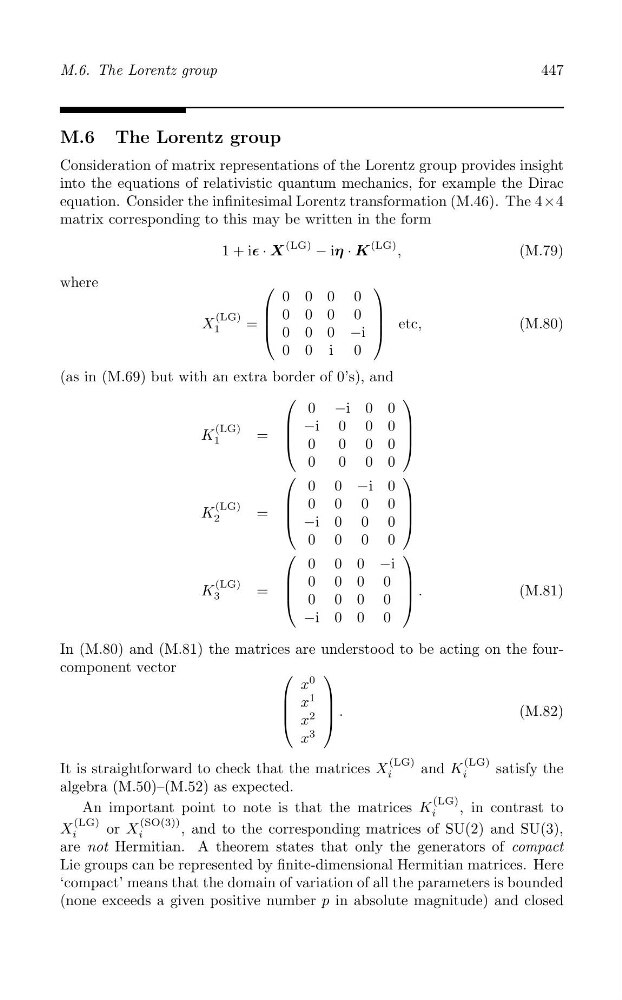
equation. Consider the infinitesimal Lorentz transformation (M.46). The 4×4
matrix corresponding to this may be written in the form
1 + i∊ · X
(LG)
− iη · K
(LG) ,
(M.79)
where
(
)
0 0 0 0
(LG)
|
X 1
= | 0 0 0 0 |
|
( 0 0
) etc,
(M.80)
0 −i
0 0 i 0
(as in (M.69) but with an extra border of 0’s), and
(
)
0
i 0 0
(LG)
|
−
| −i 0 0 0 |
K
=
|
1
( 0
0 0 0 )
0
0 0 0
(
)
0 0 −i 0
(LG)
| 0 0 0 0 |
K 2
= |
|
( −i 0 0 0 )
0 0 0 0
(
)
0 0 0
i
(LG)
|
−
| 0 0 0 0 |
K 3
=
|
(
81)
0 0 0 0 ) .
(M.
−i 0 0 0
In (M.80) and (M.81) the matrices are understood to be acting on the fourcomponent vector
(
)
x
0
| x
1 |
|
|
( x
2 ) .
(M.82)
x
3
(LG)
(LG)
It is straightforward to check that the matrices X i
and K i
satisfy the
algebra (M.50)–(M.52) as expected.
(LG)
An important point to note is that the matrices K i
, in contrast to
(LG)
(SO(3))
X i
or X i
, and to the corresponding matrices of SU(2) and SU(3),
are not Hermitian. A theorem states that only the generators of compact
Lie groups can be represented by finite-dimensional Hermitian matrices. Here
‘compact’ means that the domain of variation of all the parameters is bounded
(none exceeds a given positive number p in absolute magnitude) and closed