

74
3. Relativistic Quantum Mechanics
where the + subscript has been added to indicate that this φ is a solution of
(3.68). Such a φ + is called a two-component helicity spinor. The explicit form
of φ + can be found by solving (3.68) – see problem 3.7. Similarly, the fourcomponent spinor will be an eigenstate of h(p) belonging to the eigenvalue
−1 if it contains φ − where
σ · p φ − = −φ − .
(3.69)
|p|
Again, these two choices φ + and φ − are linearly independent.
3.4 The negative-energy solutions
In this section we shall first look more closely at the form of both the positiveand negative-energy solutions of the Dirac equation, and we shall then concentrate on the physical interpretation of the negative-energy solutions of both
the Dirac and the KG equations.
It will be convenient, from now on, to reserve the symbol ‘E’ for the
2
positive square root in (3.50): E = +(p + m
2 ). The general 4-momentum in
0
0
the plane-wave solution (3.41) will be denoted by p
μ = (p , p) where p may
be either positive or negative. With this notation equation (3.44) becomes
( ) (
) ( )
0
φ
m1 σ · p
φ
p
=
(3.70)
χ
σ · p −m1
χ
in our original representation for α and β.
3.4.1 Positive-energy spinors
For these
2
p
0 = +(p + m
2 )
1/2
≡ E > 0.
(3.71)
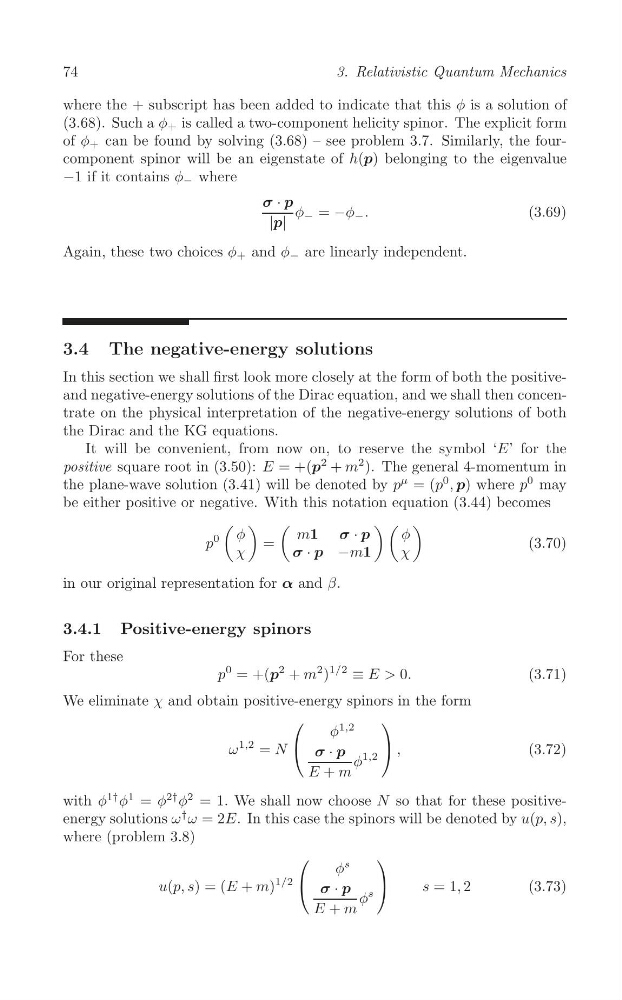
We eliminate χ and obtain positive-energy spinors in the form
(
)
φ
1,2
ω
1,2
(
)
= N
σ · p
,
(3.72)
φ
1,2
E + m
φ
2† φ
2
energy solutions ω
† ω = 2E. In this case the spinors will be denoted by u(p, s),
where (problem 3.8)
with φ
1† φ
1 =
= 1. We shall now choose N so that for these positive(
)
φ
s
m)
1/2 (
)
φ
s
E + m
u(p, s) = (E +
σ · p
s = 1, 2
(3.73)
3. Relativistic Quantum Mechanics
where the + subscript has been added to indicate that this φ is a solution of
(3.68). Such a φ + is called a two-component helicity spinor. The explicit form
of φ + can be found by solving (3.68) – see problem 3.7. Similarly, the fourcomponent spinor will be an eigenstate of h(p) belonging to the eigenvalue
−1 if it contains φ − where
σ · p φ − = −φ − .
(3.69)
|p|
Again, these two choices φ + and φ − are linearly independent.
3.4 The negative-energy solutions
In this section we shall first look more closely at the form of both the positiveand negative-energy solutions of the Dirac equation, and we shall then concentrate on the physical interpretation of the negative-energy solutions of both
the Dirac and the KG equations.
It will be convenient, from now on, to reserve the symbol ‘E’ for the
2
positive square root in (3.50): E = +(p + m
2 ). The general 4-momentum in
0
0
the plane-wave solution (3.41) will be denoted by p
μ = (p , p) where p may
be either positive or negative. With this notation equation (3.44) becomes
( ) (
) ( )
0
φ
m1 σ · p
φ
p
=
(3.70)
χ
σ · p −m1
χ
in our original representation for α and β.
3.4.1 Positive-energy spinors
For these
2
p
0 = +(p + m
2 )
1/2
≡ E > 0.
(3.71)
We eliminate χ and obtain positive-energy spinors in the form
(
)
φ
1,2
ω
1,2
(
)
= N
σ · p
,
(3.72)
φ
1,2
E + m
φ
2† φ
2
energy solutions ω
† ω = 2E. In this case the spinors will be denoted by u(p, s),
where (problem 3.8)
with φ
1† φ
1 =
= 1. We shall now choose N so that for these positive(
)
φ
s
m)
1/2 (
)
φ
s
E + m
u(p, s) = (E +
σ · p
s = 1, 2
(3.73)