

3.3. Spin
73
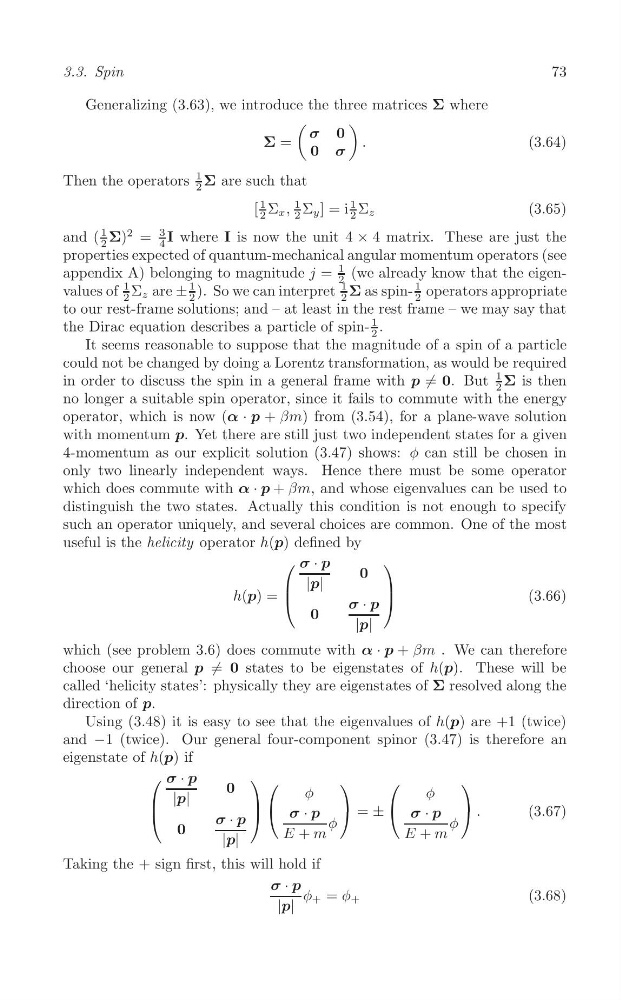
Generalizing (3.63), we introduce the three matrices Σ where
(
)
σ 0
Σ =
.
(3.64)
0 σ
1
2
Then the operators Σ are such that
1
2
1
2
1
2
[ Σ x , Σ y ] = i Σ z
(3.65)
1
2
3
4
Σ)
2 =
and (
I where I is now the unit 4 × 4 matrix. These are just the
properties expected of quantum-mechanical angular momentum operators (see
1
2
appendix A) belonging to magnitude j
(we already know that the eigen=
1
2
1
2
1 Σ as
2
1
2
Σ z are ±
values of
). So we can interpret
spin operators appropriate
to our rest-frame solutions; and – at least in the rest frame – we may say that
1
2
the Dirac equation describes a particle of spin .
It seems reasonable to suppose that the magnitude of a spin of a particle
could not be changed by doing a Lorentz transformation, as would be required
1
2
in order to discuss the spin in a general frame with p / 0. But
=
no longer a suitable spin operator, since it fails to commute with the energy
Σ is then
operator, which is now (α · p + βm) from (3.54), for a plane-wave solution
with momentum p. Yet there are still just two independent states for a given
4-momentum as our explicit solution (3.47) shows: φ can still be chosen in
only two linearly independent ways. Hence there must be some operator
which does commute with α · p + βm, and whose eigenvalues can be used to
distinguish the two states. Actually this condition is not enough to specify
such an operator uniquely, and several choices are common. One of the most
useful is the helicity operator h(p) defined by
( σ · p
)
0
| |p|
|
h(p) = (
)
(3.66)
σ · p
0
|p|
which (see problem 3.6) does commute with α · p + βm . We can therefore
choose our general p /
These will be
= 0 states to be eigenstates of h(p).
called ‘helicity states’: physically they are eigenstates of Σ resolved along the
direction of p.
Using (3.48) it is easy to see that the eigenvalues of h(p) are +1 (twice)
and −1 (twice). Our general four-component spinor (3.47) is therefore an
eigenstate of h(p) if
( σ · p
) (
)
(
)
0
φ
φ
|p|
|
| (
) = ± (
) .
(3.67)
(
)
σ · p
σ · p
σ · p
φ
φ
0
E + m
E + m
|p|
Taking the + sign first, this will hold if
σ · p φ + = φ +
(3.68)
|p|
73
Generalizing (3.63), we introduce the three matrices Σ where
(
)
σ 0
Σ =
.
(3.64)
0 σ
1
2
Then the operators Σ are such that
1
2
1
2
1
2
[ Σ x , Σ y ] = i Σ z
(3.65)
1
2
3
4
Σ)
2 =
and (
I where I is now the unit 4 × 4 matrix. These are just the
properties expected of quantum-mechanical angular momentum operators (see
1
2
appendix A) belonging to magnitude j
(we already know that the eigen=
1
2
1
2
1 Σ as
2
1
2
Σ z are ±
values of
). So we can interpret
spin operators appropriate
to our rest-frame solutions; and – at least in the rest frame – we may say that
1
2
the Dirac equation describes a particle of spin .
It seems reasonable to suppose that the magnitude of a spin of a particle
could not be changed by doing a Lorentz transformation, as would be required
1
2
in order to discuss the spin in a general frame with p / 0. But
=
no longer a suitable spin operator, since it fails to commute with the energy
Σ is then
operator, which is now (α · p + βm) from (3.54), for a plane-wave solution
with momentum p. Yet there are still just two independent states for a given
4-momentum as our explicit solution (3.47) shows: φ can still be chosen in
only two linearly independent ways. Hence there must be some operator
which does commute with α · p + βm, and whose eigenvalues can be used to
distinguish the two states. Actually this condition is not enough to specify
such an operator uniquely, and several choices are common. One of the most
useful is the helicity operator h(p) defined by
( σ · p
)
0
| |p|
|
h(p) = (
)
(3.66)
σ · p
0
|p|
which (see problem 3.6) does commute with α · p + βm . We can therefore
choose our general p /
These will be
= 0 states to be eigenstates of h(p).
called ‘helicity states’: physically they are eigenstates of Σ resolved along the
direction of p.
Using (3.48) it is easy to see that the eigenvalues of h(p) are +1 (twice)
and −1 (twice). Our general four-component spinor (3.47) is therefore an
eigenstate of h(p) if
( σ · p
) (
)
(
)
0
φ
φ
|p|
|
| (
) = ± (
) .
(3.67)
(
)
σ · p
σ · p
σ · p
φ
φ
0
E + m
E + m
|p|
Taking the + sign first, this will hold if
σ · p φ + = φ +
(3.68)
|p|