

409
22.5. Fermion masses
via
(u)
(u)
u ˆ Lα = (U ) αi u ˆ Li ,
u ˆ Rα = (U ) αi u ˆ Ri
(22.156)
L
R
(d)
(d)
ˆ
ˆ
ˆ
ˆ
d Lα = (U ) αi d Li ,
d Rα = (U ) αi d Ri .
(22.157)
L
R
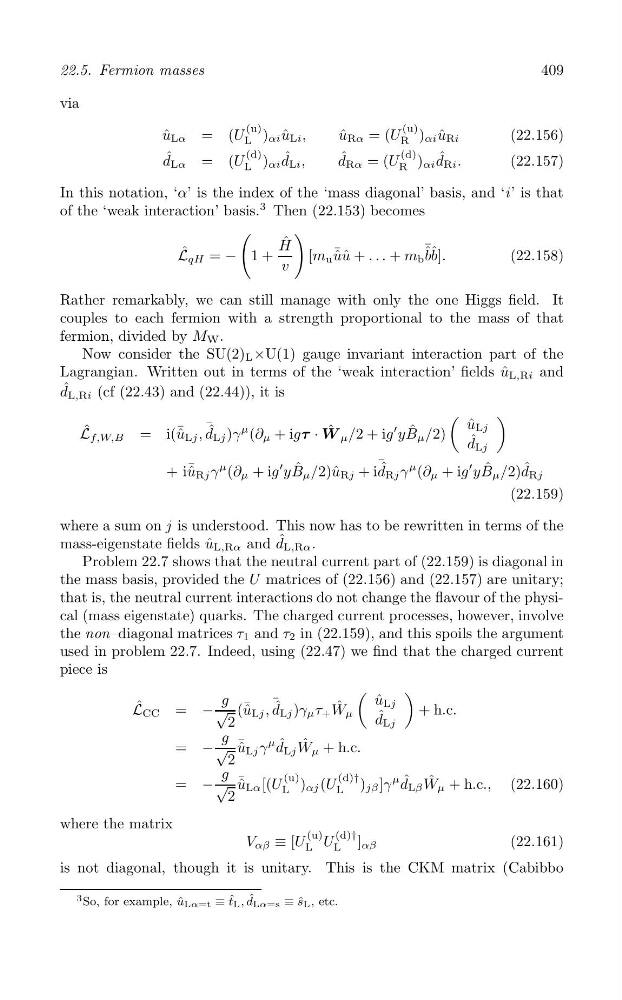
In this notation, ‘α’ is the index of the ‘mass diagonal’ basis, and ‘i’ is that
of the ‘weak interaction’ basis.
3 Then (22.153) becomes
(
)
ˆ
H
L ˆ qH = − 1 +
[m u u ¯ ˆu ˆ + . . . + m b ˆ ¯
b ˆ b].
(22.158)
v
Rather remarkably, we can still manage with only the one Higgs field. It
couples to each fermion with a strength proportional to the mass of that
fermion, divided by M W .
Now consider the SU(2) L ×U(1) gauge invariant interaction part of the
Lagrangian. Written out in terms of the ‘weak interaction’ fields ˆ
u L,Ri and
ˆ
d L,Ri (cf (22.43) and (22.44)), it is
(
)
ˆ
¯
ˆ
′
u Lj
L ˆ f,W,B = i(u ¯ ˆ Lj , d ˆ Lj )γ
μ (∂ μ + igτ · W μ /2 + ig yB ˆ μ /2) d ˆ Lj
′
¯
′ ˆ
+ iu ¯ ˆ Rj γ
μ (∂ μ + ig yB ˆ μ /2)ˆ u Rj + id ˆ Rj γ
μ (∂ μ + ig yB μ /2)d ˆ Rj
(22.159)
where a sum on j is understood. This now has to be rewritten in terms of the
mass-eigenstate fields ˆ
u L,Rα and d ˆ L,Rα .
Problem 22.7 shows that the neutral current part of (22.159) is diagonal in
the mass basis, provided the U matrices of (22.156) and (22.157) are unitary;
that is, the neutral current interactions do not change the flavour of the physical (mass eigenstate) quarks. The charged current processes, however, involve
the non–diagonal matrices τ 1 and τ 2 in (22.159), and this spoils the argument
used in problem 22.7. Indeed, using (22.47) we find that the charged current
piece is
(
)
u Lj
L ˆ CC = − √
g (u ¯ ˆ Lj ,
¯
d ˆ Lj )γ μ τ + W ˆ μ
ˆ
+ h.c.
2
d ˆ Lj
= − √
g u ¯ ˆ Lj γ
μ d ˆ Lj W ˆ μ + h.c.
2
g
(u)
(d)†
= − √ u ¯ ˆ Lα [(U L ) αj (U L ) jβ ]γ
μ d ˆ Lβ W ˆ μ + h.c., (22.160)
2
where the matrix
(u) (d)†
V αβ ≡ [U L U L ] αβ
(22.161)
is not diagonal, though it is unitary. This is the CKM matrix (Cabibbo
3 So, for example, ˆ
u Lα=t ≡ t ˆ L , d ˆ Lα=s ≡ s ˆ L , etc.