

408
22. The GSW Gauge Theory of Electroweak Interactions
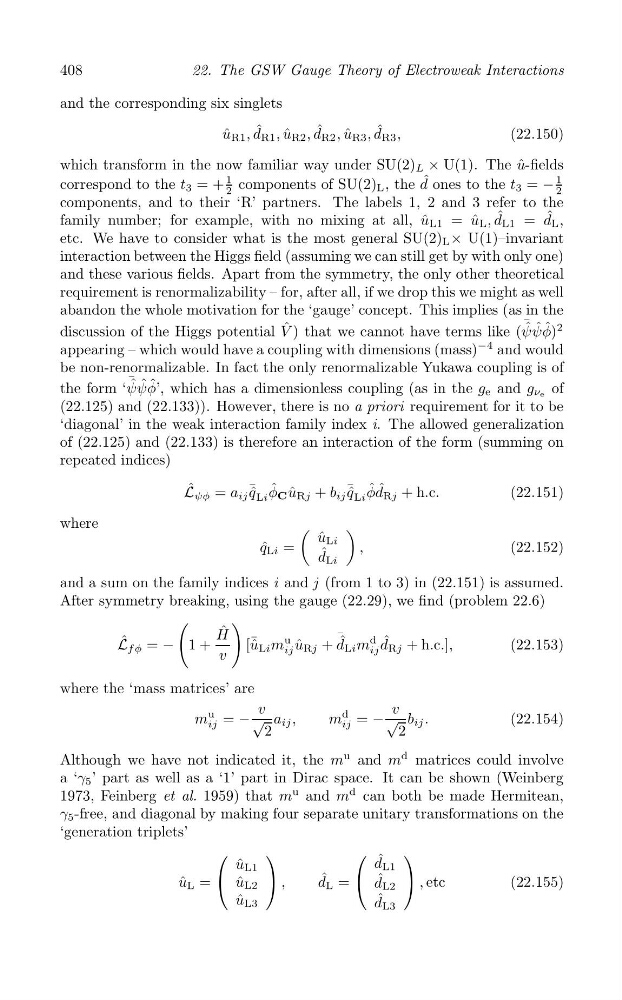
and the corresponding six singlets
ˆ
ˆ
ˆ
u ˆ R1 , d R1 , u ˆ R2 , d R2 , u ˆ R3 , d R3 ,
(22.150)
which transform in the now familiar way under SU(2) L × U(1). The u ˆ-fields
1
ˆ
correspond to the t 3 = + components of SU(2) L , the d ones to the t 3 =
2
−
1
2
components, and to their ‘R’ partners. The labels 1, 2 and 3 refer to the
ˆ
ˆ
family number; for example, with no mixing at all, u ˆ L1 = ˆ
u L , d L1 = d L ,
etc. We have to consider what is the most general SU(2) L × U(1)–invariant
interaction between the Higgs field (assuming we can still get by with only one)
and these various fields. Apart from the symmetry, the only other theoretical
requirement is renormalizability – for, after all, if we drop this we might as well
abandon the whole motivation for the ‘gauge’ concept. This implies (as in the
¯
ˆ
ˆ ˆ ˆ
discussion of the Higgs potential V ) that we cannot have terms like (ψψφ)
2
appearing – which would have a coupling with dimensions (mass)
−4 and would
be non-renormalizable. In fact the only renormalizable Yukawa coupling is of
¯ ˆ ˆ ˆ
the form ‘ψψφ’, which has a dimensionless coupling (as in the g e and g νe of
(22.125) and (22.133)). However, there is no a priori requirement for it to be
‘diagonal’ in the weak interaction family index i. The allowed generalization
of (22.125) and (22.133) is therefore an interaction of the form (summing on
repeated indices)
L ˆ
¯ ˆ
¯ ˆ ˆ
ψφ = a ij q ˆ Li φ C u ˆ Rj + b ij q ˆ Li φd Rj + h.c.
(22.151)
where
(
)
u ˆ Li
q ˆ Li =
,
(22.152)
ˆ
d Li
and a sum on the family indices i and j (from 1 to 3) in (22.151) is assumed.
After symmetry breaking, using the gauge (22.29), we find (problem 22.6)
(
)
ˆ
H
¯
L ˆ
−
¯
ˆ
[
u
fφ =
1 +
u ˆ
d ˆ
Li m ij u ˆ Rj + d Li m
v
ij d Rj + h.c.],
(22.153)
where the ‘mass matrices’ are
u
v
d
v
m ij = − √ a ij ,
m ij =
b ij .
(22.154)
2
− √
2
Although we have not indicated it, the m
u and m
d matrices could involve
a ‘γ 5 ’ part as well as a ‘1’ part in Dirac space. It can be shown (Weinberg
1973, Feinberg et al. 1959) that m
u and m
d can both be made Hermitean,
γ 5 -free, and diagonal by making four separate unitary transformations on the
‘generation triplets’
(
)
(
)
ˆ
u ˆ L1
d L1
u ˆ L = ( u ˆ L2 )
ˆ
,
d L = ( ˆ
d )
L2
, etc
(22.155)
u ˆ L3
ˆ
d L3