

390
22. The GSW Gauge Theory of Electroweak Interactions
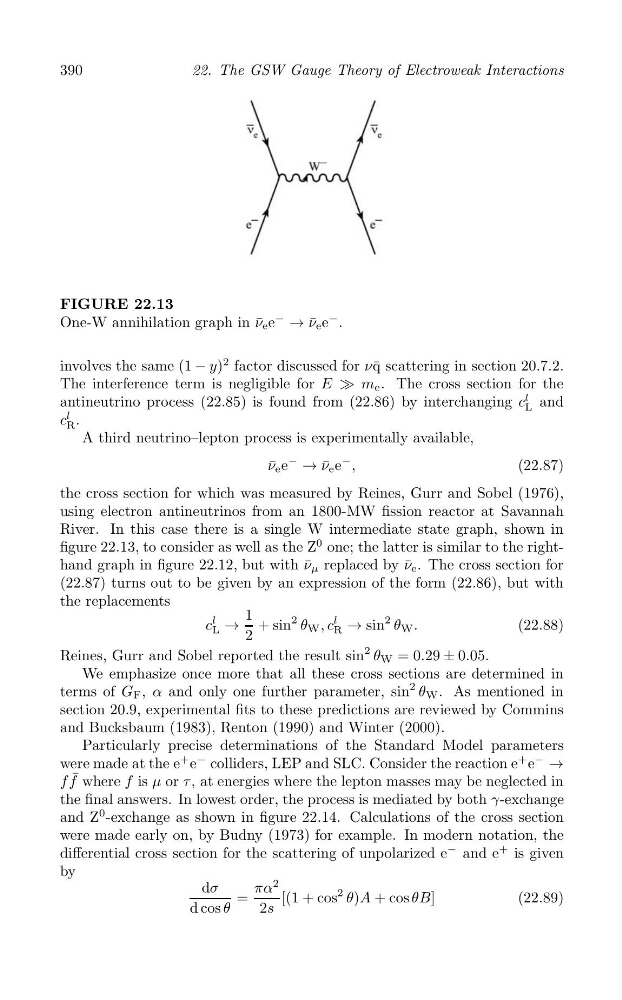
FIGURE 22.13
−
One-W annihilation graph in ¯
ν e e
−
→ ν ¯ e e .
involves the same (1 − y)
2 factor discussed for ν¯ q scattering in section 20.7.2.
The interference term is negligible for E ≫ m e . The cross section for the
l
antineutrino process (22.85) is found from (22.86) by interchanging c and
L
l
c R .
A third neutrino–lepton process is experimentally available,
−
ν ¯ e e
−
→ ν ¯ e e ,
(22.87)
the cross section for which was measured by Reines, Gurr and Sobel (1976),
using electron antineutrinos from an 1800-MW fission reactor at Savannah
River. In this case there is a single W intermediate state graph, shown in
figure 22.13, to consider as well as the Z
0 one; the latter is similar to the righthand graph in figure 22.12, but with ¯
ν μ replaced by ¯
ν e . The cross section for
(22.87) turns out to be given by an expression of the form (22.86), but with
the replacements
l
l
c L →
1 + sin
2 θ W , c R → sin
2 θ W .
(22.88)
2
Reines, Gurr and Sobel reported the result sin
2 θ W = 0.29 ± 0.05.
We emphasize once more that all these cross sections are determined in
terms of G F , α and only one further parameter, sin
2 θ W . As mentioned in
section 20.9, experimental fits to these predictions are reviewed by Commins
and Bucksbaum (1983), Renton (1990) and Winter (2000).
Particularly precise determinations of the Standard Model parameters
+
+
were made at the e e
− colliders, LEP and SLC. Consider the reaction e e
−
→
¯
f f where f is μ or τ , at energies where the lepton masses may be neglected in
the final answers. In lowest order, the process is mediated by both γ-exchange
and Z
0 -exchange as shown in figure 22.14. Calculations of the cross section
were made early on, by Budny (1973) for example. In modern notation, the
differential cross section for the scattering of unpolarized e
− and e
+ is given
by
dσ
πα
2
=
[(1 + cos
2 θ)A + cos θB]
(22.89)
d cos θ
2s